
Embarking on the journey to a National Law University (NLU) through the CLAT examination is a significant aspiration for many students across India. However, the path is competitive, and not everyone achieves their desired rank in their first attempt. This often leads to a crucial question: “Should I take a drop year for CLAT?” This article aims to provide a comprehensive, authoritative guide to help CLAT aspirants navigate this complex decision, offering insights into the factors to consider and an understanding of the potential CLAT drop year success rate 2027. Making an informed choice is paramount, as a drop year, if utilized effectively, can be a game-changer, but if mismanaged, it can lead to unnecessary pressure and wasted time. The insights provided here are particularly relevant for those eyeing CLAT 2027, as planning needs to begin now.
Key Takeaways
- Self-Assessment is Crucial: Before deciding on a drop year, thoroughly evaluate your previous CLAT attempt, identifying strengths, weaknesses, and areas for improvement.
- Clear Goals and Strategy: A successful drop year hinges on having well-defined goals, a realistic study plan, and a commitment to consistent effort.
- Structured Preparation: Leverage coaching, mock tests, and systematic revision to maximize the effectiveness of your dedicated preparation time.
- Mental Well-being: Be mindful of the psychological impact of a drop year; maintain a positive mindset, manage stress, and seek support when needed.
- Success is Attainable: While challenging, a drop year significantly boosts your chances of securing a top NLU seat, especially with focused and strategic efforts, contributing positively to the CLAT drop year success rate 2027.
Understanding the CLAT Examination Landscape in 2025
The Common Law Admission Test (CLAT) is one of India’s most sought-after law entrance examinations, serving as the gateway to 24 National Law Universities (NLUs) and several other affiliated institutions. Administered by the Consortium of NLUs, CLAT is a highly competitive exam, testing candidates on Legal Reasoning, English Language, Current Affairs including General Knowledge, Logical Reasoning, and Quantitative Techniques. The exam format emphasizes comprehension and critical thinking over rote memorization, making strategic preparation essential.
Each year, lakhs of students appear for CLAT, but the number of seats in top NLUs remains limited, leading to intense competition. In 2025, the landscape continues to evolve, with increasing awareness about legal careers and a larger pool of talented aspirants. This amplified competition inherently affects how individuals perceive their performance and the necessity of a second attempt. The notion of a “drop year” for CLAT has become increasingly common as students strive to secure a place in their dream institution. Understanding the exam pattern and syllabus is the first step towards effective preparation, whether it’s your first attempt or a drop year [1]. For a detailed understanding of the exam, you can explore resources on CLAT Exam Pattern and Syllabus.
The Allure and Risks of a Drop Year
A drop year, or a gap year specifically dedicated to CLAT preparation, is often viewed as an opportunity to solely focus on the exam without the added pressure of school or college academics. This focused approach can lead to significant improvements in scores and a better chance of admission to a top-tier NLU. Many success stories involve students who utilized a drop year to refine their strategies, strengthen their weak areas, and emerge victorious.
However, a drop year is not without its risks. The immense pressure to perform, the potential for burnout, and the social stigma associated with not immediately pursuing higher education can be daunting. It requires immense self-discipline, resilience, and a clear understanding of what went wrong in the previous attempt. Without a structured plan and unwavering commitment, a drop year can turn into a period of frustration and underperformance. The decision, therefore, must be carefully considered, weighing all pros and cons.
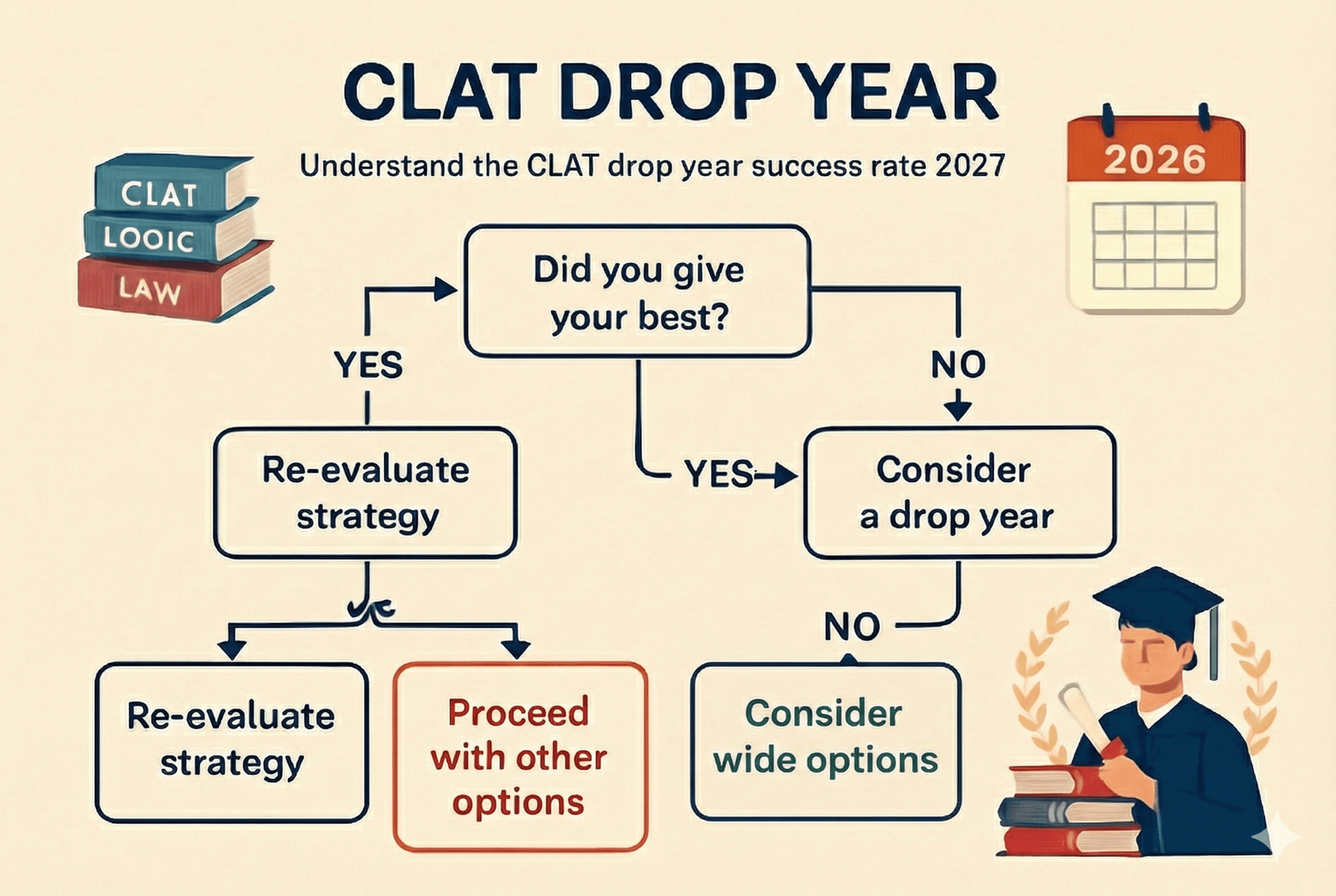
The Decision-Making Flowchart: Should You Take a Drop Year for CLAT?
To simplify this crucial decision, here is a detailed flowchart designed to guide CLAT aspirants through a systematic evaluation process. Each step requires honest self-reflection and a realistic assessment of your situation.
Step 1: Evaluate Your Previous CLAT Performance and Effort
This is the foundational step. Before considering a drop year, you must critically analyze your performance in your most recent CLAT attempt.
- Question 1: Did you give your absolute best effort in your previous attempt?
- Yes: Proceed to Question 2.
- No: Reflect deeply on why not. Were you juggling board exams, lacked proper guidance, or faced personal challenges? If you believe a lack of effort or specific external factors hindered you, a drop year might be beneficial if those factors can now be mitigated. Consider how you can improve your CLAT preparation in 3 months if you decide against a full drop year.
- Question 2: Are you clear about your mistakes and weak areas?
- Yes: Proceed to Question 3.
- No: Spend time analyzing your mock test results and the actual exam paper. Identify specific sections (e.g., Logical Reasoning, Quantitative Techniques, Current Affairs) where you consistently scored low or made common errors. Without this clarity, a drop year lacks direction. Understanding 60% of questions come from these 5 areas can help pinpoint areas.
- Question 3: Do you genuinely believe you can significantly improve your score with focused effort?
- Yes: Proceed to Step 2.
- No: If you feel you’ve plateaued or that further effort won’t yield substantial improvement, a drop year might not be the most effective path. Explore alternative career options or other law entrance exams.
Step 2: Assess Your Motivation, Discipline, and Mental Readiness
A drop year demands an immense amount of self-motivation and discipline. It’s a marathon, not a sprint.
- Question 4: Are you highly self-motivated and disciplined to study consistently for an entire year without external academic pressure?
- Yes: Proceed to Question 5.
- No: If you struggle with self-discipline or procrastination, a drop year might be challenging. Consider if an integrated coaching program with a structured environment would be more suitable. Remember, balancing school and CLAT preparation is also an option for some.
- Question 5: Are you mentally prepared for the pressure and potential isolation of a drop year?
- Yes: Proceed to Question 6.
- No: The mental toll can be significant. Discuss your concerns with parents, mentors, or counselors. Having a strong support system is vital. Be aware of CLAT exam anxiety and how to manage it.
- Question 6: Do you have a strong support system (family, mentors, friends) who understand and back your decision?
- Yes: Proceed to Step 3.
- No: Without support, the journey can feel isolating. Open communication with your family is essential to ensure they are on board and understand the challenges and benefits.
Step 3: Evaluate Your Resources and Strategic Plan
A successful drop year requires more than just motivation; it needs a concrete plan and access to appropriate resources.
- Question 7: Do you have a clear, realistic, and detailed study plan for the drop year?
- Yes: Proceed to Question 8.
- No: Develop a comprehensive plan that allocates time for each section, mock tests, revision, and analysis. This plan should address your identified weak areas. Consider enrolling in a reputable online CLAT coaching program like Lawgical, which provides structured guidance and resources. For instance, check out Lawgic Coaching.
- Question 8: Will you enroll in a dedicated CLAT coaching program (online or offline) or strictly follow a self-study approach?
- Coaching: Proceed to Question 9.
- Self-study (with a strong plan): Proceed to Question 9. (Self-study requires exceptional discipline and access to quality materials).
- Question 9: Do you have access to quality study materials, mock tests, and mentorship?
- Yes: Proceed to Step 4.
- No: Access to resources is non-negotiable. Invest in the best books for CLAT preparation and reliable mock test series. Many online platforms offer excellent resources. Learn about best online CLAT coaching platforms to aid your decision.
Step 4: Consider the Alternatives and Opportunity Cost
A drop year means delaying your entry into college by a year. It’s important to consider what you might be giving up.
- Question 10: Are you willing to accept the opportunity cost (delay in graduation, potential social pressure, financial implications)?
- Yes: Proceed to the Decision.
- No: If the trade-offs are too significant, explore alternatives such as pursuing other law entrance exams (e.g., AILET, SLAT, LSAT India), applying to private universities, or taking a different academic path. For AILET specifically, you might want to look into AILET 2025 Preparation Tips.
The Decision: Based on Your Answers
- If you answered “Yes” to most or all applicable questions and have a strong plan: A drop year is a viable and potentially highly rewarding option for you. Go for it with confidence and commitment.
- If you answered “No” to several key questions, or have significant doubts: Reconsider. A drop year might lead to frustration. Explore other avenues, bolster your self-discipline, or seek professional guidance before committing. It might be wise to look at avoiding CLAT pitfalls to learn from common mistakes.
“A drop year isn’t a pause; it’s a strategic retreat for a stronger offensive. It amplifies your chances only if accompanied by unwavering dedication and a meticulously crafted plan.”
Maximizing Your CLAT Drop Year: Strategies for Success
Once the decision to take a drop year for CLAT 2027 is made, the focus shifts entirely to execution. A well-planned and disciplined approach is crucial to maximize the CLAT drop year success rate 2027.
1. Develop a Meticulous Study Plan
Your study plan should be comprehensive, covering all sections of the CLAT syllabus.
- Section-wise Breakdown: Allocate specific days or hours to each subject:
- English Language: Focus on reading comprehension, vocabulary, grammar, and critical reasoning passages. Regular reading of editorials and literary works is key.
- Current Affairs & GK: This is a vast section. Divide it into daily reading (newspapers, magazines), weekly revisions, and monthly deep dives into significant events. Utilize resources like current affairs capsules. Consider these 10 high-yield GK topics.
- Logical Reasoning: Practice various types of puzzles, critical reasoning, and deductive logic questions.
- Legal Reasoning: Understand legal principles, read legal maxims, and practice applying principles to factual scenarios. Focus on the analytical aspect rather than memorizing laws.
- Quantitative Techniques: Review basic arithmetic, algebra, geometry, and data interpretation. Identify common question patterns. For tricks and shortcuts, check out Approach Quantitative Techniques in CLAT.
- Daily, Weekly, Monthly Targets: Set achievable goals. For example, daily practice of 2-3 reading comprehension passages, weekly mock tests, and monthly revision of all topics covered.
- Revision Schedule: Integrate regular revision into your plan. Spaced repetition is highly effective for long-term retention.
- Mock Tests and Analysis: Take at least 2-3 full-length mock tests every week in the last few months. More importantly, dedicate significant time to analyze your performance: identify mistakes, understand concepts you missed, and refine your time management. Learn how to boost your CLAT readiness with CLAT mock tests.
2. Choose the Right Coaching and Resources
While self-study is possible, structured guidance often provides an edge, especially in a competitive exam like CLAT.
- Online vs. Offline Coaching: Evaluate the pros and cons based on your learning style, location, and budget. Online coaching offers flexibility and access to top educators regardless of location. For example, Lawgical Coaching offers comprehensive online programs. Check out our Best Online CLAT Coaching in India.
- Study Materials: Invest in high-quality CLAT books and online resources. Refer to recommended booklists for each section. Here’s a guide to the best books for CLAT preparation.
- Mock Test Series: Subscribe to a reputable mock test series that provides detailed analysis and covers the latest CLAT pattern.
- Current Affairs Sources: Regularly read newspapers like The Hindu or The Indian Express, and follow reliable current affairs magazines or online portals.
3. Focus on Weak Areas and Conceptual Clarity
A common mistake in the first attempt is often superficial understanding. A drop year is your chance to build a strong foundation.
- Deep Dive into Concepts: Don’t just skim topics. Understand the underlying concepts thoroughly. If you struggle with Quantitative Techniques, spend extra time on basic math principles.
- Targeted Practice: Once weak areas are identified (through mock test analysis), allocate more practice time to those specific sections. For instance, if Legal Reasoning is a challenge, practice more passages from previous years’ papers and sample questions.
- Seek Clarification: Don’t hesitate to ask doubts from mentors, teachers, or online forums.
4. Prioritize Mental and Physical Well-being
The intensity of a drop year can lead to stress and burnout. Maintaining balance is crucial.
- Regular Breaks: Incorporate short breaks during study sessions and longer breaks weekly. This helps prevent fatigue and improves retention. Remember to boost your CLAT prep with the underrated power of taking breaks.
- Healthy Lifestyle: Ensure adequate sleep, a balanced diet, and regular physical activity.
- Stress Management: Practice mindfulness, meditation, or hobbies to manage stress. Avoid isolation; stay connected with your support system.
- Positive Mindset: Believe in your ability to succeed. Learn from failures, but don’t dwell on them.
5. Monitor Progress and Adapt Your Strategy
Your study plan is not set in stone. It needs to be dynamic.
- Track Performance: Maintain a journal of your mock test scores, section-wise performance, and areas of improvement.
- Analyze Trends: Identify patterns in your mistakes. Are you consistently making errors in a particular type of question?
- Adjust as Needed: Based on your progress and evolving strengths/weaknesses, modify your study schedule and focus areas. For example, if your GK score isn’t improving, re-evaluate your GK strategy. For those with a GK backlog, check out CLAT GK Backlog Clearance.
The CLAT Drop Year Success Rate 2027: What to Expect

It is challenging to provide an exact, universal CLAT drop year success rate 2027 as official data specifically tracking dropper performance is not publicly released by the CLAT Consortium. However, based on anecdotal evidence, expert observations, and trends within the coaching industry, it is widely acknowledged that a significant percentage of students who secure top ranks in CLAT each year are indeed droppers.
Factors Influencing Success Rate:
- Maturity and Focus: Droppers generally approach the exam with greater maturity, a clearer understanding of the stakes, and a more focused mindset compared to those juggling board exams.
- Identified Weaknesses: Having experienced the exam once, droppers often have a better grasp of their personal weak areas and the exam’s demands, allowing for more targeted preparation.
- Dedicated Time: A drop year provides uninterrupted time solely for CLAT preparation, which is a luxury not afforded to students simultaneously managing school or college.
- Strategic Coaching: Many droppers opt for intensive coaching programs, leveraging expert guidance, comprehensive study materials, and a competitive peer group.
- Mental Resilience: Successful droppers are those who can withstand the pressure, maintain motivation, and learn from setbacks without giving up.
What the Data Suggests (Anecdotal & Industry Insights)
While hard numbers are scarce, coaching institutes often report that a substantial portion of their top rankers are students taking a drop year. It’s not uncommon for students to improve their rank by several thousands or even tens of thousands after a dedicated drop year.
For instance, a student who might have scored in the 60-70 range in their first attempt, potentially securing a lower-tier NLU or not qualifying for an NLU, often targets scores upwards of 90-100+ after a focused drop year, putting them in contention for top NLUs like NLSIU Bangalore, NALSAR Hyderabad, or NLU Delhi (via AILET). This significant jump in scores and ranks contributes positively to the perceived CLAT drop year success rate 2027.
However, it is crucial to understand that success is not guaranteed. The drop year’s effectiveness is directly proportional to the effort, discipline, and strategic planning invested. Students who treat the drop year casually, lack a structured approach, or succumb to pressure are less likely to see substantial improvement.
Key Elements for a High Success Rate in 2027:
- Early Start: Begin preparation immediately after the previous CLAT results.
- Consistent Practice: Regular mock tests and sectionals are non-negotiable.
- Deep Analysis: Every mock test needs thorough analysis, not just a score.
- Stay Updated: Especially for Current Affairs, daily engagement is essential.
- Mental Toughness: Build resilience to handle setbacks and maintain motivation.
The CLAT drop year success rate 2027 for dedicated and strategically prepared aspirants is generally very encouraging, making it a viable and often beneficial option for those aiming for the pinnacle of legal education in India.
Common Pitfalls to Avoid During a Drop Year
While a drop year offers immense potential, it also comes with unique challenges. Being aware of common pitfalls can help aspirants navigate them effectively.
1. Lack of a Structured Plan
- Pitfall: Waking up without a clear agenda, passively attending classes, or aimlessly flipping through books.
- Solution: Create a daily, weekly, and monthly schedule. Break down the syllabus into manageable chunks. Allocate specific time slots for each subject, mock tests, and revision. Stick to the plan rigorously.
2. Over-reliance on Coaching Without Self-Study
- Pitfall: Assuming that merely enrolling in a coaching institute guarantees success, without putting in personal effort.
- Solution: Coaching provides guidance, materials, and a competitive environment, but it’s only effective when combined with diligent self-study. Use coaching as a tool to clarify doubts, learn strategies, and practice, but dedicate ample time to independent learning and practice.
3. Ignoring Weak Areas
- Pitfall: Continuously practicing what you’re good at, avoiding challenging sections or question types.
- Solution: Confront your weaknesses head-on. Dedicate extra time to understanding fundamental concepts in challenging areas. Practice a higher volume of questions from these sections. Utilize resources tailored for CLAT weak section emergency kit.
4. Excessive Mock Test Taking Without Analysis
- Pitfall: Taking numerous mock tests but not spending adequate time analyzing errors, understanding solutions, and identifying conceptual gaps.
- Solution: Mock test analysis is arguably more important than taking the test itself. For every mock test, dedicate at least an equal amount of time (or more) to reviewing every question – correct, incorrect, and unattempted. Understand why an answer was correct or incorrect.
5. Neglecting Current Affairs
- Pitfall: Treating Current Affairs as a last-minute chore, leading to superficial knowledge and poor scores in this high-weightage section.
- Solution: Current Affairs preparation is an ongoing process. Read newspapers daily, make concise notes, and revise regularly. Engage with different sources to get a well-rounded perspective. A structured approach is key for CLAT GK preparation.
6. Burnout and Mental Exhaustion
- Pitfall: Studying for extremely long hours without breaks, leading to mental fatigue, decreased productivity, and loss of motivation.
- Solution: Incorporate short, regular breaks into your study routine. Maintain a hobby, engage in physical activity, and get adequate sleep. Connect with family and friends. Recognize signs of burnout and address them proactively.
7. Comparison with Peers
- Pitfall: Constantly comparing your progress, mock scores, or situation with others, leading to self-doubt, anxiety, or overconfidence.
- Solution: Focus on your own journey and progress. Everyone has a different learning pace and starting point. Celebrate your improvements and learn from your setbacks without getting bogged down by others’ performances. Your competition is primarily yourself.
8. Inconsistent Effort
- Pitfall: Having bursts of intense study followed by long periods of inactivity, leading to a fragmented learning process.
- Solution: Consistency is key. Even if it’s for shorter durations, regular study is more effective than sporadic marathon sessions. Develop a routine and stick to it daily. This builds momentum and reinforces learning over time.
By being mindful of these common pitfalls and actively working to avoid them, CLAT aspirants can significantly enhance their chances of success during a drop year, contributing positively to the overall CLAT drop year success rate 2027.
Conclusion
The decision to take a drop year for CLAT 2027 is a deeply personal one, laden with both immense potential and significant challenges. It is not a path to be chosen lightly but rather with meticulous thought, honest self-assessment, and a robust plan. The journey requires unwavering commitment, discipline, and a resilient mindset. While the CLAT drop year success rate 2027 for dedicated individuals is encouraging, success is not a given; it is earned through strategic preparation and consistent effort.
For those who emerge from the decision-making flowchart with a strong “Yes,” remember that this year is your opportunity to convert aspirations into reality. Leverage every resource available, from expert coaching at Lawgic Coaching to high-quality mock tests and a well-structured study schedule. Focus on conceptual clarity, meticulous practice, and diligent analysis of your performance. Most importantly, nurture your mental well-being, as a healthy mind is paramount to sustained academic rigor.
Ultimately, a drop year is a strategic investment in your future. When approached with seriousness and an unyielding will to succeed, it can unlock the doors to a top National Law University, setting you on a fulfilling path in the legal profession.
Actionable Next Steps:
- Re-evaluate: Use the provided flowchart for a final, honest self-assessment.
- Plan: If proceeding with a drop year, develop a detailed, week-by-week study plan.
- Resource Acquisition: Secure quality study materials and consider enrolling in a reputable CLAT coaching program.
- Support System: Communicate your decision and plan to your family and establish a strong support network.
- Commit: Embark on your preparation with renewed determination and a positive outlook, ready to maximize your chances for CLAT 2027.
References
[1] Consortium of National Law Universities. (2025). CLAT 2025 Information Brochure. Retrieved from official CLAT website.[2] Lawgical Coaching. (2025). Various articles on CLAT preparation strategies. Retrieved from https://lawgiccoaching.com/blogs/
Should You Take a CLAT Drop Year? Your Decision Helper
1. Did you give your absolute best effort in your previous CLAT attempt?
Decision Outcome: