Scoring 30 in CLAT mocks feels like standing at the bottom of a mountain, looking up at an impossible climb. The frustration sets in. The self-doubt creeps up. But here's what most students don't realize: the journey from 30 to 95 in CLAT mocks isn't about working harder. It's about working smarter with a structured, realistic plan that transforms weaknesses into strengths over 90 focused days.
This comprehensive guide presents a realistic 90-day transformation plan that has helped hundreds of students make this exact jump. Not through magic formulas or unrealistic shortcuts, but through strategic preparation that addresses every aspect of the CLAT exam systematically.
Before you plan ninety days, get a baseline. Our free CLAT mock test is 30 questions on the official pattern and gives you a starting score to measure the plan against.
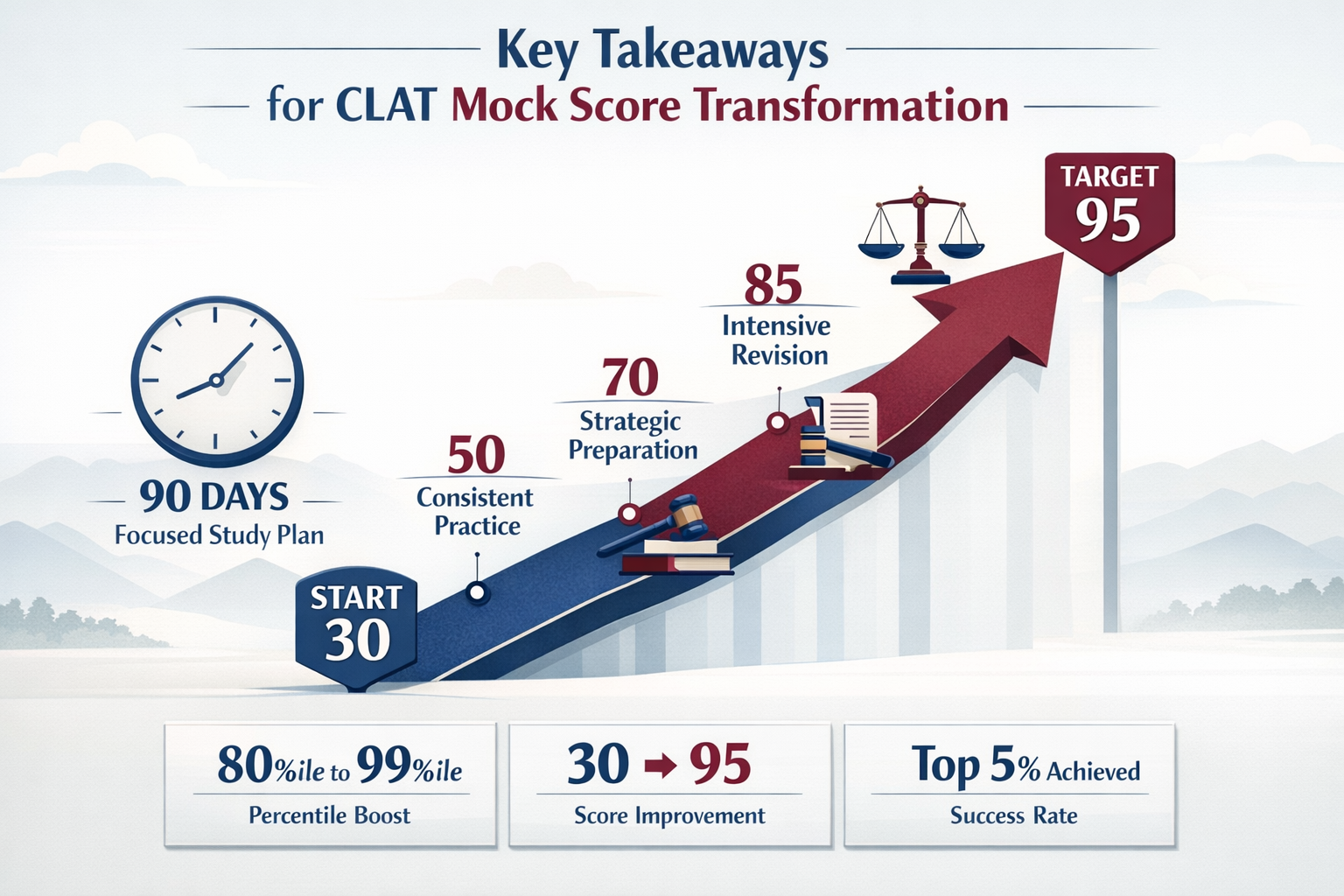
Key Takeaways
- A structured 90-day plan can realistically transform CLAT mock scores from 30 to 95 through phased preparation focusing on foundation, skill building, and performance optimization
- Section-wise targeted improvement with daily practice schedules yields better results than generic study approaches
- Mock test analysis is more valuable than taking multiple tests without proper evaluation and error correction
- Psychological preparation and stress management are as critical as academic preparation for consistent high performance
- The final 30 days should focus on revision, speed enhancement, and exam simulation rather than learning new concepts
Understanding the Score Gap: Why You're Stuck at 30
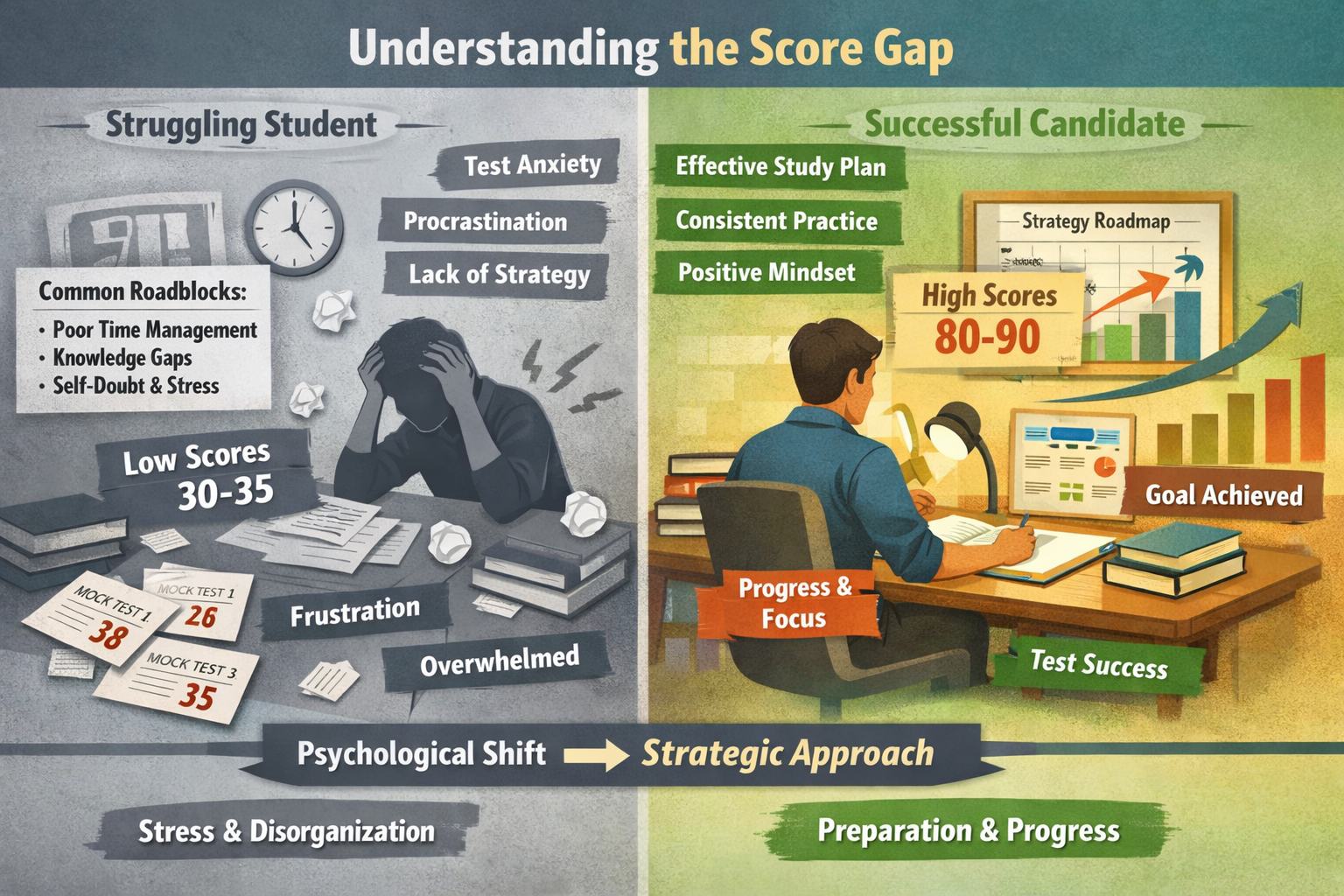
Before diving into the transformation plan, it's important to understand why scores stagnate around 30. This isn't about intelligence or capability. Most students scoring in this range share common patterns that keep them trapped.
The Pattern Recognition Problem
Students at this level often read questions but fail to identify what's actually being asked. They see words but miss the underlying legal principle or logical structure. This happens because pattern recognition skills haven't been developed through systematic practice.
Time Mismanagement Crisis
Spending 4 minutes on a question worth the same as one that takes 90 seconds creates a cascading failure. By the time you reach question 80, you're rushing through sections where you could have scored easily.
Weak Foundational Knowledge
Attempting advanced legal reasoning without understanding basic legal principles is like building a house on sand. The structure collapses under pressure. Similarly, tackling complex CLAT passages without solid comprehension skills leads to consistent underperformance.
Analysis Paralysis
Taking mock after mock without proper analysis creates an illusion of preparation. You're practicing mistakes, not correcting them. This reinforces wrong approaches and cements bad habits.
Let's be honest. Recognizing these patterns is the first step. The good news? Each of these problems has a systematic solution built into this 90-day plan.
The 90-Day Framework: Three Distinct Phases
The transformation from 30 to 95 in CLAT mocks requires a phased approach where each month serves a specific purpose. Jumping straight to advanced strategies without building foundations guarantees failure.
Phase 1: Foundation Building (Days 1-30)
This first month focuses entirely on building the base. Think of it as preparing the soil before planting seeds. Rush this phase, and everything that follows will struggle to take root.
Week 1-2: Diagnostic and Skill Assessment
Start with a detailed diagnostic test that goes beyond just scoring. Map every question to specific skills: reading speed, comprehension accuracy, logical reasoning ability, legal principle application, and quantitative aptitude. This creates your baseline data.
Spend these two weeks identifying exactly where the 30 marks are coming from. Are they random guesses that got lucky? Are they from one strong section? Understanding your current state with brutal honesty shapes the entire strategy ahead.
Week 3-4: Core Concept Mastery
Now begins the actual building. For English and comprehension, focus on reading diverse materials daily. Not just legal passages, but editorials, essays, and analytical pieces. Build vocabulary through context, not rote memorization.
For legal reasoning, start with understanding basic legal principles. Don't jump to complex passages yet. Master concepts like precedent, liability, contract essentials, and constitutional basics. Create simple flashcards linking principles to everyday situations.
Current affairs preparation needs a systematic approach. Rather than random reading, follow structured GK topics that appear repeatedly in CLAT. Focus on understanding issues, not just memorizing facts.
Logical reasoning requires daily practice with basic puzzles and arrangements. Start simple. Master blood relations, seating arrangements, and basic syllogisms before moving to complex analytical reasoning.
Quantitative techniques at this stage means solidifying Class 10 math fundamentals. Percentages, ratios, averages, and basic algebra must become second nature.
Phase 2: Skill Enhancement and Strategy Development (Days 31-60)
Month two is where the actual transformation begins. You've built the foundation. Now it's time to construct the structure that will support high scores.
Week 5-6: Section-Wise Deep Dives
Dedicate specific days to specific sections, but with intensity. Monday becomes English day where you read 5-6 passages, analyze every question type, and track comprehension speed. Tuesday focuses entirely on legal reasoning with 30-40 principle-based questions.
Wednesday dives deep into current affairs, but now you're connecting events to their legal, social, and economic implications. Thursday tackles logical reasoning with increasingly complex problem sets. Friday belongs to quantitative techniques with timed problem-solving sessions.
Weekends are for integration. Take section-wise tests that combine everything learned during the week. But here's the critical part: spend more time analyzing these tests than taking them. Every wrong answer needs a detailed post-mortem.
Week 7-8: Speed and Accuracy Balance
You're now 60 days in. Knowledge is building. But CLAT isn't just about knowing answers. It's about finding them fast. This phase introduces strict time constraints.
Practice reading comprehension passages with a timer. Start at 6 minutes per passage, then gradually reduce to 4 minutes. Track not just accuracy but also reading speed and retention.
For legal reasoning, develop the skill of quickly identifying the core principle in a passage. Practice extracting the legal rule in 30 seconds, then applying it to questions in 60 seconds each.
Current affairs questions need instant recall. If you're spending more than 45 seconds on a GK question, you don't know it well enough. This phase is about converting knowledge into reflexive responses.
Create personal shortcuts for logical reasoning. Develop your own notation system for complex arrangements. Build mental models for common puzzle types. Speed comes from pattern recognition, not from reading faster.
Phase 3: Peak Performance and Exam Simulation (Days 61-90)
The final month is about performing under pressure. You have the knowledge. You have the skills. Now it's about consistent execution when it matters most.
Week 9-10: Full-Length Mock Integration
Take full-length CLAT mocks every alternate day. But these aren't just practice tests. They're dress rehearsals for the actual exam. Same time, same conditions, same pressure.
After each mock, spend the next day on detailed analysis. Not just reviewing wrong answers, but understanding why you chose wrong options. What pattern of thinking led you astray? Was it time pressure? Misreading? Conceptual gap?
Track your scores across sections. You should see consistent improvement from the 30 baseline. If any section is lagging, dedicate focused hours to that area. This is your last chance to shore up weaknesses before the final push.
Week 11-12: Revision and Refinement
Stop learning new things. This is crucial. The final two weeks are only for consolidating what you already know. Review your notes, revisit difficult concepts, and reinforce strong areas.
Take mocks but reduce frequency to every third day. Use the gap days for targeted practice on persistent weak areas. If legal reasoning is still shaky, do 50 questions daily. If current affairs has gaps, focus revision there.
The last week before CLAT should be light. One mock every two days. Rest in between. Your brain needs recovery time to perform at peak capacity. Cramming now will hurt more than help.
Section-Wise Transformation Strategies
Generic preparation doesn't move scores from 30 to 95. Each CLAT section demands specific strategies tailored to its unique challenges. Here's how to approach each section systematically over 90 days.
English Language and Comprehension: Building Reading Intelligence
Most students think English preparation means learning vocabulary. That's only 20% of what's needed. The real skill is reading intelligence: extracting meaning quickly, identifying author's tone, and understanding implicit arguments.
Daily Reading Protocol
Read for 90 minutes daily from diverse sources. Spend 30 minutes on legal judgments or law-related articles. Another 30 minutes on editorial pieces from major newspapers. The final 30 minutes on literary essays or analytical writing.
But don't just read passively. After each piece, summarize the main argument in two sentences. Identify the author's perspective. Note any assumptions made. This active reading builds the comprehension muscle CLAT demands.
Vocabulary in Context
Instead of memorizing word lists, learn vocabulary through reading. When you encounter an unfamiliar word, note the sentence, infer meaning from context, then verify. This builds contextual understanding that helps in the exam when you face new words.
Create personal vocabulary groups based on themes: legal terms, economic concepts, social issues, political terminology. This thematic organization makes recall easier under exam pressure.
Question Pattern Mastery
CLAT comprehension questions follow predictable patterns: main idea, inference, tone, vocabulary in context, and author's purpose. Practice identifying which pattern each question represents before attempting it. This reduces reading time and increases accuracy.
Legal Reasoning: From Confusion to Clarity
Legal reasoning feels intimidating because it uses unfamiliar language and concepts. But it's actually the most systematic section once you understand the underlying structure.
Principle-Based Thinking
Every legal reasoning passage provides a principle or rule. Your job isn't to apply real law but to apply the given principle to the facts. Students scoring 30 often bring outside knowledge that conflicts with the passage principle. Stop doing that.
Practice extracting the principle in one sentence. Then identify the key facts in the fact pattern. Finally, apply the principle mechanically to those facts. This three-step process eliminates confusion.
Case Law Understanding
While CLAT doesn't require deep legal knowledge, familiarity with basic case law helps. Spend 30 minutes daily reading simplified case summaries. Focus on understanding the legal principle established, not memorizing case names.
Create a personal case law database organized by topic: contract law, constitutional law, criminal law, tort law. When you encounter a principle in mocks, connect it to cases you've read. This builds legal intuition.
Elimination Technique
Legal reasoning questions often have two obviously wrong answers and two plausible ones. Learn to eliminate the clearly wrong options first. Then analyze the remaining two against the exact wording of the principle. Usually, one will have a subtle mismatch with the principle's language.
Current Affairs and General Knowledge: Strategic Coverage
Current affairs preparation can feel overwhelming because the world generates infinite information daily. The key is strategic filtering based on CLAT patterns.
The 60-40 Rule
Approximately 60% of GK questions come from five major areas: legal developments, constitutional amendments, Supreme Court judgments, government schemes, and international relations. Focus 60% of your GK time on these high-yield topics.
The remaining 40% covers sports, awards, science developments, and miscellaneous current events. Don't ignore these, but don't let them dominate your preparation either.
Monthly Current Affairs Consolidation
At the end of each month, create a consolidated document of major events. Organize by category: political, legal, economic, social, international, sports, awards. This monthly review ensures nothing important slips through.
But don't just list events. For each major development, note its significance, implications, and connections to other events. CLAT increasingly asks analytical GK questions that test understanding, not just recall.
Newspaper Reading Strategy
Reading newspapers is essential, but reading everything is inefficient. Focus on editorial pages, legal affairs sections, and major national/international news. Skip entertainment gossip and sports details beyond major tournaments.
Spend 45 minutes daily on newspaper reading, but make it active. Highlight important points, make margin notes, and create mental connections. Passive reading wastes time without building retention.
Logical Reasoning: Pattern Recognition Mastery
Logical reasoning separates high scorers from average performers. It's the section where systematic practice creates the most dramatic improvement.
Question Type Categorization
Logical reasoning includes distinct question types: arrangements, blood relations, syllogisms, critical reasoning, and analytical puzzles. Each type requires specific solving techniques.
Dedicate one week to mastering each type. Week one focuses only on arrangements. Week two tackles blood relations. Week three covers syllogisms. This focused approach builds deep competence in each area.
Visualization Techniques
Most logical reasoning problems become easier when visualized. Develop the habit of drawing quick diagrams, charts, or tables for arrangement problems. Use symbols for blood relations. Create Venn diagrams for syllogisms.
Speed comes from having standard visualization templates ready. When you see a circular arrangement problem, your hand should automatically draw a circle with positions marked. This automation saves precious seconds.
Elimination and Assumption Testing
For critical reasoning questions, learn to test answer options against the passage. The correct answer must be supported by information in the passage, not by outside knowledge or assumptions.
Practice identifying assumptions in arguments. What must be true for this conclusion to follow? What evidence would weaken this argument? This analytical thinking is exactly what CLAT tests.
Quantitative Techniques: Efficient Problem Solving
Quant in CLAT isn't about complex mathematics. It's about solving Class 10 level problems quickly. Speed matters more than advanced techniques.
Formula Sheet Mastery
Create a one-page formula sheet covering percentages, ratios, averages, profit-loss, time-speed-distance, and basic algebra. Memorize this sheet so thoroughly that formulas come instantly to mind.
But don't just memorize formulas. Understand when to apply each one. Practice identifying problem types in 5 seconds, then applying the appropriate formula. This pattern recognition is what creates speed.
Shortcut Techniques
Learn percentage shortcuts like converting fractions to percentages mentally, calculating 10% and deriving other percentages, and using approximation for complex calculations. CLAT doesn't require exact answers for every calculation.
Practice mental math daily. Calculate bills, percentages, and ratios in everyday situations. This builds the mental calculation muscle that eliminates dependency on lengthy written calculations.
Time Management in Quant
Spend no more than 90 seconds per quant question. If a problem seems complex, mark it and move on. Return to difficult questions only after completing easier ones. This ensures you don't sacrifice easy marks while struggling with hard problems.
Mock Test Analysis: The Real Game Changer
Taking mocks without proper analysis is like going to the gym and lifting weights randomly without a program. You'll get tired, but you won't build strength systematically. Mock test analysis is where transformation actually happens.
The Three-Layer Analysis Framework
After every mock test, conduct analysis at three levels: question-level, section-level, and test-level. Each layer reveals different insights.
Question-Level Analysis
For every wrong answer, ask these questions: Did I misread the question? Did I misunderstand the concept? Did I make a calculation error? Was it a time-pressure mistake? Did I fall for a trap answer?
Categorize mistakes into buckets: conceptual gaps, careless errors, time management issues, and trap answers. Track which bucket has the most mistakes. That's where your focused improvement effort should go.
For every correct answer, verify you got it right for the right reasons. Sometimes you guess correctly, which gives false confidence. Mark these as "lucky correct" and treat them like mistakes in your analysis.
Section-Level Analysis
Look at performance patterns across sections. Is one section consistently dragging down your score? That section needs dedicated daily practice. Are you strong in one section but inconsistent? That suggests exam pressure issues, not knowledge gaps.
Track time spent per section. Are you spending 35 minutes on legal reasoning but only 15 on quant? This imbalance might be costing you easy marks. Adjust your time allocation strategy based on this data.
Calculate accuracy rates by section. Sometimes spending less time but maintaining accuracy is better than spending more time and making mistakes. Find your optimal speed-accuracy balance for each section.
Test-Level Analysis
Review your overall test-taking strategy. Did you attempt sections in the right order? Did you spend too long on difficult questions? Did you rush through easy questions and make careless mistakes?
Track your score progression over multiple mocks. Plot it on a graph. You should see an upward trend, even if it's not linear. If scores are stagnating, your preparation strategy needs adjustment.
Identify your peak performance timing. Do you score better in morning mocks or evening ones? This tells you when your brain is sharpest, which should guide your actual exam slot preference if possible.
Creating a Mistake Journal
Maintain a detailed mistake journal where you log every error from every mock. But don't just write "got question 45 wrong." Document the question type, your wrong answer, the correct answer, why you chose wrong, and what you'll do differently next time.
Review this journal weekly. You'll notice patterns. Maybe you consistently miss inference questions in comprehension. Maybe you make calculation errors in percentage problems. These patterns guide your focused practice.
The mistake journal becomes your most valuable study resource. Before the actual CLAT, reviewing this journal is more useful than taking another mock because it contains your personalized weak areas.
The 48-Hour Analysis Rule
Never take another mock until you've thoroughly analyzed the previous one. This means spending at least 2-3 hours on analysis after a 2-hour mock. If you're taking mocks daily without analysis, you're wasting time.
The 48-hour gap between mocks allows for focused improvement work on identified weaknesses. Take a mock, analyze it thoroughly, practice weak areas for a day, then take the next mock. This cycle creates systematic improvement.
Time Management: The Hidden Score Multiplier
Students often underestimate how much time management affects scores. You might know 90% of the content but score only 60% because of poor time allocation. Mastering time management can add 20-30 marks without learning anything new.
The Section-Wise Time Allocation Strategy
CLAT gives you 120 minutes for approximately 120 questions. Simple math suggests one minute per question, but that's not the optimal strategy. Different sections demand different time investments.
Optimal Time Distribution
Allocate time based on section difficulty and question complexity, not just question count. A suggested distribution for most students:
- English Comprehension: 35-40 minutes for 28-30 questions
- Current Affairs: 15-20 minutes for 35-40 questions
- Legal Reasoning: 35-40 minutes for 28-30 questions
- Logical Reasoning: 20-25 minutes for 18-20 questions
- Quantitative Techniques: 10-15 minutes for 10-13 questions
This leaves 5-10 minutes for review and revisiting marked questions. Adjust these numbers based on your strengths, but having a plan prevents time wastage.
The Two-Pass Strategy
Don't attempt questions linearly from 1 to 120. Use a two-pass approach. In the first pass, attempt all easy and moderate questions, skipping difficult ones. Mark difficult questions and return in the second pass.
This ensures you secure all easy marks first. Many students waste 5 minutes on question 15, then rush through questions 100-120 where they could have scored easily. The two-pass strategy prevents this.
During the first pass, if a question takes more than 90 seconds, mark it and move on. Don't get emotionally invested in solving every question you start. This discipline is what separates high scorers from average performers.
Building Speed Without Sacrificing Accuracy
Speed without accuracy is useless. But accuracy without speed means incomplete tests. The goal is finding your optimal speed-accuracy balance, which varies by section.
Progressive Speed Training
Start by solving questions untimed, focusing purely on accuracy. Once you're consistently hitting 85-90% accuracy, introduce time constraints. Begin with generous time limits, then gradually tighten them.
For reading comprehension, start by allowing 8 minutes per passage. Once comfortable, reduce to 6 minutes, then 5 minutes, and finally 4 minutes. Track how accuracy changes with speed. Find the sweet spot where you maintain 80%+ accuracy.
For legal reasoning, practice extracting principles in 30 seconds. Then practice applying principles to facts in 60 seconds per question. This structured timing builds speed systematically.
Elimination Speed
Train yourself to eliminate obviously wrong options in 10 seconds. Most CLAT questions have at least two clearly incorrect options. Eliminating these instantly reduces your decision-making to choosing between two options, which is faster and more accurate.
Practice elimination drills where you only eliminate wrong options without selecting the correct one. This builds the skill of quickly spotting red flags in options: extreme language, scope mismatches, factual errors, or logical inconsistencies.
Psychological Preparation: The Overlooked Dimension
Technical preparation gets you to 80. Psychological preparation takes you from 80 to 95. Yet most students ignore this dimension until exam anxiety cripples their performance.
Building Exam Resilience
CLAT is a pressure test as much as a knowledge test. Students who perform well under pressure often outscore more knowledgeable students who crack under stress. Building resilience is trainable.
Simulated Pressure Training
Take at least 10 mocks under actual exam conditions. Same time, same environment, same restrictions. No pausing for water breaks. No checking phones. No comfortable interruptions. This trains your brain to perform under constraint.
Gradually increase pressure in practice. Take some mocks in noisy environments. Take some when you're slightly tired. Take some in unfamiliar locations. This builds adaptability so exam day surprises don't derail performance.
Developing Pre-Performance Routines
Athletes use pre-performance routines to enter optimal mental states. You need one too. Develop a 10-minute routine before each mock that you'll replicate on exam day: specific breathing exercises, positive affirmations, physical warm-up, or mental visualization.
Practice this routine before every mock for the last 30 days. By exam day, this routine will automatically trigger your brain into performance mode, reducing anxiety and increasing focus.
Managing Test Anxiety
Some anxiety is useful. It sharpens focus. But excessive anxiety impairs performance. Learn to regulate anxiety to optimal levels.
Breathing Techniques
Practice 4-7-8 breathing: inhale for 4 counts, hold for 7 counts, exhale for 8 counts. This activates your parasympathetic nervous system, reducing physical anxiety symptoms. Use this technique before the exam and during bathroom breaks if needed.
Cognitive Reframing
When you think "I'm so nervous," reframe it as "I'm excited and ready." Research shows this simple reframing reduces performance anxiety. Your body's physical response to nervousness and excitement is similar. Reframing changes how you interpret those sensations.
When you encounter a difficult question, instead of thinking "I don't know this, I'm going to fail," think "This is hard for everyone, I'll do my best and move on." This prevents catastrophic thinking that spirals into panic.
Confidence Building Through Incremental Wins
Confidence isn't built through positive thinking alone. It comes from evidence of competence. Track your progress meticulously to build genuine confidence.
Progress Visualization
Create a visual chart showing your mock test scores over time. Seeing the upward trend provides concrete evidence that you're improving. On difficult days, reviewing this chart reminds you that progress is real.
Celebrate small wins. When you master a difficult concept, acknowledge it. When you improve accuracy in a weak section, recognize it. These small celebrations build the confidence foundation that supports peak performance.
Common Pitfalls and How to Avoid Them
Even with a solid plan, students make predictable mistakes that derail transformation. Being aware of these pitfalls helps you avoid them.
The Overlearning Trap
Some students spend 80% of their time on sections they're already good at because it feels comfortable. This creates an illusion of productivity without addressing actual weaknesses.
Solution: Proportional Time Investment
Spend preparation time inversely proportional to current performance. If you're scoring 80% in English but 40% in legal reasoning, spend more time on legal reasoning. This targeted approach yields better overall score improvement.
Set minimum time requirements for weak sections. Even if it's uncomfortable, dedicate at least 90 minutes daily to your weakest section until it reaches acceptable performance levels.
The Mock Test Addiction
Taking 5 mocks per week without proper analysis creates exhaustion without improvement. You're practicing test-taking, not learning from mistakes.
Solution: Quality Over Quantity
Limit mocks to 2-3 per week maximum, with thorough analysis after each. Spend the remaining days on focused practice targeting identified weaknesses. This creates a learn-test-improve cycle that actually moves scores.
Remember: One well-analyzed mock is worth five mocks taken without analysis. The learning happens in the analysis, not in the taking.
The Resource Hoarding Problem
Collecting 50 books, 10 online courses, and 100 PDF notes creates information overload. You spend more time organizing resources than actually studying.
Solution: Minimal Effective Resources
Choose one primary resource per section and stick with it. Add supplementary resources only for specific weak areas. Quality coaching with focused materials beats scattered self-study with excessive resources.
At Lawgic Coaching, we've seen students transform their scores not by accessing more materials, but by deeply mastering fewer, high-quality resources with expert guidance.
The Comparison Trap
Constantly comparing your progress to peers creates anxiety and distorts your preparation strategy. Everyone's starting point and learning curve is different.
Solution: Personal Baseline Focus
Compare yourself only to your previous performance. Are you better than you were last week? That's the only comparison that matters. Your journey from 30 to 95 is personal, not competitive.
Avoid discussing scores with peers if it triggers anxiety. Focus on your process, trust your plan, and let results follow naturally.
The Final Week: Peak Performance Protocol
The last seven days before CLAT require a different approach. This isn't learning time. It's optimization time.
Revision Strategy
Review only what you've already learned. Go through your notes, formula sheets, and mistake journals. Reinforce strong areas and do light practice on weak areas. No new topics.
Take one final mock 3-4 days before CLAT. Analyze it lightly, noting any last-minute adjustments needed. Then stop taking mocks. Your brain needs recovery time.
Physical Preparation
Sleep becomes non-negotiable. Aim for 7-8 hours nightly. Reduce screen time before bed. Your cognitive performance on exam day depends heavily on sleep quality the week before.
Eat regular, nutritious meals. Avoid experimenting with new foods that might cause digestive issues. Stay hydrated. These basics sound obvious but are often neglected under stress.
Light exercise like walking or yoga helps manage anxiety and improves focus. Don't start intense workouts now, but gentle movement supports mental performance.
Mental Preparation
Visualize yourself taking the exam calmly and confidently. Mental rehearsal activates the same neural pathways as actual performance, making the real event feel familiar.
Prepare your exam day logistics: test center location, route, travel time, required documents, backup plans. Eliminating logistical uncertainty reduces exam day stress.
The night before CLAT, do something relaxing. Watch a light movie, spend time with family, or pursue a hobby. Don't study. Your preparation is complete. Rest is what you need now.
Tracking Progress: Metrics That Matter
What gets measured gets improved. But tracking the wrong metrics creates false confidence or unnecessary anxiety. Focus on metrics that actually indicate progress.
Primary Progress Indicators
Mock Test Score Trend: Your overall score should show an upward trend over 90 days, even if individual mocks fluctuate. Plot scores on a graph to visualize progress.
Section-Wise Accuracy: Track accuracy percentage by section. Improving accuracy from 40% to 70% in legal reasoning is more significant than score fluctuations caused by question difficulty variations.
Time Management Efficiency: Measure how many questions you complete in allotted time. Improving from 80 attempted to 115 attempted (with maintained accuracy) represents significant progress.
Mistake Category Reduction: Track whether conceptual mistakes are decreasing over time. If careless errors persist but conceptual mistakes reduce, you're learning but need to work on focus.
Secondary Progress Indicators
Reading Speed: Measure words per minute in comprehension passages. Improvement from 150 wpm to 250 wpm while maintaining comprehension is a valuable skill gain.
Confidence Levels: Subjectively rate your confidence (1-10) after each mock. Increasing confidence that correlates with improving scores indicates genuine competence building.
Stress Management: Note anxiety levels before mocks. If anxiety decreases over time despite increasing stakes, your psychological preparation is working.
Resources and Support Systems
Transformation doesn't happen in isolation. Having the right resources and support accelerates progress and prevents derailment.
Choosing the Right Coaching Support
Self-study works for some students, but structured coaching provides accountability, expert guidance, and systematic curriculum that prevents gaps. Choosing the right coaching makes a significant difference.
At Lawgic Coaching, we've helped thousands crack CLAT through personalized mentorship and proven strategies. Our expert faculty from top NLUs understand exactly what it takes to move from struggling scores to top percentiles because they've done it themselves.
The advantage of structured coaching isn't just content delivery. It's the systematic approach, regular feedback, doubt resolution, and motivation during difficult phases. These elements are hard to replicate in solo preparation.
Building a Study Support Network
Find 2-3 serious aspirants to form a study group. Not for socializing, but for accountability, doubt discussion, and motivation. Meet weekly to discuss difficult concepts and share strategies.
But choose study partners carefully. Negative, anxious, or unserious students will drag down your preparation. Surround yourself with people who inspire better performance.
Digital Tools and Resources
Use apps for time management, habit tracking, and focused study sessions. Tools like Forest or Focus@Will help maintain concentration during study sessions.
For current affairs, curated news apps and CLAT-specific GK resources are more efficient than reading everything. Quality coaching platforms provide these curated resources, saving you filtering time.
Real Success Stories: From 30 to 95 in 90 Days
Theory is important, but seeing real transformations makes the plan feel achievable. Here are patterns from students who've made this exact journey.
Rahul's Story: Systematic Section Focus
Rahul scored 32 in his first mock in January 2026. Legal reasoning was his nightmare, with barely 30% accuracy. He dedicated 2 hours daily to legal reasoning for 45 days, using the principle-extraction method described earlier.
By day 60, his legal reasoning accuracy was 75%. His overall score jumped to 78. The final 30 days focused on speed and integration. His final mock before CLAT: 94. Actual CLAT score: 92. He's now at a top-7 NLU.
Key Takeaway: Rahul didn't try to improve everything simultaneously. He systematically addressed his weakest section first, which created cascading improvements across the test.
Priya's Journey: Mock Analysis Mastery
Priya was taking 4 mocks per week but her scores stayed stuck around 35-40. She was practicing mistakes, not learning from them. When she switched to 2 mocks per week with 3-hour analysis sessions after each, everything changed.
Her mistake journal revealed she consistently misread questions under time pressure. She practiced reading questions twice before attempting, which added 30 seconds per question but improved accuracy by 25%. Her scores climbed steadily: 45, 58, 71, 84, 91.
Key Takeaway: Priya's transformation came not from more practice, but from smarter analysis and targeted correction of specific error patterns.
Arjun's Transformation: Psychological Breakthrough
Arjun had the knowledge but crumbled under pressure. Practice tests at home: 75-80. Mock tests in test centers: 35-45. The anxiety gap was costing him 30-40 marks.
He worked on psychological preparation: meditation, breathing techniques, and simulated pressure training. He took mocks in noisy cafes, in uncomfortable chairs, at odd times. He built resilience through exposure.
His final mocks showed consistent 85-90 scores regardless of environment. Actual CLAT: 88. He's now studying at his dream NLU.
Key Takeaway: Technical preparation isn't enough. Psychological resilience can be the difference between knowing answers and actually selecting them under pressure.
Your Personalized 90-Day Action Plan
Generic plans don't work because every student starts from a different baseline. Here's how to customize this plan for your specific situation.
Week 1: Detailed Self-Assessment
Take a comprehensive diagnostic test. Analyze it at all three levels. Create a detailed strengths-weaknesses matrix. Identify your biggest scoring opportunities: which section improvement will most impact overall score?
Based on this assessment, adjust time allocation. If you're already strong in English (70%+ accuracy), reduce daily English time to 45 minutes and invest that saved time in weaker sections.
Weeks 2-4: Foundation Building with Personal Focus
Follow the general foundation building approach, but weight your time toward weak sections. If legal reasoning is your weakness, spend 2.5 hours daily there instead of 1.5 hours.
Create section-specific goals. By day 30, aim for minimum 60% accuracy in every section. If any section is below 60%, that's your primary focus for month two.
Weeks 5-8: Intensive Skill Development
This is your transformation phase. Implement the section-wise deep dive approach, but customize based on your week 4 assessment. If logical reasoning improved significantly but current affairs lagged, adjust time accordingly.
Take section tests twice weekly and full mocks weekly. The ratio of section tests to full mocks should be 2:1 during this phase. You're building section mastery before integration.
Weeks 9-12: Integration and Peak Performance
Increase full mock frequency to every alternate day. Reduce section-specific study and focus on integration: how sections interact, time management across the full test, and maintaining performance under sustained pressure.
Your final two weeks should feel easier, not harder. If you're still struggling with basic concepts in week 11, your foundation phase was insufficient. But if you followed the plan systematically, week 11-12 should be about refinement, not learning.
Maintaining Momentum Through Difficult Phases

Every 90-day journey has difficult phases. Scores plateau. Motivation dips. Doubt creeps in. Anticipating these challenges helps you navigate them without derailing.
The Week 4-5 Plateau
Many students see minimal score improvement between week 4 and 5. This is normal. You're building foundations that haven't yet translated to test performance. Trust the process. Breakthrough usually comes around week 6-7.
The Week 8 Burnout Risk
By week 8, you've been grinding for two months. Burnout risk is high. This is when taking a full day off becomes essential. Rest isn't wasted time. It's when consolidation happens.
Schedule one complete off day per week where you don't study at all. Do something you enjoy. This sustainable approach prevents burnout and maintains long-term motivation.
The Week 11 Anxiety Spike
As CLAT approaches, anxiety naturally increases. This is when psychological preparation techniques become critical. Double down on breathing exercises, positive visualization, and routine practice.
Remind yourself: you've done the work. You've taken 20+ mocks. You've analyzed every mistake. You've built the skills. Now it's about executing what you know, not learning more.
Beyond the Plan: Developing a Law Student Mindset
The transformation from 30 to 95 in CLAT mocks isn't just about exam scores. It's about developing the mindset and skills that will serve you throughout law school and your legal career.
Analytical Thinking
The analytical approach you develop for legal reasoning translates directly to case analysis in law school. The habit of extracting principles and applying them to facts is the foundation of legal thinking.
Research Skills
The systematic approach to current affairs preparation builds research skills. Learning to filter information, identify credible sources, and synthesize knowledge from multiple sources prepares you for legal research.
Pressure Management
The psychological resilience you build for CLAT serves you in moot courts, viva examinations, and eventually in court appearances. Learning to perform under pressure is a lifelong professional skill.
Systematic Problem-Solving
The structured approach to mock analysis teaches systematic problem-solving. This methodology applies to legal problems, case preparation, and professional challenges throughout your career.
Conclusion: Your Transformation Starts Now
The journey from 30 to 95 in CLAT mocks over 90 days is challenging but absolutely achievable. It requires systematic preparation, strategic focus, consistent effort, and psychological resilience. But thousands of students have walked this path successfully, and you can too.
The plan outlined here isn't theoretical. It's based on proven strategies that have worked for countless successful CLAT aspirants. The three-phase approach ensures you build strong foundations before advancing to complex skills. The section-wise strategies address the specific demands of each CLAT component. The psychological preparation techniques ensure you perform at your peak when it matters most.
But reading this plan isn't enough. Transformation requires action. Start today with your diagnostic assessment. Identify your baseline. Create your personalized schedule. Commit to the 90-day journey.
Remember, this isn't just about CLAT. The skills you develop, the discipline you build, and the resilience you cultivate will serve you throughout your legal education and career. You're not just preparing for an exam. You're becoming the kind of person who achieves ambitious goals through systematic effort.
Your success is our mission at Lawgic Coaching. We've helped thousands crack CLAT through expert guidance without the premium price tag. Our mentors from top NLUs understand this journey because they've lived it. We offer personalized attention you deserve, flexible learning that fits your life, and proven strategies that actually work.
The transformation from 30 to 95 in CLAT mocks isn't about luck or innate talent. It's about following a systematic plan with consistency and determination. You have the plan. You have 90 days. Now it's time to execute.
Let's build your law career together. Your 90-day transformation starts now.
Next Steps
- Take your diagnostic test today: Establish your baseline and identify specific weak areas
- Create your personalized schedule: Adapt this 90-day plan to your specific strengths and weaknesses
- Join a structured program: Consider expert coaching support for systematic guidance and accountability
- Start your mistake journal: Begin tracking errors from today's practice for systematic improvement
- Commit to the process: Trust the phased approach and stay consistent through difficult periods
The difference between students who transform their scores and those who stay stuck isn't talent. It's having a clear plan and the discipline to execute it. You now have the plan. The execution is up to you.
Your dream NLU is 90 days away. Let's make it happen.
References
[1] CLAT Consortium Official Data on Score Distributions and Percentiles, 2025-2026 [2] National Law University Admission Statistics and Cutoff Trends, 2024-2026 [3] Educational Psychology Research on Spaced Repetition and Skill Acquisition [4] Cognitive Science Studies on Test Anxiety and Performance Under Pressure [5] Analysis of Top CLAT Performer Preparation Strategies and Time Management TechniquesYour Personalized 90-Day CLAT Transformation Plan
Enter your current mock scores to get a customized preparation strategy