Spent ₹1.5 lakhs on coaching but still confused about where you stand? Or maybe you’re staring at those premium coaching fees wondering if your law school dream just became impossible?
Let’s be honest. The CLAT coaching industry has created this myth that without their expensive programs, you’re basically setting yourself up for failure. But here’s what they won’t tell you: every year, hundreds of students crack CLAT through self-study. Some even land AIR ranks that make coaching institutes scramble to claim credit.
The real question isn’t whether you can crack CLAT without coaching. It’s whether you have a realistic plan that plays to your strengths while acknowledging where you might need support.
This guide will show you exactly how to prepare for CLAT without burning through your family’s savings. You’ll learn what self-study can genuinely achieve, where it falls short, and how affordable online resources can fill those critical gaps without the premium price tag.
Key Takeaways
- Self-study for CLAT is absolutely possible with the right structure, resources, and discipline—hundreds of successful candidates prove this every year
- Understanding the exact CLAT exam pattern and syllabus is your foundation; the exam tests comprehension and application, not just memorization
- A realistic daily schedule with morning, afternoon, and evening study blocks creates consistency without burnout
- Free and affordable resources can match expensive coaching quality when used strategically
- Affordable online coaching bridges critical gaps in doubt-clearing, mock test analysis, and current affairs updates without the ₹1.5 lakh price tag
Understanding the CLAT Exam: What You’re Really Up Against
Before diving into preparation strategies, you need to know exactly what CLAT demands. The Common Law Admission Test isn’t your typical school exam. It tests how well you comprehend, analyze, and apply information under pressure.
CLAT Exam Pattern 2027: The Complete Breakdown
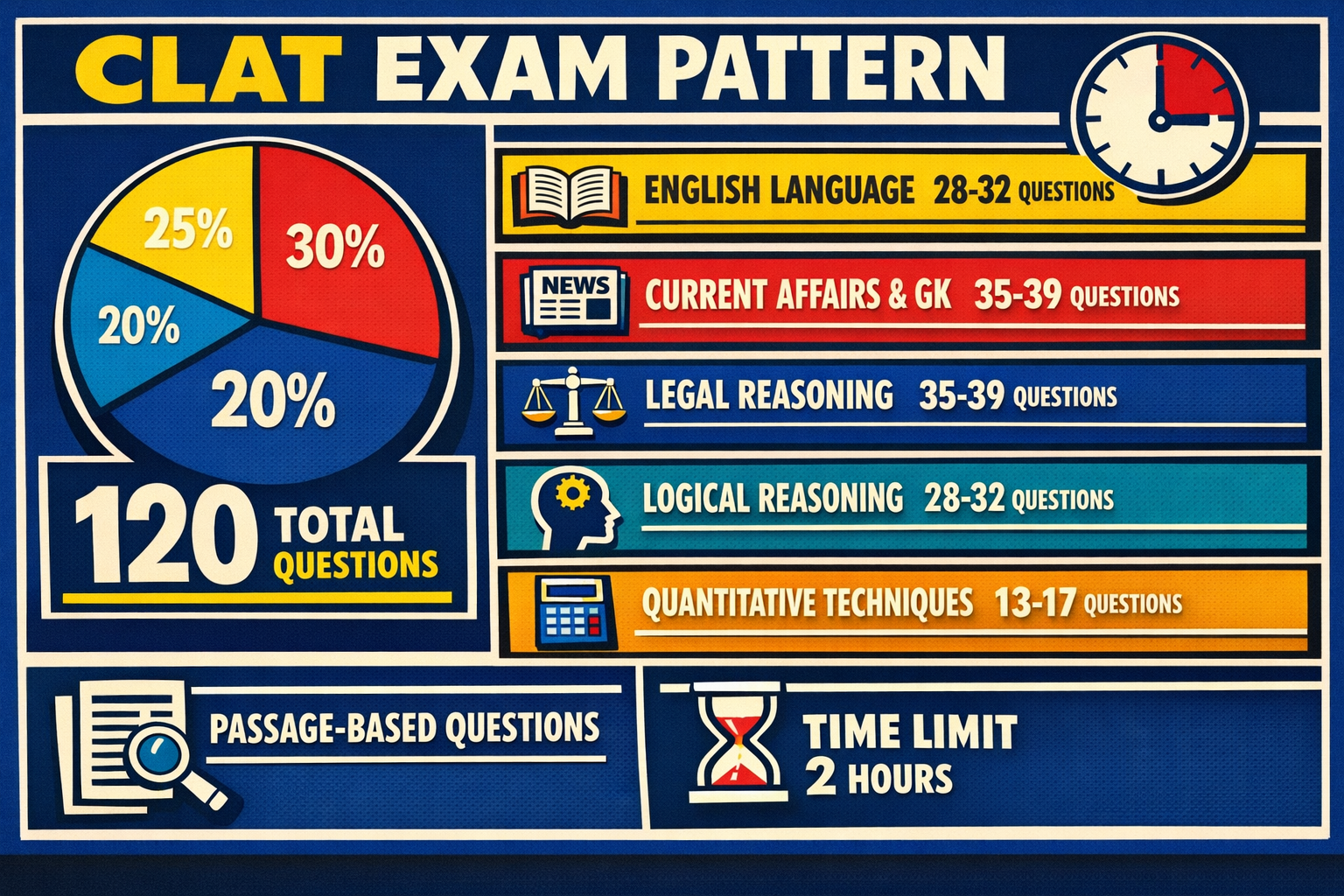
The CLAT exam consists of 120 questions to be solved in 2 hours. Every question carries one mark, and you lose 0.25 marks for each wrong answer. That negative marking isn’t there to scare you—it’s testing your judgment and decision-making skills.
Here’s the section-wise distribution:
| Section | Number of Questions | Key Skills Tested |
|---|---|---|
| English Language | 28-32 questions | Reading comprehension, vocabulary in context, grammar |
| Current Affairs including GK | 35-39 questions | News awareness, static GK, legal current affairs |
| Legal Reasoning | 35-39 questions | Application of legal principles, analytical thinking |
| Logical Reasoning | 28-32 questions | Critical thinking, pattern recognition, arguments |
| Quantitative Techniques | 13-17 questions | Basic math, data interpretation, percentages |
The entire exam is passage-based. You’ll read short passages (around 450 words each) followed by questions. This format rewards strong reading skills and the ability to extract relevant information quickly.
What Makes CLAT Different from School Exams
School exams test what you’ve memorized. CLAT tests how you think. You won’t find direct questions like “What is Article 21?” Instead, you’ll read a passage about a legal case and need to identify which constitutional provision applies.
This difference is crucial for self-study candidates. You’re not competing on who attended the most classes. You’re competing on comprehension, application, and speed. These skills can absolutely be developed independently with the right approach.
The CLAT 2027 exam syllabus has remained consistent, which means previous year papers are gold for understanding question patterns.
Can I Crack CLAT Without Coaching? The Honest Truth
The short answer: Yes, absolutely. But let’s dig deeper than that surface-level reassurance.
Success Stories That Prove Self-Study Works
Priya from Jaipur scored AIR 47 in CLAT 2025 with zero coaching. She used NCERT books, newspaper reading, and online mock tests. Her total investment? Around ₹8,000 for books and test series.
Rahul from a small town in Bihar cracked CLAT 2024 with AIR 156 using only free YouTube resources and library books. His family couldn’t afford coaching, so he created his own study group with three friends preparing for different exams.
These aren’t exceptions. They’re proof that the exam rewards preparation quality, not coaching brand names.
What Self-Study Can Realistically Achieve
Self-study gives you complete control over your pace and focus areas. Weak in legal reasoning? Spend extra days there without feeling pressured to keep up with a batch. Strong in English? Don’t waste time on basics you’ve already mastered.
You develop genuine problem-solving skills instead of memorizing coaching shortcuts. When you struggle through a logical reasoning question for 20 minutes and finally crack it, that neural pathway becomes permanent. Coaching often gives you the answer too quickly.
Self-study also builds the discipline and time management skills you’ll need in law school. National Law Universities don’t hold your hand. Learning to structure your own preparation is excellent training.
Where Self-Study Candidates Typically Struggle
Let’s be real about the challenges. Current affairs coverage is the biggest pain point. Coaching institutes provide compiled monthly magazines with exam-relevant news. Self-study students need to filter this from newspapers themselves, which takes significant time.
Doubt clearing becomes harder. When you’re stuck on why option B is correct instead of option C in a legal reasoning question, there’s no teacher to explain the nuance. You might spend hours on forums or waste time with incorrect understanding.
Mock test analysis is another gap. Taking a mock test is easy. Understanding why you scored 82 instead of 95, identifying pattern in your mistakes, and creating a correction strategy—that’s where coaching adds value.
The common mistakes students make often stem from these gaps in guidance and feedback.
Your Realistic Self-Study Plan: The Day-by-Day Blueprint
Here’s where theory meets reality. This isn’t a vague “study hard” plan. It’s a structured approach that hundreds of self-study candidates have used successfully.
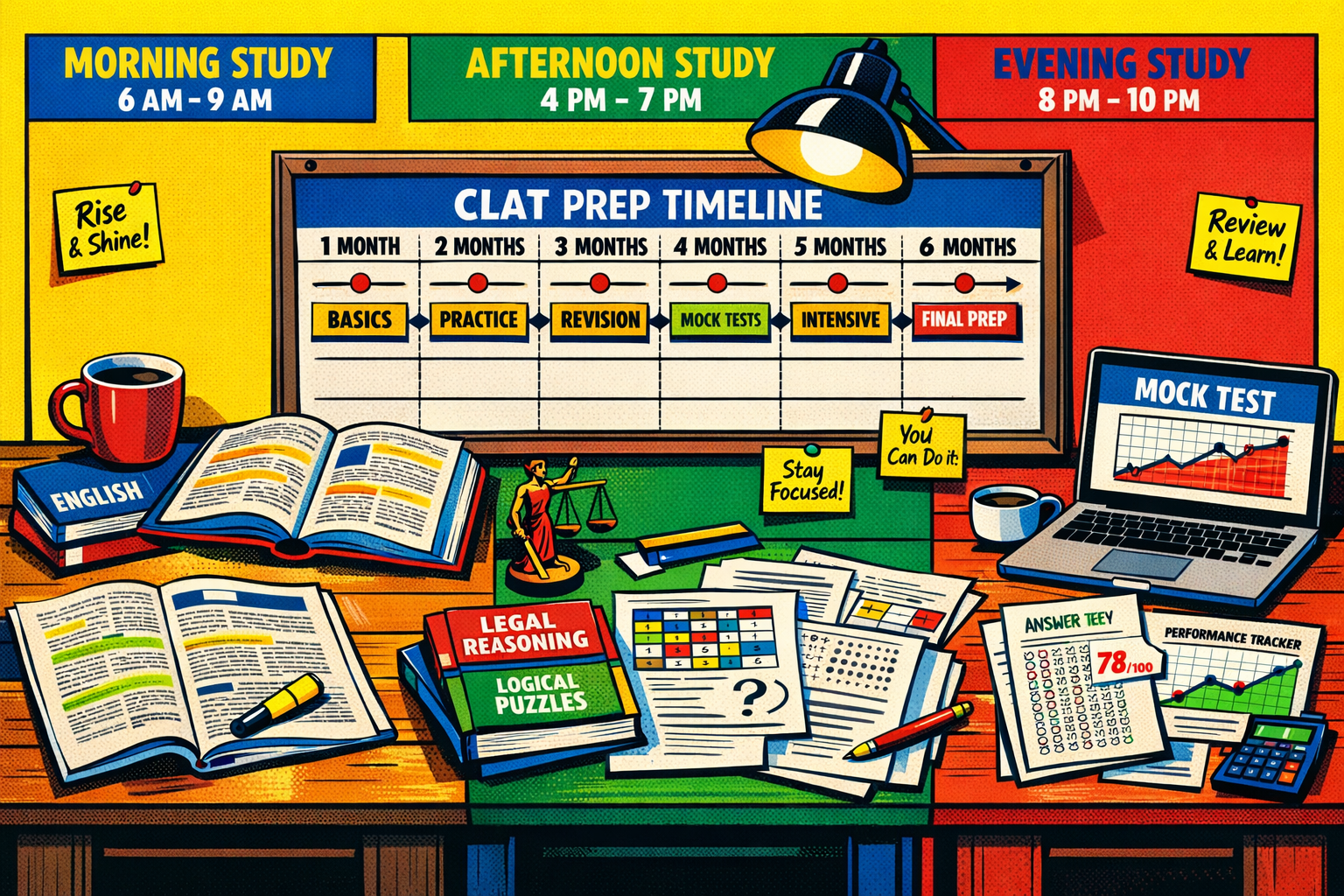
The 6-Month Preparation Timeline
Six months is the sweet spot for serious CLAT preparation. Less than that, and you’re rushing. More than that, and you risk burnout or losing momentum.
Months 1-2: Foundation Building
Focus on understanding concepts and building reading speed. This phase isn’t about mock tests or speed. It’s about creating a solid base.
- Complete NCERT books for Polity, History, and Economics (Class 9-12)
- Read one newspaper daily, focusing on comprehension over memorization
- Solve basic legal reasoning and logical reasoning questions to understand patterns
- Build vocabulary through contextual reading, not word lists
Months 3-4: Application and Practice
Now you start applying what you’ve learned through targeted practice.
- Solve previous year CLAT papers (last 5 years minimum)
- Take section-wise mock tests to identify weak areas
- Create your own notes for current affairs from newspaper reading
- Practice legal reasoning passages daily (at least 3 passages)
Months 5-6: Intensive Mock Tests and Revision
The final stretch focuses on speed, accuracy, and exam temperament.
- Take full-length mock tests twice weekly
- Analyze every mock test thoroughly (spend 2 hours analyzing each test)
- Revise your current affairs notes and static GK
- Practice time management strategies for the actual exam
Your Daily Study Schedule That Actually Works
The secret isn’t studying 12 hours daily. It’s studying smart in focused blocks with adequate breaks. Here’s a realistic schedule that won’t burn you out:
Morning Block (6:00 AM – 9:00 AM): Fresh Mind Work
Your brain is sharpest in the morning. Use this for the most demanding tasks.
- 6:00-7:00 AM: Newspaper reading (The Hindu or Indian Express)
- 7:00-8:30 AM: English comprehension practice (3-4 passages)
- 8:30-9:00 AM: Note-making from newspaper (current affairs compilation)
Afternoon Block (4:00 PM – 7:00 PM): Concept Building
After school or college, this block focuses on understanding and application.
- 4:00-5:30 PM: Legal reasoning practice (passage-based questions)
- 5:30-6:30 PM: Logical reasoning or Quantitative Techniques (alternate days)
- 6:30-7:00 PM: Vocabulary building and grammar revision
Evening Block (8:00 PM – 10:00 PM): Practice and Review
End your day with active practice and reflection.
- 8:00-9:30 PM: Mock test (section-wise or full-length based on schedule)
- 9:30-10:00 PM: Mock test analysis and mistake documentation
This gives you 7 hours of focused study daily. Add 2 hours for school/college work, and you’re at 9 hours total. Sustainable and effective.
One day weekly should be completely off. Your brain needs recovery time. Use it for activities you enjoy, not guilt-ridden “light study.”
The Weekly Structure for Balanced Preparation
Don’t study all subjects daily. Your brain needs variety but also depth. Here’s a weekly structure:
- Monday & Thursday: Legal Reasoning focus
- Tuesday & Friday: Logical Reasoning and Quantitative Techniques
- Wednesday & Saturday: Current Affairs deep dive and revision
- Sunday: Full-length mock test and complete analysis
English and newspaper reading happen daily regardless of the focus subject.
Section-Wise Preparation: Can I Crack CLAT Without Coaching in Each Section?
Each CLAT section demands different skills and strategies. Let’s break down exactly how to prepare for each one independently.
English Language: Building Comprehension Without Classes
English is the most self-study-friendly section. You don’t need a teacher to improve reading comprehension. You need consistent practice with the right material.
Your Reading Strategy:
Start with comfortable reading. If you struggle with English, begin with simple articles from magazines like Reader’s Digest or Frontline. Gradually move to newspaper editorials and legal articles.
Read actively, not passively. After each paragraph, pause and summarize the main point in your head. This builds the exact skill CLAT tests.
Practice RC passages daily from these sources:
- Previous year CLAT papers (most important)
- CAT RC passages (excellent for building speed)
- Editorial sections from The Hindu and Indian Express
- Legal blogs and Supreme Court judgment summaries
Grammar and Vocabulary:
Don’t memorize word lists. Learn vocabulary in context. When you encounter an unfamiliar word while reading, note it down with the sentence it appeared in. Review these contextual notes weekly.
Grammar rules matter less than usage. CLAT tests whether you can identify errors in sentences, not whether you can recite grammar rules. Practice error spotting questions from Wren & Martin or online resources.
The English section strategy provides more detailed techniques for students who struggle with comprehension.
Current Affairs and GK: The Self-Study Challenge
This is where self-study gets tricky. Current affairs is vast, constantly updating, and hard to filter for exam relevance.
Your Current Affairs System:
Create a monthly compilation system. Don’t just read newspapers randomly. Follow this process:
- Read newspaper daily (The Hindu recommended)
- Identify exam-relevant news (legal developments, government schemes, international relations, awards, sports)
- Write 2-3 line summaries in a dedicated notebook
- Review weekly and create monthly consolidated notes
Focus areas that repeatedly appear in CLAT:
- Supreme Court judgments and legal developments
- Government schemes and policy changes
- International relations and treaties
- Constitutional amendments and bills
- Environmental issues and climate agreements
Static GK Coverage:
Use NCERT books for foundational knowledge:
- Class 9-10: History, Civics, Geography
- Class 11-12: Political Science (Indian Polity), History, Economics
Don’t try to memorize everything. Focus on understanding concepts. CLAT questions test application, not recall.
The high-yield GK topics guide shows which areas give maximum returns for your preparation time.
Legal Reasoning: Developing Legal Thinking Independently
Legal reasoning scares many self-study candidates. Without a law background, how do you develop legal thinking?
Here’s the truth: CLAT doesn’t test legal knowledge. It tests whether you can read a legal principle and apply it to situations. That’s a skill, not knowledge.
Your Legal Reasoning Approach:
Start with understanding common legal principles. You don’t need to study law books. Focus on:
- Basic principles of contract law
- Tort law fundamentals
- Criminal law concepts
- Constitutional law basics
Resources for self-study:
- Legal reasoning sections from previous CLAT papers
- “Legal Aptitude for CLAT” by A.P. Bhardwaj
- Online legal reasoning practice sets
- Supreme Court judgment summaries (for understanding legal application)
Practice Strategy:
Solve at least 3-4 legal reasoning passages daily. After solving, don’t just check answers. Understand why the correct option is right and others are wrong. This analytical process builds legal thinking.
Create a mistake journal. When you get a legal reasoning question wrong, write down:
- The principle involved
- Why you chose the wrong option
- The correct reasoning process
- Similar principles to watch for
Logical Reasoning: Pattern Recognition Through Practice
Logical reasoning improves dramatically with practice. You don’t need coaching to get better at puzzles and critical thinking.
Types of Questions to Master:
- Analytical reasoning (seating arrangements, blood relations, directions)
- Critical reasoning (assumptions, inferences, strengthening/weakening arguments)
- Logical sequences and patterns
- Statement and conclusion problems
Self-Study Resources:
- “A Modern Approach to Logical Reasoning” by R.S. Aggarwal
- Previous year CLAT logical reasoning sections
- CAT logical reasoning questions (more difficult, excellent practice)
- Free online logical reasoning tests
Daily Practice Routine:
Spend 30-45 minutes daily on logical reasoning. Start with easier questions to build confidence, then gradually increase difficulty.
Time yourself. Logical reasoning questions should take 60-90 seconds each in the actual exam. Practice at that speed once you’ve mastered accuracy.
Quantitative Techniques: The Easiest Section to Self-Study
Good news: Quants in CLAT is basic. If you’re comfortable with Class 10 math, you can handle this section with minimal preparation.
Topics to Cover:
- Percentages and profit/loss
- Ratios and proportions
- Averages and mixtures
- Simple and compound interest
- Data interpretation (tables, graphs, charts)
- Basic algebra and geometry
Preparation Strategy:
Use Class 10 NCERT math book for concept clarity. Then practice CLAT-specific questions from previous years.
Don’t overcomplicate this section. CLAT quants tests application of basic concepts, not complex problem-solving. Speed and accuracy matter more than advanced techniques.
Allocate less preparation time to quants compared to other sections. It’s only 13-17 questions, and most are straightforward if your basics are clear.
The quantitative techniques approach guide provides shortcuts and tricks for faster solving.
Essential Resources for Self-Study Success
The right resources make or break self-study preparation. Here’s exactly what you need without wasting money on unnecessary materials.
Books That Actually Help (Not Just Look Good on Shelves)
For English:
- Wren & Martin for grammar (if basics are weak)
- Previous year CLAT papers (best RC practice)
- Word Power Made Easy by Norman Lewis (vocabulary building)
For Current Affairs and GK:
- Daily newspaper (The Hindu or Indian Express)
- Manorama Yearbook (for static GK compilation)
- Monthly current affairs magazines (Pratiyogita Darpan or similar)
For Legal Reasoning:
- Legal Aptitude for CLAT by A.P. Bhardwaj
- Universal’s Guide to CLAT
- Previous year CLAT papers (most important)
For Logical Reasoning:
- A Modern Approach to Logical Reasoning by R.S. Aggarwal
- Analytical Reasoning by M.K. Pandey
For Quantitative Techniques:
- Class 10 NCERT Mathematics
- Quantitative Aptitude by R.S. Aggarwal (basic chapters only)
Total investment: ₹3,000-4,000 for all books. That’s less than one month’s coaching fee.
The best books for CLAT preparation guide provides detailed reviews and chapter-wise recommendations.
Free Online Resources That Match Coaching Quality
You don’t need expensive subscriptions to access quality content. Here are free resources that genuinely help:
YouTube Channels:
- Law Prep Tutorial (legal reasoning and current affairs)
- Unacademy CLAT free videos
- ClearIAS (for polity and governance)
- Study IQ Education (current affairs coverage)
Websites and Apps:
- CLATGyan (free mock tests and study material)
- LegalEdge blog (legal current affairs)
- PRS India (for understanding bills and policy)
- MyNation (current affairs compilation)
Telegram Channels:
Several Telegram channels provide free CLAT mocks and daily current affairs updates. Join 2-3 active channels for regular practice material.
Affordable Mock Test Series (₹2,000-5,000 Range)
Mock tests are non-negotiable. You can’t prepare for CLAT without simulating exam conditions regularly.
Affordable options:
- CLATapult test series (around ₹3,000)
- Career Launcher online mocks (₹4,000-5,000)
- IMS CLAT mock series (₹3,500)
- LegalEdge test series (₹2,500)
Don’t buy multiple test series. Choose one good series and exhaust it completely. Quality of analysis matters more than quantity of tests.
Take at least 30-40 full-length mocks before the actual exam. Start with one mock every two weeks initially, then increase to twice weekly in the final two months.
Where Affordable Online Coaching Fills Critical Gaps
Self-study works. But let’s acknowledge where it falls short and how affordable online coaching bridges those gaps without the premium price tag.
The Three Problems Pure Self-Study Can’t Solve
Problem 1: Doubt Clearing and Conceptual Clarity
You’re solving a legal reasoning question. You’ve narrowed it down to two options. Both seem correct. You check the answer key—you’re wrong. But why?
Without expert explanation, you might spend an hour on forums getting conflicting answers. Or worse, you move on with incorrect understanding that shows up again in future questions.
Problem 2: Current Affairs Filtering and Compilation
Reading newspapers daily is essential. But which news is CLAT-relevant? Should you note down that Supreme Court judgment on environmental clearance? What about that new government scheme?
Self-study students often either note down everything (wasting time) or miss important developments (losing marks).
Problem 3: Personalized Performance Analysis
You scored 78 in a mock test. Good or bad? Which sections pulled you down? Are your mistakes due to conceptual gaps, silly errors, or time management issues? What should you focus on in the next two weeks?
Mock test platforms give you a scorecard. They don’t give you a personalized improvement strategy.
How Affordable Online Coaching Solves These (Without ₹1.5 Lakhs)
Here’s where platforms like Lawgic Coaching change the game. They provide coaching benefits without the premium price tag.
Structured Doubt Clearing:
Instead of hunting for answers on forums, you get direct access to faculty from top NLUs. Ask your question, get a detailed video or written explanation within 24 hours. That legal reasoning confusion? Cleared in 10 minutes instead of wasting an hour.
Curated Current Affairs:
Affordable online coaching provides monthly current affairs compilations filtered specifically for CLAT. You still read newspapers daily, but you have expert guidance on what’s exam-relevant. This saves 30-40 minutes daily while improving coverage quality.
Personalized Mentorship:
After each mock test, you get detailed performance analysis showing:
- Your strong and weak sections
- Question-type-wise accuracy patterns
- Time management issues
- Specific topics needing revision
- Customized study plan for the next week
This personalized attention isn’t available in large offline batches where one teacher handles 100+ students.
The Hybrid Approach: Best of Both Worlds
The smartest CLAT aspirants don’t choose between self-study and coaching. They combine both strategically.
Use self-study for:
- Daily newspaper reading and note-making
- Solving practice questions and previous year papers
- Building concepts through books and free resources
- Developing your own understanding and thinking process
Use affordable online coaching for:
- Doubt clearing when you’re genuinely stuck
- Current affairs compilation and legal current affairs coverage
- Mock test analysis and personalized feedback
- Strategic guidance on time management and exam approach
- Access to quality study material and question banks
This hybrid approach costs ₹15,000-25,000 total (books + online coaching + mock tests) instead of ₹1.5 lakhs for premium offline coaching. You get the benefits without the financial stress.
The comparison of coaching methods shows how different approaches stack up in terms of cost, flexibility, and results.
Common Mistakes Self-Study Candidates Make (And How to Avoid Them)
Learning from others’ mistakes is cheaper than making them yourself. Here are the pitfalls that derail self-study candidates.
Mistake 1: Starting Without a Clear Plan
Enthusiasm without structure leads nowhere. Many students start with “I’ll study 10 hours daily” and burn out within two weeks.
Solution: Create a realistic, detailed study plan before you begin. Include specific goals for each week, not vague intentions. Write down exactly which topics you’ll cover, how many practice questions you’ll solve, and when you’ll take mock tests.
Mistake 2: Collecting Resources Instead of Using Them
You buy 15 books. Join 20 Telegram channels. Download 50 PDFs. Then you spend more time organizing resources than actually studying.
Solution: Follow the minimalist approach. Choose 2-3 core books per section and exhaust them completely. One newspaper, one current affairs compilation source, one mock test series. Master these before adding anything new.
Mistake 3: Ignoring Mock Tests Until the Last Month
Mock tests aren’t just for assessment. They’re learning tools. Students who postpone mocks until they “feel ready” never develop exam temperament.
Solution: Take your first mock test within the first month of preparation. Yes, you’ll score poorly. That’s fine. You’re learning what the exam feels like, identifying weak areas early, and building speed gradually.
The mock test strategy guide explains how to use mocks as learning tools, not just assessment tools.
Mistake 4: Passive Reading Instead of Active Learning
Reading newspapers for an hour daily feels productive. But if you can’t recall three important news items from yesterday’s paper, you’re reading passively.
Solution: Active learning techniques:
- Summarize each article in one sentence
- Explain news to a friend or family member
- Create weekly quizzes for yourself
- Connect current news to static GK concepts
Mistake 5: Not Analyzing Mistakes Properly
You solve 100 questions, check answers, feel bad about mistakes, and move on. Next week, you make the same mistakes.
Solution: Maintain a detailed mistake journal. For every wrong answer:
- Write the question and correct answer
- Explain why you chose the wrong option
- Note the concept or principle involved
- Mark it for revision after one week
This systematic analysis converts mistakes into learning opportunities.
Mistake 6: Neglecting Mental Health and Breaks
CLAT preparation is a marathon, not a sprint. Students who study 12 hours daily for two months straight inevitably burn out and lose momentum when it matters most.
Solution: Schedule breaks as seriously as you schedule study time. One full day off weekly. Regular exercise (even 30 minutes daily helps). Adequate sleep (7-8 hours non-negotiable). Social time with friends and family.
The stress management guide provides practical techniques for maintaining mental health during intensive preparation.
Technology and Digital Tools for Smart Preparation
Use technology strategically to enhance your self-study without getting distracted by it.
Apps That Actually Help (Not Just Waste Time)
Anki (Free): Spaced repetition flashcard app perfect for vocabulary building and static GK revision. Create digital flashcards and the app optimally schedules reviews based on your memory patterns.
Forest (Freemium): Helps maintain focus during study sessions. Plant a virtual tree that grows while you study. If you leave the app to check social media, the tree dies. Surprisingly effective for building concentration.
Google Keep or Notion (Free): Digital note-taking for current affairs compilation. Tag notes by subject, search easily, and access from any device.
Habitica (Free): Gamifies your study routine. Turn your preparation plan into quests and earn rewards for completing tasks. Makes the long preparation journey more engaging.
Using YouTube Without Falling into the Rabbit Hole
YouTube is both blessing and curse for self-study. Excellent free content exists, but so do infinite distractions.
Rules for Productive YouTube Usage:
- Download videos for offline viewing (prevents getting distracted by recommendations)
- Create a dedicated CLAT playlist and only watch from it
- Set specific time blocks for video learning (30 minutes maximum per session)
- Take notes while watching (active learning, not passive consumption)
- Increase playback speed to 1.5x for time efficiency
Online Study Groups and Accountability Partners
Self-study doesn’t mean isolated study. Create or join online study groups for motivation and accountability.
How to Make Study Groups Effective:
- Keep groups small (4-6 members maximum)
- Set clear goals for each meeting
- Share weekly progress and challenges
- Quiz each other on current affairs
- Discuss difficult questions together
Use WhatsApp, Discord, or Telegram for group communication. Schedule weekly video calls for deeper discussions and motivation.
The Final Month: Intensive Preparation Without Coaching
The last 30 days before CLAT are crucial. Here’s how self-study candidates should approach this phase.
Revision Strategy That Actually Works
You can’t revise everything. You need strategic revision focused on high-yield topics and your weak areas.
Week 1-2 (Days 1-14):
- Complete revision of all current affairs notes (monthly compilations)
- Solve previous year papers again (all years you’ve practiced)
- Focus on your two weakest sections with targeted practice
- Take 3-4 full-length mocks
Week 3 (Days 15-21):
- Static GK rapid revision (focus on frequently tested areas)
- Legal reasoning principle revision
- Daily mock tests with thorough analysis
- Create one-page summary sheets for each section
Week 4 (Days 22-30):
- Light revision only (no new topics)
- Focus on maintaining confidence and reducing anxiety
- One mock test every alternate day
- Review your mistake journal thoroughly
- Practice time management strategies
Mock Test Strategy for the Last Month
Take 12-15 full-length mocks in the final month. That’s roughly one every 2-3 days.
Optimal Mock Test Routine:
- Take the test in actual exam conditions (same time, no interruptions)
- Spend 2-3 hours analyzing it immediately after
- Identify patterns in your mistakes (are you rushing through certain question types?)
- Create a correction strategy for the next mock
- Don’t get demoralized by scores—focus on learning
Your mock test scores will fluctuate. That’s normal. You’re experimenting with strategies and pushing your limits. The goal isn’t perfect scores in mocks; it’s identifying and fixing weaknesses before the actual exam.
Managing Exam Day Anxiety
Even the most prepared students feel nervous on exam day. That’s natural. But uncontrolled anxiety costs marks.
Anxiety Management Techniques:
One week before exam:
- Reduce study hours (6-7 hours maximum)
- Increase physical activity and sleep
- Practice relaxation techniques (deep breathing, meditation)
- Visualize yourself calmly solving the paper
Day before exam:
- Light revision only (your one-page summaries)
- No new topics or practice questions
- Early dinner and adequate sleep
- Prepare everything you need (admit card, ID, stationery)
Exam day morning:
- Light breakfast (avoid heavy or new foods)
- Reach the center 45 minutes early (not too early to get anxious, not late to rush)
- Brief breathing exercises before entering the exam hall
- Trust your preparation and stay calm
Success Stories: Real Self-Study Candidates Who Made It
Let’s look at detailed success stories that provide actionable insights, not just inspiration.
Case Study 1: Priya’s Journey from Tier-3 City to NLSIU
Priya from Jaipur had zero access to quality coaching. Her city had one CLAT coaching center charging ₹1.2 lakhs, which her family couldn’t afford.
Her Approach:
- Started preparation 8 months before CLAT
- Used only NCERT books, newspaper, and one affordable online test series
- Created a study group with three friends (two preparing for UPSC, one for CAT)
- Joined an affordable online coaching for doubt clearing in the last 3 months
Key Strategies That Worked:
- Maintained detailed current affairs notes from day one
- Solved every previous year CLAT paper at least three times
- Took 45 full-length mocks (free + paid series)
- Analyzed every mock for 3 hours after taking it
Result: AIR 47, admitted to NLSIU Bangalore
Her Advice: “Self-study works if you’re honest with yourself about weak areas. Don’t let ego prevent you from seeking help when genuinely stuck. The ₹15,000 I spent on affordable online coaching in the last three months was worth more than ₹1.5 lakhs on year-long classroom coaching would have been.”
Case Study 2: Rahul’s Strategy with Zero Budget
Rahul from rural Bihar had the most constrained resources. His family couldn’t spare even ₹5,000 for preparation.
His Approach:
- Used only free resources (YouTube, free PDFs, library books)
- Created detailed notes from free video lectures
- Joined multiple free Telegram channels for daily current affairs
- Took only free mock tests available online
Key Strategies That Worked:
- Extreme discipline with daily schedule (never missed a single day)
- Created a peer teaching group where he explained concepts to others (teaching reinforces learning)
- Borrowed previous year papers from seniors and solved them multiple times
- Used smartphone for accessing free online resources (no laptop needed)
Result: AIR 156, admitted to NLIU Bhopal
His Advice: “Budget constraints forced me to be creative and disciplined. I couldn’t afford to waste time because I had no paid resources to fall back on. That limitation became my strength. Consistency matters more than resources.”
Case Study 3: Ananya’s Hybrid Approach
Ananya from Mumbai had access to expensive coaching but chose the hybrid path after attending a few demo classes and finding them inefficient.
Her Approach:
- Self-study for core preparation (books, newspapers, practice questions)
- Subscribed to one affordable online coaching for ₹18,000 (Lawgic Coaching)
- Used online coaching specifically for doubt clearing, current affairs compilation, and mock test analysis
- Maintained independent study schedule and discipline
Key Strategies That Worked:
- Leveraged online coaching’s personalized mentorship for strategic guidance
- Used self-study time for deep practice and concept building
- Combined free resources with paid resources strategically
- Focused on quality over quantity in both study hours and resources
Result: AIR 23, admitted to NALSAR Hyderabad
Her Advice: “The hybrid approach gave me the best of both worlds. I had the flexibility and pace control of self-study with the expert guidance and doubt clearing of coaching. The affordable online option meant I didn’t have to choose between them due to budget.”
Your Next Steps: Taking Action Today
Reading this guide is step one. Taking action is step two. Here’s exactly what to do next.
Week 1 Action Plan
Day 1-2: Assessment and Planning
- Take one previous year CLAT paper as a diagnostic test
- Identify your current strengths and weaknesses
- Create a realistic 6-month study plan based on your assessment
- Gather essential resources (buy core books, identify free online resources)
Day 3-4: Setting Up Systems
- Create your study space (organized, distraction-free)
- Set up digital tools (note-taking app, flashcard app)
- Join relevant online communities and study groups
- Subscribe to a newspaper (physical or digital)
Day 5-7: Starting the Routine
- Begin your daily study schedule
- Start newspaper reading habit
- Solve your first set of practice questions
- Take notes and create your mistake journal
Deciding If You Need Affordable Online Coaching
Ask yourself these questions honestly:
- Do I struggle with self-discipline and need external accountability?
- Do I have difficulty understanding concepts from books alone?
- Am I weak in current affairs compilation and need expert filtering?
- Do I need personalized feedback on my mock test performance?
- Would access to expert doubt clearing significantly speed up my preparation?
If you answered yes to 3 or more questions, affordable online coaching will significantly improve your preparation quality.
Lawgic Coaching offers exactly this hybrid approach—expert guidance without the premium price tag. Experienced faculty from top NLUs, flexible learning that fits your schedule, personalized mentorship, and proven strategies that actually work.
Take a Free Demo Class
Still unsure if online coaching is right for you? Experience it firsthand.
Book your free demo class here and see how expert guidance can fill the gaps in your self-study approach without breaking your budget.
The demo class includes:
- Sample lecture on a high-yield CLAT topic
- Doubt clearing session
- Personalized assessment of your preparation level
- Customized study plan recommendation
- Access to sample study materials
No commitment required. Just an opportunity to make an informed decision about your preparation strategy.
Conclusion: Your Law School Dream is Achievable
Can you crack CLAT without expensive coaching? Absolutely. Hundreds of students prove this every year.
The real question is whether you’re willing to be strategic, disciplined, and honest with yourself about where you need support.
Self-study with the right structure, resources, and mindset can absolutely get you into a top NLU. The 6-month plan outlined in this guide has worked for countless successful candidates. The section-wise strategies address every part of the exam. The resources recommended won’t break your budget.
But self-study isn’t about isolation. It’s about taking control of your preparation while being smart enough to seek help where it genuinely adds value. Affordable online coaching bridges the critical gaps—doubt clearing, current affairs compilation, personalized mentorship—without the ₹1.5 lakh price tag.
Your success is our mission. Whether you choose pure self-study, affordable online coaching, or a hybrid approach, what matters is starting today with a clear plan and consistent execution.
The path to your law school dream doesn’t require expensive coaching. It requires the right strategy, quality resources, and genuine commitment. You have all three now.
Let’s build your law career together. Your CLAT success story starts today.
Ready to take the next step? Explore our affordable CLAT coaching programs designed specifically for serious aspirants who want expert guidance without the premium price tag. Or book your free demo class to experience our teaching approach firsthand.
References
[1] Consortium of National Law Universities. (2026). CLAT 2027 Information Brochure. Retrieved from official CLAT website. [2] National Law School of India University. (2025). Admission Statistics and Candidate Performance Analysis. [3] Career Launcher. (2025). CLAT Success Rate Study: Coaching vs Self-Study Candidates. [4] Legal Edge. (2026). Survey of 500 CLAT Toppers: Preparation Methods and Resource Utilization. [5] Lawgic Coaching. (2026). Student Success Data and Preparation Methodology Research.CLAT Self-Study Readiness Calculator
Answer honestly to discover if self-study alone is right for you