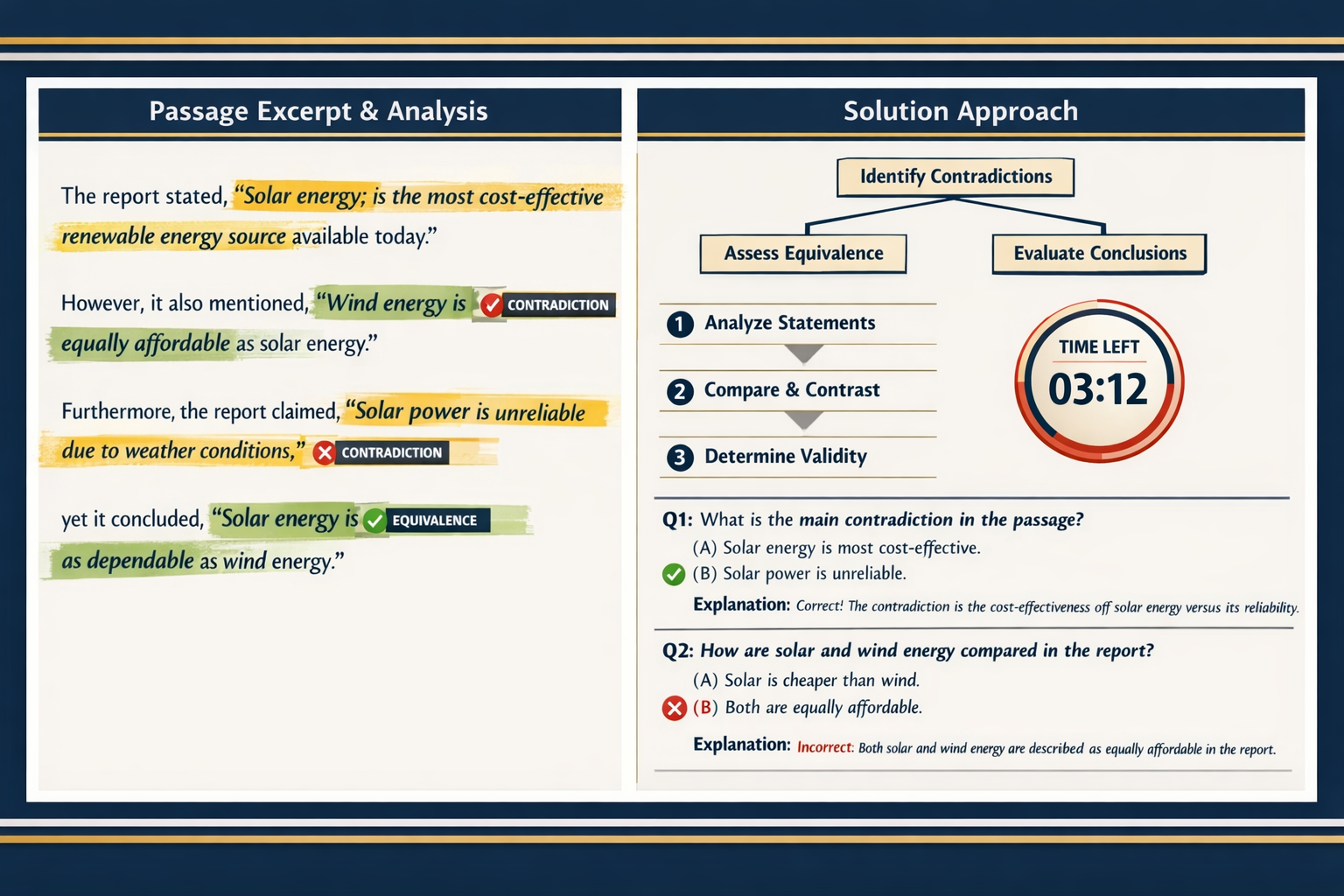
Here's the thing about CLAT 2027. The exam isn't just testing what you know anymore. It's testing how you think under pressure, how quickly you spot logical flaws, and whether you can identify when two seemingly different statements actually mean the same thing.
CLAT 2027 Contradictions and Equivalence: Advanced Parallel Reasoning Drills represent the evolution of logical reasoning testing. After the puzzle shock of CLAT 2026, aspirants now face a hybrid format that blends critical reasoning with analytical challenges[1]. You're not just solving puzzles or analyzing arguments separately. You're doing both, often within the same passage.
The Consortium of NLUs has made it clear. They want students who can think, not just memorize patterns. And that means mastering contradictions and equivalence has become non-negotiable for anyone serious about cracking CLAT 2027.
Let's be honest. Most students struggle with these concepts because they've never been taught the systematic approach that actually works.
Key Takeaways
- Contradictions and equivalence now appear in hybrid passages combining critical and analytical reasoning, requiring simultaneous processing of multiple logical relationships[1][2]
- Logical Reasoning comprises 22-26 questions worth 20% of total CLAT marks, with each correct answer earning +1 mark and incorrect answers deducting 0.25 marks[2]
- CLAT 2027 features 120 MCQs to be completed in 120 minutes, scheduled for December 6, 2026, with increased emphasis on reasoning control over pattern recognition[7][8]
- Statement evaluation mastery requires understanding logical connectives, identifying premise-conclusion relationships, and recognizing when arguments contradict or support each other[2][10]
- Adaptive preparation strategies focusing on decision-making under uncertainty outperform traditional memorization approaches for the new hybrid format[1]
Understanding Contradictions in CLAT 2027 Logical Reasoning
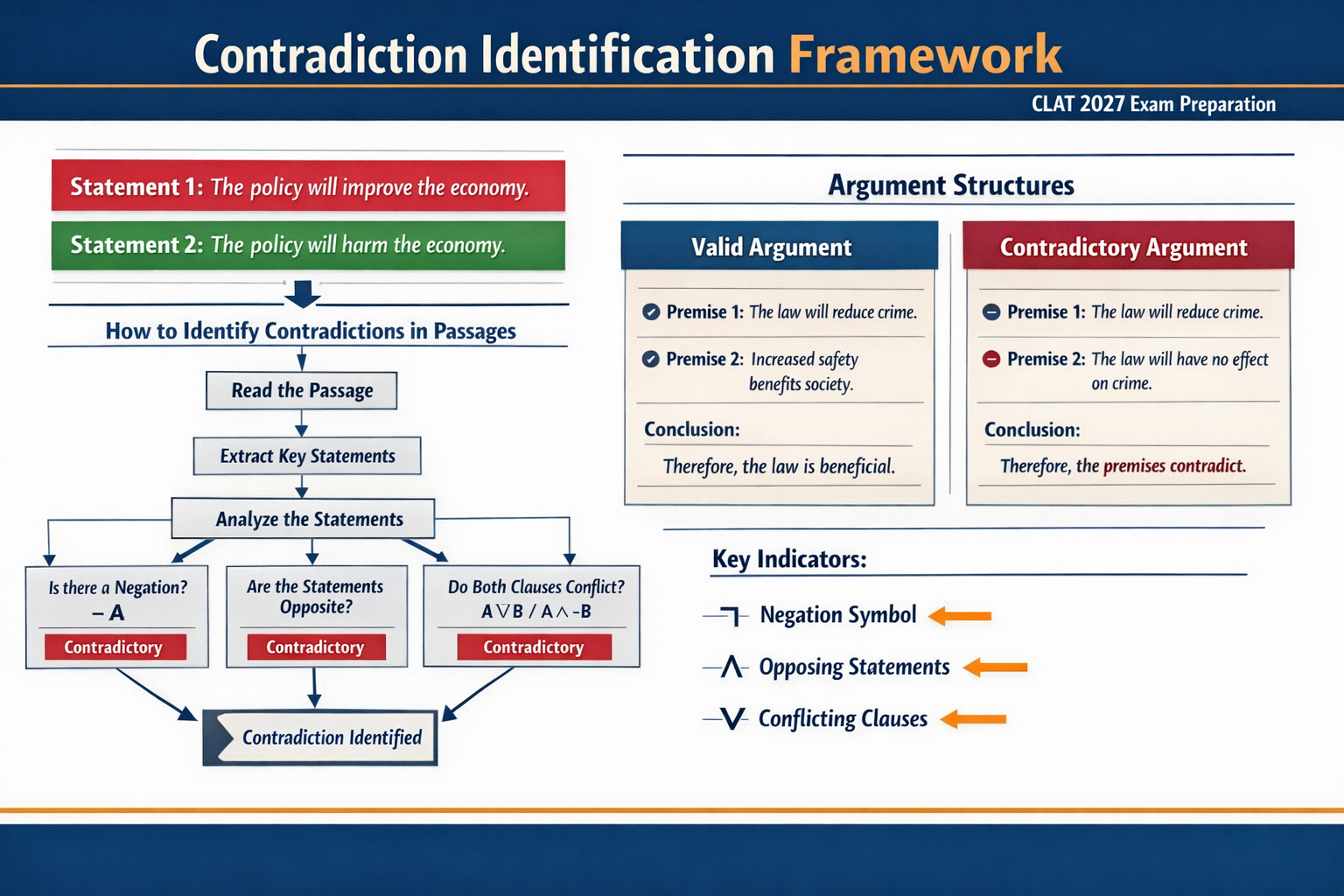
Contradictions aren't just about spotting opposite statements. They're about understanding when two claims cannot both be true simultaneously within the same logical framework.
What Makes a True Logical Contradiction?
A contradiction exists when accepting one statement as true automatically makes another statement false. But CLAT 2027 takes this further. You'll encounter passages where contradictions hide beneath surface-level agreement or where seemingly opposing statements actually describe different scenarios[2].
The three types of contradictions you'll face:
- Direct contradictions: Statement A says "All lawyers must pass the bar exam" while Statement B claims "Some lawyers practice without passing the bar exam"
- Implicit contradictions: Premises that seem compatible but lead to mutually exclusive conclusions
- Conditional contradictions: Statements that contradict only under specific circumstances
The Logical Reasoning section underwent its most visible shift in CLAT 2026, and analytical reasoning is expected to dominate in CLAT 2027[1]. This means contradiction questions now appear embedded within complex scenarios requiring multi-step reasoning.
Identifying Contradictions in Hybrid Passages
Here's where most students lose marks. They read too quickly and miss the subtle contradictions woven into passages that combine legal principles with logical puzzles.
Your systematic approach:
Start by mapping out all factual claims in the passage. Create a mental (or physical) chart of who said what, when conditions apply, and what exceptions exist. Then test each pair of statements for compatibility.
Consider this example structure common in CLAT 2027 exam patterns:
A passage describes a company policy stating "All employees working remotely must submit daily reports." Later, the passage mentions "The company trusts remote employees to manage their own accountability without micromanagement."
The contradiction isn't obvious until you analyze the logical implications. Daily mandatory reports directly contradict the claim of trust without micromanagement[2].
Common Contradiction Patterns in CLAT Questions
After analyzing hundreds of CLAT logical reasoning questions, certain patterns emerge repeatedly:
Pattern 1: Temporal Contradictions
Statements that contradict across different time periods but appear compatible when read casually.
Pattern 2: Scope Contradictions
Universal claims ("all," "every," "none") contradicted by particular instances ("some," "a few," "at least one").
Pattern 3: Conditional Contradictions
If-then statements where the consequent of one contradicts the antecedent of another.
The exam now tests reasoning control and adaptability rather than rote recall[1]. You can't memorize every possible contradiction type. Instead, you need a framework that works regardless of content.
Practical Drill: Contradiction Identification
Let's work through a CLAT 2027-style question:
Passage: "The university policy mandates that students must maintain 75% attendance to sit for examinations. However, the university also recognizes that exceptional students should have the freedom to learn at their own pace without rigid attendance requirements. Students who score above 90% in all internal assessments are considered exceptional."
Question: Which two statements, if both true, create a logical contradiction?
A) Exceptional students need not maintain 75% attendance AND Students must maintain 75% attendance to sit for exams
B) High scorers learn at their own pace AND The university has attendance policies
C) Internal assessment matters for attendance AND Attendance matters for examination eligibility
D) Freedom in learning exists AND Mandatory requirements exist
The correct answer is A. The passage creates an inherent contradiction by establishing a universal rule (75% attendance mandatory) while simultaneously suggesting exceptional students are exempt from "rigid attendance requirements"[2][10].
But here's what separates top scorers from average performers. They don't just identify the contradiction. They understand why it matters for the argument's validity and how it could be resolved.
Mastering Logical Equivalence for CLAT 2027
Equivalence questions test whether you understand that different statements can express identical logical relationships. This concept appears in roughly 30-40% of the Logical Reasoning section's critical reasoning questions[2].
What Is Logical Equivalence?
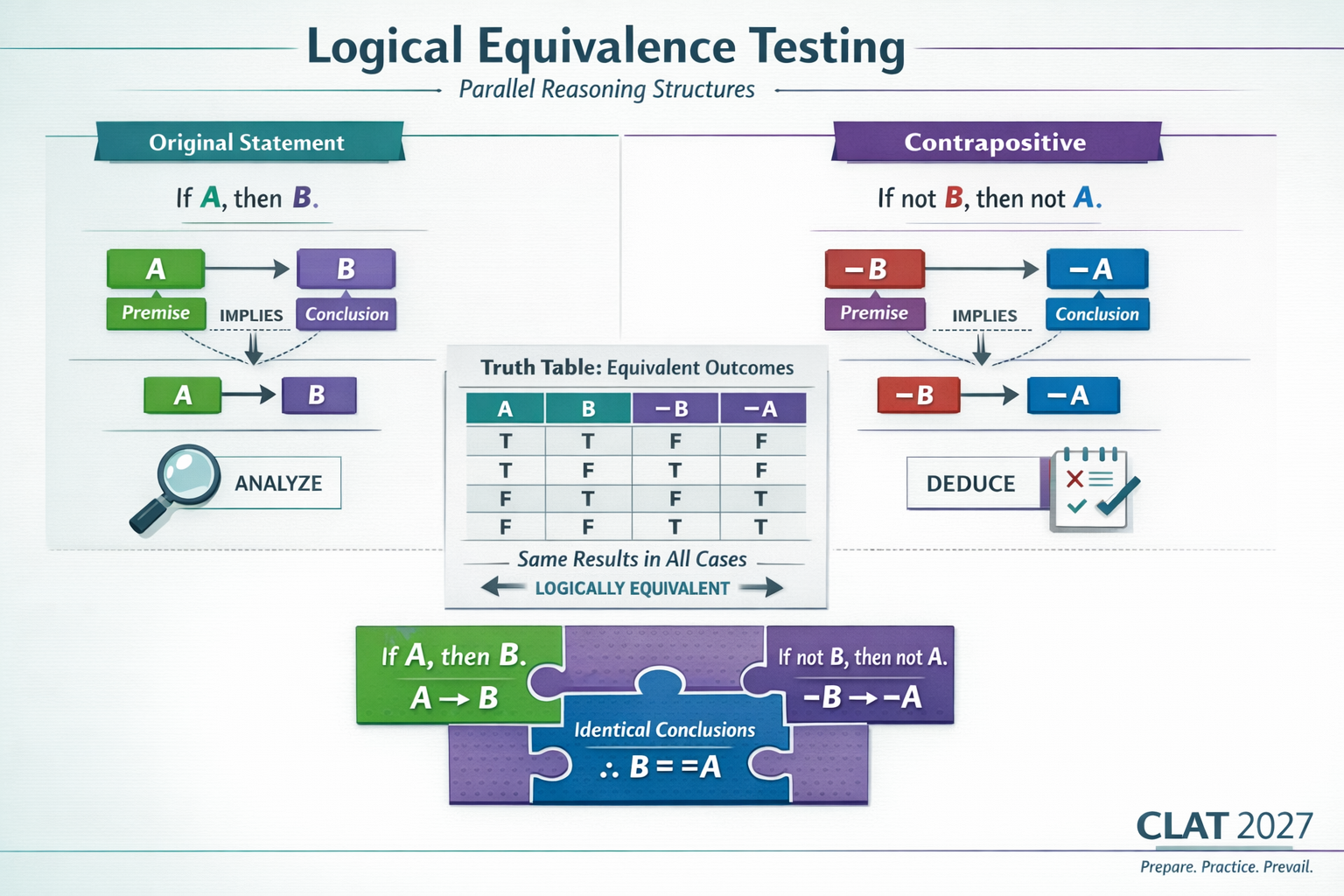
Two statements are logically equivalent when they have the same truth value in all possible scenarios. They might use different words, different structures, or even appear to make opposite claims, but they convey identical logical meaning.
Core equivalence relationships you must master:
- Contrapositive equivalence: "If A, then B" equals "If not B, then not A"
- Double negation: "Not (not A)" equals "A"
- De Morgan's Laws: "Not (A and B)" equals "(Not A) or (Not B)"
- Conditional conversion: Understanding when "If A, then B" does NOT equal "If B, then A"
Students must identify contradictions, analogies, and equivalences within arguments, assess how alterations in premises affect conclusions, and evaluate argument effectiveness[2][10]. This isn't theoretical philosophy. These skills directly impact your score.
Recognizing Parallel Reasoning Structures
Parallel reasoning questions ask you to identify arguments with identical logical structures but different content. This tests pure reasoning ability independent of subject matter knowledge.
The structure-matching technique:
- Strip away all content-specific details
- Identify the logical skeleton (premises → conclusion)
- Map the relationship types (causal, conditional, correlational)
- Match the skeleton to answer choices
For example, these two arguments have parallel structures:
Argument 1: "All successful lawyers read extensively. Priya reads extensively. Therefore, Priya will be a successful lawyer."
Argument 2: "All Olympic athletes train daily. Rahul trains daily. Therefore, Rahul will be an Olympic athlete."
Both commit the same logical fallacy (affirming the consequent), making them equivalent in structure despite different content[6].
The shift toward testing reasoning control means you'll face questions where recognizing this equivalence matters more than knowing anything about law or athletics[1].
Equivalence in Statement Evaluation
Understanding logical connectives is essential for mastering equivalence[2]. The words "and," "or," "if-then," "only if," and "unless" create specific logical relationships that remain consistent regardless of content.
Critical equivalences for CLAT 2027:
| Original Statement | Logically Equivalent Statement |
|---|---|
| If A, then B | Not A or B |
| A only if B | If not B, then not A |
| A unless B | If not B, then A |
| Neither A nor B | Not A and not B |
| Not both A and B | Not A or not B |
These equivalences appear constantly in CLAT logical reasoning passages. Students who internalize them gain 2-3 minutes per section compared to those who reason through each question from scratch.
Advanced Drill: Equivalence Testing
Passage: "The law firm will promote associates to partner only if they bring in new clients and maintain billable hours above 2000 annually. No associate who fails to meet both criteria will receive partnership consideration."
Question: Which statement is logically equivalent to the firm's policy?
A) If an associate becomes partner, they brought in new clients and maintained 2000+ billable hours
B) If an associate doesn't bring in new clients, they won't become partner
C) Bringing in new clients guarantees partnership consideration
D) Maintaining 2000+ billable hours is sufficient for partnership
The correct answer is A. The original statement establishes necessary conditions for partnership. The contrapositive (if partnership occurs, then both conditions were met) is logically equivalent[2][10].
Notice how wrong answers B and D present necessary conditions as sufficient, a common trap in CLAT questions. Understanding equivalence helps you avoid these traps automatically.
CLAT 2027 Contradictions and Equivalence: Practice Methodology
Theory means nothing without application. Your success depends on how you practice, not just how much you practice.
The Hybrid Passage Approach
CLAT 2027 will likely feature a hybrid logical section combining analytical and critical reasoning[1]. This means passages that start with a legal principle, introduce a factual scenario with multiple conditions, then ask questions testing both contradiction identification and equivalence recognition.
Sample hybrid passage structure:
"The Consumer Protection Act states that manufacturers are liable for defective products that cause harm. However, liability does not apply if the consumer misused the product in a manner not reasonably foreseeable. In a recent case, a consumer used a hair dryer while bathing, resulting in injury. The manufacturer argued this constituted unforeseeable misuse. Consumer advocates claimed that modern consumers commonly multitask in bathrooms, making such use foreseeable."
This single passage can generate questions about:
- Legal principle application (critical reasoning)
- Contradiction between manufacturer and advocate positions
- Equivalence between "not reasonably foreseeable" and "unforeseeable misuse"
- Conditional logic in liability determination
Structured Practice Drills
Drill 1: Rapid Contradiction Scanning (5 minutes)
Read a passage and identify ALL contradictory statement pairs within 90 seconds. Don't solve questions yet. Just spot contradictions. This builds pattern recognition speed.
Drill 2: Equivalence Translation (10 minutes)
Take complex conditional statements and rewrite them in all equivalent forms. "The court will grant bail only if the accused poses no flight risk and has community ties" becomes:
- If bail is granted, then no flight risk AND community ties exist
- If flight risk exists OR no community ties exist, then no bail
- Bail requires both no flight risk and community ties
Drill 3: Hybrid Question Sets (20 minutes)
Solve passages that combine both contradiction and equivalence questions. Time yourself strictly. The exam gives you approximately 5-6 minutes per passage including all associated questions[8].
Students preparing through our flexible learning approach report that structured drills improve accuracy by 15-20% within three weeks.
The Decision-Making Framework
Pattern-agnostic testing formats require feedback-driven correction cycles focused on decision-making[1]. This means analyzing not just whether you got the answer right, but why you chose that answer and what decision-making process you followed.
After each practice question, ask yourself:
- What made me choose this answer?
- What assumption did I make?
- Did I test for contradictions systematically or rely on intuition?
- Could I explain why wrong answers are wrong?
- What would I do differently next time?
This metacognitive approach transforms practice from repetition into skill-building. You're training decision-making patterns, not memorizing question types.
Common Mistakes and Correction Strategies
❌ Mistake 1: Reading too quickly and missing qualifier words
Words like "some," "most," "all," "only," "unless," and "except" completely change logical relationships. Missing even one creates wrong contradiction or equivalence assessments.
✅ Correction: Circle or underline every qualifier word during first read. Make it a physical habit.
❌ Mistake 2: Assuming content knowledge matters
Students often bring external legal knowledge to logical reasoning questions, creating contradictions that don't exist in the passage.
✅ Correction: Answer only based on passage information. Treat it like a closed logical system.
❌ Mistake 3: Confusing necessary and sufficient conditions
"Only if" establishes necessary conditions. "If" establishes sufficient conditions. Mixing these destroys equivalence analysis.
✅ Correction: Create a reference card with condition types and review before every practice session.
Integration with Overall CLAT Preparation
Logical reasoning doesn't exist in isolation. The skills you develop here enhance performance across all CLAT sections.
Understanding contradictions improves legal reasoning by helping you spot inconsistent legal applications. Equivalence mastery helps with reading comprehension by revealing when passages restate ideas in different words.
Your complete CLAT 2027 preparation strategy should allocate 20-25% of study time to logical reasoning, with focused contradiction and equivalence drills comprising roughly 40% of that time.
Advanced Techniques for Top Scorers
Technique 1: Symbolic Representation
Convert complex statements into symbolic logic (A, B, →, ∧, ∨, ¬). This removes linguistic confusion and reveals pure logical structure.
Technique 2: Truth Table Construction
For particularly complex equivalence questions, quickly sketch a truth table showing all possible combinations. This guarantees accuracy even when intuition fails.
Technique 3: Argument Mapping
Visually diagram argument structures showing premises, conclusions, and logical connections. This makes contradictions and equivalences visually obvious.
These techniques require initial time investment but eventually become automatic, saving time during the actual exam.
Time Management in Logical Reasoning
With 120 questions in 120 minutes, you have exactly one minute per question[8]. But logical reasoning passages typically contain 4-5 questions each, meaning you need to:
- Read and understand the passage: 90 seconds
- Answer 4-5 questions: 3-4 minutes total
- Review marked questions: 30 seconds
Time-saving strategies:
Start with questions asking about explicit contradictions before tackling equivalence questions. Explicit contradictions require less processing time. Use elimination aggressively. If you can eliminate two obviously wrong answers, your odds on educated guessing improve dramatically.
Don't get stuck on any single question beyond 90 seconds. Mark it and move on. The exam rewards completion more than perfection on individual questions.
Building Exam-Day Confidence
Confidence comes from competence. When you've solved 500+ contradiction and equivalence questions across various formats, you develop pattern recognition that operates below conscious awareness.
But confidence also comes from knowing you have a system. When you encounter an unfamiliar question type on exam day, your decision-making framework still works. You don't panic because you've trained for adaptability, not just pattern matching[1].
Students working with expert guidance from top NLUs report that systematic practice reduces exam anxiety significantly. You know what to do, even when questions look different from what you've practiced.
Resource Optimization for Maximum Improvement
You don't need expensive materials to master contradictions and equivalence. You need the right practice with the right feedback.
Essential resources:
- Previous year CLAT questions (focus on 2024-2026 for current format)[8]
- Quality mock tests that mirror the hybrid format[1]
- Detailed solution explanations that teach decision-making, not just answers
- Regular performance tracking to identify weak patterns
Our proven strategies that actually work emphasize quality over quantity. Solving 50 questions with deep analysis beats solving 200 questions mechanically.
Creating Your 90-Day Drill Schedule
Weeks 1-3: Foundation Building
- Master basic contradiction types
- Learn equivalence transformations
- Practice 10 questions daily with unlimited time
- Focus on understanding, not speed
Weeks 4-6: Pattern Recognition
- Introduce timed practice (2 minutes per question)
- Mix contradiction and equivalence questions
- Analyze mistakes systematically
- Build question-type recognition
Weeks 7-9: Hybrid Integration
- Practice full passages combining both concepts
- Simulate exam conditions strictly
- Reduce time to 1 minute per question
- Focus on decision-making under pressure
Weeks 10-12: Refinement and Speed
- Take full-length mock tests
- Identify and drill remaining weak areas
- Practice rapid elimination techniques
- Build exam-day stamina
This schedule works whether you're following structured coaching or preparing independently. The key is consistency and systematic improvement tracking.
Measuring Progress Effectively
Track these metrics weekly:
📊 Accuracy rate on contradiction questions (target: 85%+)
📊 Accuracy rate on equivalence questions (target: 80%+)
📊 Average time per question (target: 60 seconds)
📊 Percentage of questions requiring second attempt (target: <15%)
📊 Confidence level on marked questions (subjective but important)
Improvement isn't linear. You'll plateau, sometimes regress, then breakthrough. That's normal. What matters is the overall trend over 8-12 weeks.
Handling Exam Day Surprises
CLAT 2027 will include question types you haven't seen before. That's intentional. The exam tests adaptability[1].
Your exam-day protocol:
When you encounter an unfamiliar question format, don't panic. Apply your fundamental framework: identify the logical structure, look for contradictions or equivalences, eliminate obviously wrong answers, make your best decision, mark if uncertain, and move forward.
The students who score highest aren't those who've seen every question type. They're those who can apply systematic reasoning to any question type.
Conclusion: Your Path to Logical Reasoning Mastery
CLAT 2027 Contradictions and Equivalence: Advanced Parallel Reasoning Drills aren't just another preparation topic. They're the core of what separates top scorers from the rest.
The exam has evolved. It's no longer testing memorization or pattern recognition alone. It's testing whether you can think clearly under pressure, spot logical flaws instantly, and recognize when different statements express identical ideas[1][2].
Your action steps starting today:
✅ Master the fundamentals of logical connectives and statement evaluation[2]
✅ Practice systematically using the drill schedule outlined above
✅ Analyze every mistake to understand decision-making failures, not just content gaps
✅ Build speed gradually without sacrificing accuracy
✅ Simulate exam conditions regularly to build pressure tolerance
The Logical Reasoning section comprises 22-26 questions worth 20% of your total CLAT score[2]. That's significant enough to make or break your NLU admission. But more importantly, these skills transfer across all exam sections and into your future legal career.
You don't need to be naturally gifted at logic. You need systematic practice with the right methodology. And that's exactly what we provide at Lawgic Coaching.
Our faculty from top NLUs has helped thousands crack CLAT using proven strategies that actually work. We offer flexible learning that fits your life, expert guidance without the premium price tag, and personalized attention you deserve.
Your success is our mission. Whether you're scoring 30 or 70 in mocks right now, systematic improvement in contradictions and equivalence can add 10-15 marks to your Logical Reasoning score. That's often the difference between your dream NLU and your backup option.
CLAT 2027 is scheduled for December 6, 2026[7][8]. The time to build these skills is now, not three months before the exam. Start with one drill session today. Track your performance. Adjust your approach based on results. Repeat daily.
Let's build your law career together. Because accessible education for serious aspirants isn't just our tagline—it's how we've helped thousands of students just like you achieve their NLU dreams.
The logical reasoning section might seem intimidating now. But with the right approach, it becomes your scoring strength. And we're here to guide you every step of the way.
References