Last updated: May 13, 2026
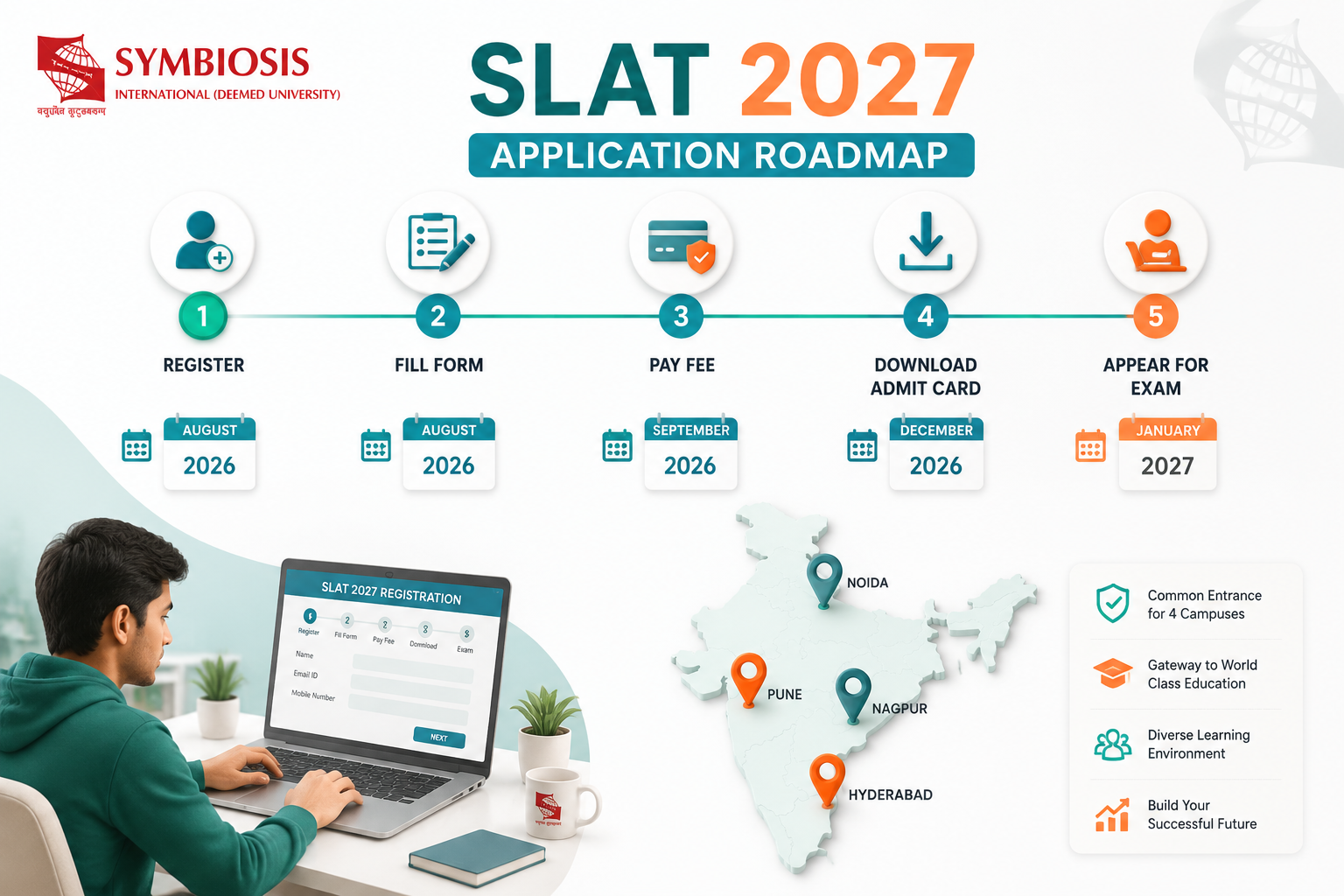
Quick Answer: The Symbiosis Law Admission Test (SLAT) 2027 is a national-level undergraduate law entrance exam conducted by Symbiosis International University (SIU). It is a 60-minute, 60-question Computer-Based Test covering five sections, and it opens doors to BA LLB and BBA LLB programs across four Symbiosis Law School campuses. Registration for SLAT 2027 is expected to begin in August 2026.
Key Takeaways
- Conducting body: Symbiosis International University (SIU), a deemed university
- Exam mode: Online Computer-Based Test (CBT) in English
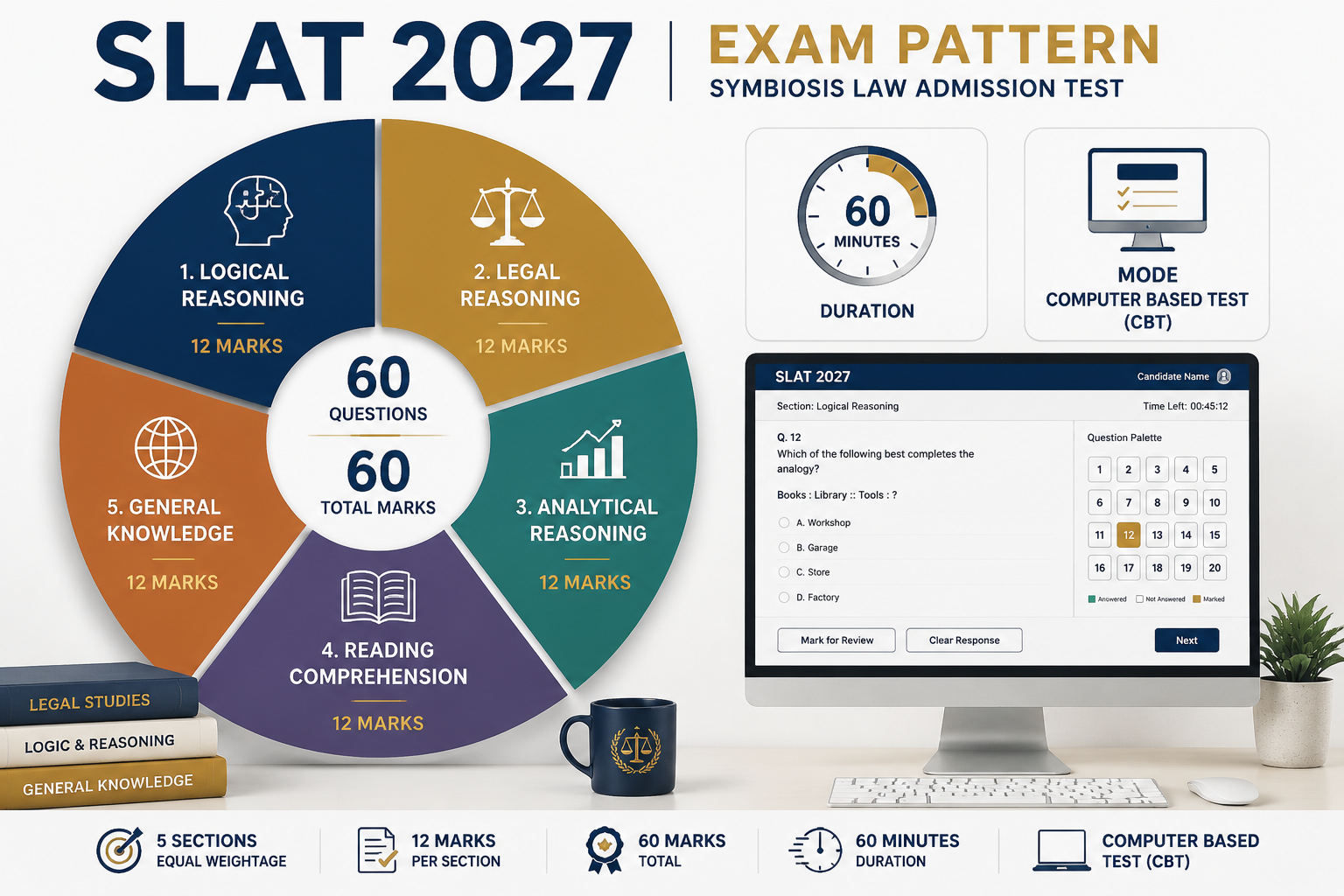
- Total questions: 60 MCQs, 60 marks, 60 minutes
- Five sections: Logical Reasoning, Legal Reasoning, Analytical Reasoning, Reading Comprehension, and General Knowledge (12 questions each)
- Eligibility: Class 12 pass with minimum 50% marks (45% for SC/ST); no age limit
- Total seats: 1,080 across SLS Pune, SLS Noida, SLS Hyderabad, and SLS Nagpur
- Application fee: Approximately Rs. 2,250
- Test cities: 76 cities across India
- Programs offered: BA LLB (Hons.), BBA LLB (Hons.), BA LLB, BBA LLB (all 5-year programs)
- Registration window: Expected August 2026 to November-December 2026
What Is the Symbiosis Law Entrance Exam (SLAT)?
SLAT, or the Symbiosis Law Admission Test, is a national-level entrance examination conducted by Symbiosis International University for admission to undergraduate law programs at its four law school campuses. It is one of the most recognized law entrance exams in India outside of CLAT, and it follows a distinct pattern that rewards analytical thinking, legal aptitude, and reading speed.
Here’s what makes SLAT different from CLAT: it is shorter (60 minutes vs. 120 minutes), has no negative marking, and is conducted in an online CBT format. For students who find CLAT’s length and negative marking stressful, SLAT can be a genuinely strategic choice.
Symbiosis Law School, Pune, is particularly well-regarded among private law institutions in India. Getting into SLS Pune through SLAT is a serious career move, and many law firms and corporate legal departments actively recruit from its campus.
If you’re exploring all your law entrance options, check out this complete guide to law entrance exams in India to understand how SLAT fits into the broader picture.
Who Is SLAT 2027 For? Eligibility Criteria Explained
SLAT 2027 is open to any student who has passed Class 12 (or an equivalent examination) from a recognized board or university, with no upper age limit.
Here are the exact eligibility requirements:
| Criterion | Requirement |
|---|---|
| Educational Qualification | Class 12 or equivalent from a recognized board |
| Minimum Marks (General) | 50% aggregate in Class 12 |
| Minimum Marks (SC/ST) | 45% aggregate in Class 12 |
| Age Limit | No age restriction |
| Nationality | Indian nationals and NRI/international candidates (check SIU guidelines) |
Appearing candidates: Students who are currently in Class 12 and awaiting results can also apply provisionally. Admission will be confirmed only upon meeting the minimum marks criteria.
Common mistake: Many students assume that because SLAT has no age limit, it is only for students who missed the standard admission cycle. That’s not true. SLAT is a mainstream entrance exam for anyone who wants a quality legal education at a private deemed university.
Choose SLAT if: You want a strong private law school education, prefer a shorter exam format, or are looking to hedge your CLAT preparation with a solid backup option that still leads to excellent career outcomes.
SLAT 2027 Exam Pattern: What Exactly Will You Face?
SLAT 2027 is a 60-minute online exam with 60 multiple-choice questions, divided equally across five sections, with no negative marking.
This is one of the most student-friendly exam formats among all law entrance tests in India. Let’s break it down:
Section-Wise Breakdown
| Section | Number of Questions | Marks |
|---|---|---|
| Logical Reasoning | 12 | 12 |
| Legal Reasoning | 12 | 12 |
| Analytical Reasoning | 12 | 12 |
| Reading Comprehension | 12 | 12 |
| General Knowledge | 12 | 12 |
| Total | 60 | 60 |
Key features of the exam format:
- Mode: Computer-Based Test (CBT) only
- Language: English
- Duration: 60 minutes
- Marking scheme: +1 for each correct answer
- Negative marking: None
- Question type: Multiple Choice Questions (MCQs)
What Each Section Actually Tests
Logical Reasoning: Syllogisms, analogies, series completion, blood relations, direction sense, and coding-decoding. This section rewards students who practice pattern recognition regularly.
Legal Reasoning: Legal principles and fact-based scenarios. You don’t need prior law knowledge here. The question gives you a legal principle, and you apply it to a given situation. This is pure reasoning, not memorization.
Analytical Reasoning: Puzzles, seating arrangements, data interpretation, and critical reasoning. Think of it as the “brain workout” section.
Reading Comprehension: Passages followed by inference, vocabulary, and main idea questions. Speed and accuracy both matter here.
General Knowledge: Current affairs, static GK, legal awareness, and general science. This section often separates well-prepared candidates from the rest.
No negative marking means you should attempt all 60 questions. Never leave a question blank in SLAT.
For students also preparing for CLAT, understanding how CLAT’s syllabus compares to other law entrance exams will help you see exactly where SLAT overlaps and where it diverges.
SLAT 2027 Important Dates: Your Planning Timeline
Registration for SLAT 2027 is expected to open in August 2026, with the exam likely scheduled in early 2027.
Note: Official dates are released by Symbiosis International University on the official portal at slat-test.org. The timeline below is based on the expected schedule derived from previous years’ patterns.
| Event | Expected Timeline |
|---|---|
| Registration Opens | August 2026 |
| Last Date to Apply | November-December 2026 |
| Admit Card Release | January 2027 (estimated) |
| SLAT 2027 Exam Date | January-February 2027 (estimated) |
| Result Declaration | February-March 2027 (estimated) |
| Counselling/Selection Process | March-April 2027 (estimated) |
Pro tip: Don’t wait until the last week to register. The SIU portal can experience high traffic near deadlines, and technical issues have historically caused last-minute stress for applicants. Register early, pay the fee, and keep your confirmation email safe.
Always verify dates directly on the official SLAT portal (slat-test.org) before making any decisions.
How to Apply for SLAT 2027: Step-by-Step Application Guide
Applying for SLAT 2027 involves registering on the official portal, filling in your academic details, uploading documents, and paying the application fee of approximately Rs. 2,250.
Here’s the complete process:
Step 1: Register on the Official Portal
Go to slat-test.org and create a new account using your email ID and mobile number. Keep your login credentials safe.
Step 2: Fill the Application Form
Log in and complete the application form. You’ll need to enter:
- Personal details (name, date of birth, contact information)
- Academic details (Class 10 and Class 12 marks)
- Program preference (BA LLB or BBA LLB)
- Campus preference (Pune, Noida, Hyderabad, or Nagpur)
Step 3: Upload Required Documents
Have these ready in the prescribed format:
- Recent passport-size photograph
- Scanned signature
- Class 10 mark sheet
- Class 12 mark sheet (or provisional certificate if results are awaited)
- Category certificate (if applicable for SC/ST)
Step 4: Pay the Application Fee
The application fee is approximately Rs. 2,250 (some sources report Rs. 1,950; check the official portal for the confirmed amount at the time of registration). Payment is accepted via net banking, credit card, or debit card.
Step 5: Download Confirmation
After successful payment, download and save your application confirmation. This will be required for future reference.
Step 6: Download Admit Card
The admit card will be available on the portal closer to the exam date. It will contain your exam center details, roll number, and reporting time.
Edge case: If you’re an NRI or international student, SIU has a separate admission process. Check the official website for specific guidelines applicable to your category.
Symbiosis Law Schools: Campuses, Programs, and Seats
SLAT 2027 offers admission to 1,080 seats across four Symbiosis Law School campuses, with programs spanning five-year integrated law degrees.
Participating Campuses
| Campus | Location | Programs Offered |
|---|---|---|
| Symbiosis Law School (SLS) Pune | Pune, Maharashtra | BA LLB (Hons.), BBA LLB (Hons.) |
| Symbiosis Law School (SLS) Noida | Noida, Uttar Pradesh | BA LLB (Hons.), BBA LLB (Hons.) |
| Symbiosis Law School (SLS) Hyderabad | Hyderabad, Telangana | BA LLB, BBA LLB |
| Symbiosis Law School (SLS) Nagpur | Nagpur, Maharashtra | BA LLB, BBA LLB |
Programs at a Glance
All programs are five-year integrated undergraduate law degrees:
- BA LLB (Hons.): Combines arts and law, focusing on humanities, political science, and legal theory
- BBA LLB (Hons.): Combines business administration and law, ideal for students interested in corporate law and business legal practice
- BA LLB and BBA LLB: Similar programs at the Hyderabad and Nagpur campuses
SLS Pune is consistently ranked among the top private law schools in India. Its alumni network, moot court tradition, and placement record make it a highly competitive destination. If SLS Pune is your target, treat SLAT with the same seriousness you’d give CLAT.
SLAT 2027 Test Centers: Where Can You Appear?
SLAT 2027 will be conducted across 76 test cities in India, making it one of the more accessible national law entrance exams in terms of geographic reach.
The wide distribution of test centers means most candidates won’t need to travel to a different state to appear for the exam. Cities covered include major metros like Mumbai, Delhi, Bengaluru, Chennai, Kolkata, and Hyderabad, as well as Tier-2 cities across most states.
How to choose your test center:
- Select a city closest to your home during the application process
- Center allotment is done by SIU based on availability
- Your specific exam center address will be mentioned on the admit card
Important: Test center preferences are not always guaranteed. Apply early to improve your chances of getting a center in your preferred city.
How to Prepare for the Symbiosis Law Entrance Exam: Proven Strategies
SLAT preparation requires focused practice across five sections, with particular attention to Legal Reasoning and Reading Comprehension, which together account for 40% of the total marks.
Let’s be honest: SLAT is not as difficult as CLAT. But that doesn’t mean you can walk in underprepared. The 60-minute time limit means you have exactly one minute per question. Speed and accuracy both matter.
Section-Wise Preparation Strategy
Logical Reasoning
Practice 20-30 questions daily from standard reasoning books. Focus on syllogisms, blood relations, and series. These question types are predictable and highly scorable with practice.
Legal Reasoning
This section trips up students who try to memorize law. Don’t. The questions give you a legal principle and ask you to apply it. Practice legal reasoning passages from CLAT mock tests, as the format is similar.
Analytical Reasoning
Work through seating arrangement and puzzle sets daily. These take time to master but become mechanical once you’ve done enough of them.
Reading Comprehension
Read editorials from The Hindu or Indian Express every day. Focus on identifying the main idea, author’s tone, and implied meanings. Speed reading practice will pay dividends in this section.
General Knowledge
Maintain a daily current affairs habit. Focus on legal developments, constitutional amendments, Supreme Court judgments, and major national/international events. A monthly GK capsule can help you stay organized.
Preparation Timeline
| Time Available | Recommended Approach |
|---|---|
| 6+ months | Section-by-section mastery, full mock tests from month 4 |
| 3-6 months | Parallel preparation across all sections, weekly mocks |
| 1-3 months | Intensive revision, daily mocks, focus on weak areas |
Since many SLAT aspirants also prepare for CLAT, the good news is that the syllabi overlap significantly. If you’re already working through CLAT 2027 preparation, you’re simultaneously building a strong base for SLAT.
Mock Tests and Practice Papers
Take at least 15-20 full-length mock tests before the exam. Analyze each mock carefully. Don’t just look at your score. Look at which questions you got wrong and why. Pattern recognition in your mistakes is what actually improves your score.
For students who want structured guidance without the heavy price tag, Lawgic Coaching’s flexible self-paced programs are designed to fit real student schedules, whether you’re balancing board exams, coaching, or both.
SLAT vs CLAT: How Do These Exams Compare?
SLAT and CLAT are both undergraduate law entrance exams, but they differ significantly in duration, difficulty, conducting body, and the institutions they provide access to.
| Feature | SLAT 2027 | CLAT 2027 |
|---|---|---|
| Conducting Body | Symbiosis International University | Consortium of NLUs |
| Exam Duration | 60 minutes | 120 minutes |
| Total Questions | 60 | 120 |
| Negative Marking | No | Yes (0.25 per wrong answer) |
| Mode | Online CBT | Online CBT |
| Institutions Accessible | 4 Symbiosis Law Schools | 24 National Law Universities |
| Difficulty Level | Moderate | Moderate to High |
| Application Fee | ~Rs. 2,250 | ~Rs. 4,000 |
Choose SLAT if: You want a strong private university law degree, prefer a shorter exam with no negative marking, or want to diversify your law entrance exam portfolio.
Choose CLAT if: Your goal is an NLU, and you’re targeting the top national law universities for maximum career options.
Here’s the thing: most serious law aspirants appear for both. SLAT and CLAT preparation overlaps by roughly 70-80%. You’re not doubling your workload. You’re maximizing your options.
For a deeper look at how CLAT compares to other exams, this comparative analysis of law entrance exams is worth reading before you finalize your strategy.
Career Pathways After Symbiosis Law School Admission
Graduating from a Symbiosis Law School opens doors to corporate law, litigation, legal consulting, judicial services, and academia, with SLS Pune being particularly strong in corporate and commercial law placements.
Here’s what students who make it into SLS Pune and other campuses typically pursue:
Corporate Law: Top law firms like AZB & Partners, Cyril Amarchand Mangaldas, and Khaitan & Co. actively recruit from SLS Pune. Corporate law is the dominant placement track.
Litigation: Students interested in court practice can pursue litigation at district courts, high courts, or the Supreme Court after completing their five-year program.
Legal Consulting and Compliance: Many SLS graduates join in-house legal teams at banks, MNCs, and startups in roles like legal counsel, compliance officer, or regulatory advisor.
Judicial Services: The five-year integrated program qualifies graduates to appear for state judicial services exams directly after graduation.
Higher Studies: LLM programs at Indian and international universities, including prestigious schools in the UK and USA, are a popular choice for SLS graduates.
Academia and Research: Students with a strong academic record often pursue legal research, policy work, or teaching positions.
The legal profession in India is growing rapidly, and a degree from a recognized institution like SLS gives you a meaningful head start. To understand what the profession looks like financially, this guide on highest paid lawyers in India gives you a realistic picture of earning potential.
Scholarship and Financial Aid at Symbiosis Law Schools
Symbiosis International University offers merit-based scholarships and financial assistance programs for eligible students admitted through SLAT.
Here’s what you should know:
- Merit Scholarships: SIU offers fee waivers and scholarships to high-scoring SLAT candidates. The specific scholarship amounts and eligibility criteria are announced during the admission process.
- Government Scholarships: SC/ST candidates and students from economically weaker sections may be eligible for state and central government scholarship schemes.
- Education Loans: Most nationalized banks offer education loans for courses at SIU under the Vidya Lakshmi portal. Loan amounts typically cover tuition and living expenses.
- SIU Financial Aid: The university has a financial assistance cell that evaluates applications from students facing genuine financial hardship.
Actionable step: Contact the SIU admissions office directly after receiving your admission offer to inquire about available scholarships. Don’t assume you won’t qualify. Many students miss out on financial aid simply because they didn’t ask.
Frequently Asked Questions About SLAT 2027
Q1: What is the full form of SLAT?
SLAT stands for Symbiosis Law Admission Test. It is conducted by Symbiosis International University for undergraduate law admissions.
Q2: Is there negative marking in SLAT 2027?
No. SLAT 2027 has no negative marking. Each correct answer carries one mark, and wrong answers carry zero marks. Attempt all 60 questions.
Q3: How many seats are available through SLAT 2027?
A total of 1,080 seats are available across all four Symbiosis Law School campuses: Pune, Noida, Hyderabad, and Nagpur.
Q4: Can Class 12 appearing students apply for SLAT 2027?
Yes. Students currently in Class 12 and awaiting results can apply provisionally. Final admission is subject to meeting the minimum marks criteria (50% for general, 45% for SC/ST).
Q5: What is the application fee for SLAT 2027?
The application fee is approximately Rs. 2,250. Verify the exact amount on the official portal (slat-test.org) at the time of registration, as fees can vary slightly.
Q6: In how many cities is SLAT 2027 conducted?
SLAT 2027 is conducted across 76 test cities in India.
Q7: Is SLAT conducted online or offline?
SLAT is conducted in online Computer-Based Test (CBT) mode only.
Q8: What programs can I get into through SLAT?
SLAT qualifies you for BA LLB (Hons.), BBA LLB (Hons.), BA LLB, and BBA LLB programs, all five-year integrated undergraduate law degrees.
Q9: Is SLAT harder than CLAT?
Generally, SLAT is considered slightly less difficult than CLAT. The shorter duration, no negative marking, and structured five-section format make it more manageable. However, competition for SLS Pune seats is intense, so preparation should be thorough.
Q10: Can I appear for both SLAT and CLAT in the same year?
Absolutely. Most law aspirants appear for both exams. The preparation overlaps significantly, and appearing for multiple exams maximizes your admission options.
Q11: Is there an age limit for SLAT 2027?
No. There is no upper or lower age limit for SLAT 2027.
Q12: Where can I find official SLAT 2027 information?
The official SLAT portal is slat-test.org. Always verify dates, fees, and eligibility criteria directly on this portal before applying.
Conclusion: Your SLAT 2027 Action Plan
SLAT 2027 is a real opportunity. With 1,080 seats across four campuses, no negative marking, and a 60-minute format that rewards focused preparation, it’s one of the most accessible quality law entrance exams in India.
Here’s your action plan:
- Confirm eligibility now. Check that your Class 12 marks meet the 50% threshold (45% for SC/ST).
- Mark your calendar. Registration opens in August 2026. Set a reminder and don’t miss the window.
- Start preparing today. Even if the exam is months away, building daily habits in reading comprehension and current affairs takes time.
- Appear for CLAT too. The preparation overlaps, and having multiple options is always smarter than betting everything on one exam.
- Take mock tests seriously. Fifteen to twenty full-length mocks before exam day is the minimum. Analyze every mistake.
- Explore financial aid. Contact SIU’s admissions office about scholarships after receiving your offer letter.
Your success is our mission at Lawgic Coaching. We’ve helped thousands crack competitive law entrance exams with proven strategies that actually work, and we’re here to guide you through SLAT 2027 the same way. No cookie-cutter approach here. Personalized attention you deserve, flexible learning that fits your life, and expert guidance without the premium price tag.
If you’re also preparing for CLAT alongside SLAT, explore our complete CLAT preparation guide and our CLAT 2027 exam syllabus breakdown to build a preparation strategy that covers both exams efficiently.
Let’s build your law career together. Results speak louder than promises, and the first step is yours to take.