Last updated: May 22, 2026
Quick Answer: The best CLAT study materials for 2027 combine three to four core books (not ten), a structured mock test series that mirrors the actual CLAT format, one reliable current affairs source consumed daily, and a repeatable daily practice routine of three to five hours. The biggest mistake aspirants make is buying too much and using too little. This guide tells you exactly what to buy, what to skip, and how to build one clean system that works whether you're a first-timer, a school-going student, or a repeater.
Key Takeaways
- Less is more: Three to four well-chosen books outperform a shelf of ten half-read ones.
- The CLAT 2027 pattern is passage-based, so comprehension speed and analytical reading matter more than rote memorization.
- Mock tests are non-negotiable. Aim for at least 20 to 25 full-length mocks before exam day.
- Current affairs should be consumed daily from one or two sources, not five.
- Self-study is entirely viable for CLAT 2027 — coaching is useful but not mandatory.
- School-going aspirants can prepare effectively with two to three focused hours per day.
- Repeaters should prioritize mock analysis and weak-area drilling over re-reading theory.
- The most cost-effective stack (books + mocks + free current affairs) can be built for under ₹3,000 to ₹5,000.
- Legal reasoning and English together account for roughly 60% of the CLAT paper — these sections deserve the most preparation time.
- Consistency over intensity: a steady daily routine beats weekend cramming every time.
What Are the Top Recommended Books for CLAT 2027 Preparation?
The best books for CLAT 2027 are those that match the passage-based exam format, cover all five sections, and are regularly updated. A curated stack of three to four books is sufficient for most aspirants.
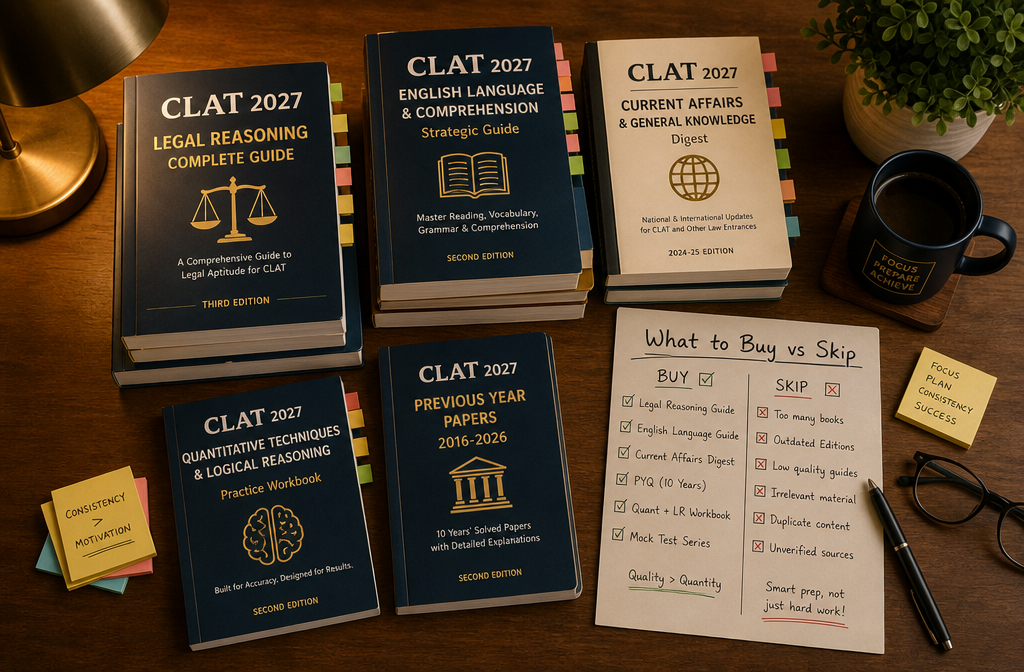
Here is a section-wise breakdown of what actually works:
English Language and Comprehension
- "Word Power Made Easy" by Norman Lewis — still the gold standard for vocabulary building; read alongside passage practice, not as a standalone exercise.
- Previous year CLAT papers — the single best source for English comprehension practice because they show exactly how passages are framed.
- For reading speed and comprehension, see this guide on how to read 450-word CLAT passages — it breaks down the passage-attack method used by high scorers.
Legal Reasoning
- "Legal Reasoning for CLAT" by A.P. Bhardwaj — covers principles, rules, and fact-application well.
- Supplement with bare reading of landmark Supreme Court judgments summarized in legal news digests.
- Check out the step-by-step approach to CLAT 2026 legal reasoning passages for a structured method.
Logical Reasoning
- "Analytical Reasoning" by M.K. Pandey — solid for critical reasoning and argument-based questions.
- CLAT 2027 logical reasoning is passage-based, so practice reading dense arguments and identifying conclusions quickly.
Quantitative Techniques
- NCERT Mathematics (Class 8–10) — covers all the arithmetic and data interpretation needed for CLAT's quantitative section.
- For a focused resource, the best maths book for CLAT preparation guide narrows this down further.
General Knowledge and Current Affairs
- "Manorama Yearbook" (latest edition) — for static GK.
- Daily current affairs from one curated source (covered in detail below).
Decision rule: If you already have strong English reading habits, skip the vocabulary book and go straight to passage practice. If you're weak in maths, spend two weeks on NCERT before touching any CLAT-specific quant material.
For a complete section-by-section reading list, the CLAT 2027 booklist expert guide is worth bookmarking.
How Much Do Comprehensive CLAT Study Materials Cost?
A complete CLAT 2027 study stack does not have to be expensive. Here is a realistic cost breakdown:
| Category | Budget Option | Mid-Range Option |
|---|---|---|
| Books (4–5 titles) | ₹800–₹1,200 (second-hand) | ₹1,800–₹2,500 (new) |
| Mock Test Series | ₹500–₹800 (basic online) | ₹1,500–₹2,500 (full series) |
| Current Affairs | ₹0 (free apps/websites) | ₹300–₹500 (printed digest) |
| Previous Year Papers | ₹200–₹400 | ₹200–₹400 |
| Total (estimate) | ₹1,500–₹2,400 | ₹4,000–₹5,900 |
Common mistake: Spending ₹15,000 to ₹20,000 on a full offline coaching package when a ₹4,000 self-study stack plus a good online mock series delivers comparable results for disciplined aspirants.
For students on tight budgets, the 7 ultimate free CLAT resources for 2027 guide lists zero-cost options that are genuinely useful.
Which Online Mock Tests Are Most Similar to the Actual CLAT Exam?
The best CLAT mock tests replicate the passage-heavy format, use a similar difficulty level, and provide detailed answer explanations — not just a score.
Platforms worth considering for CLAT 2027:
- Consortium's official sample papers — always the closest to the real exam; use these first.
- LegalEdge, CL Educate, and Career Launcher mock series — well-regarded for passage quality and difficulty calibration.
- Lawgic Coaching mock tests — particularly useful for students who want section-wise analysis alongside full-length tests.
What to look for in a mock series:
- Passage-based questions across all five sections (not MCQ-only formats from pre-2020 patterns).
- Detailed explanations for every answer, including why wrong options are wrong.
- Time-stamped performance analytics so you can track where you're losing minutes.
- At least 15 to 20 full-length tests in the package.
Edge case: Some older mock series still follow the pre-2020 CLAT format with standalone MCQs. These are not useful for CLAT 2027 preparation. Always verify the format before purchasing.
For a deeper look at how mock tests should be used strategically, see CLAT mock test mastery: how to uncover weaknesses.
Best Current Affairs Sources for Law Entrance Exam Preparation
For CLAT 2027, the best current affairs sources are those that cover legal and constitutional developments, not just general news. One well-chosen source used consistently beats five sources used randomly.
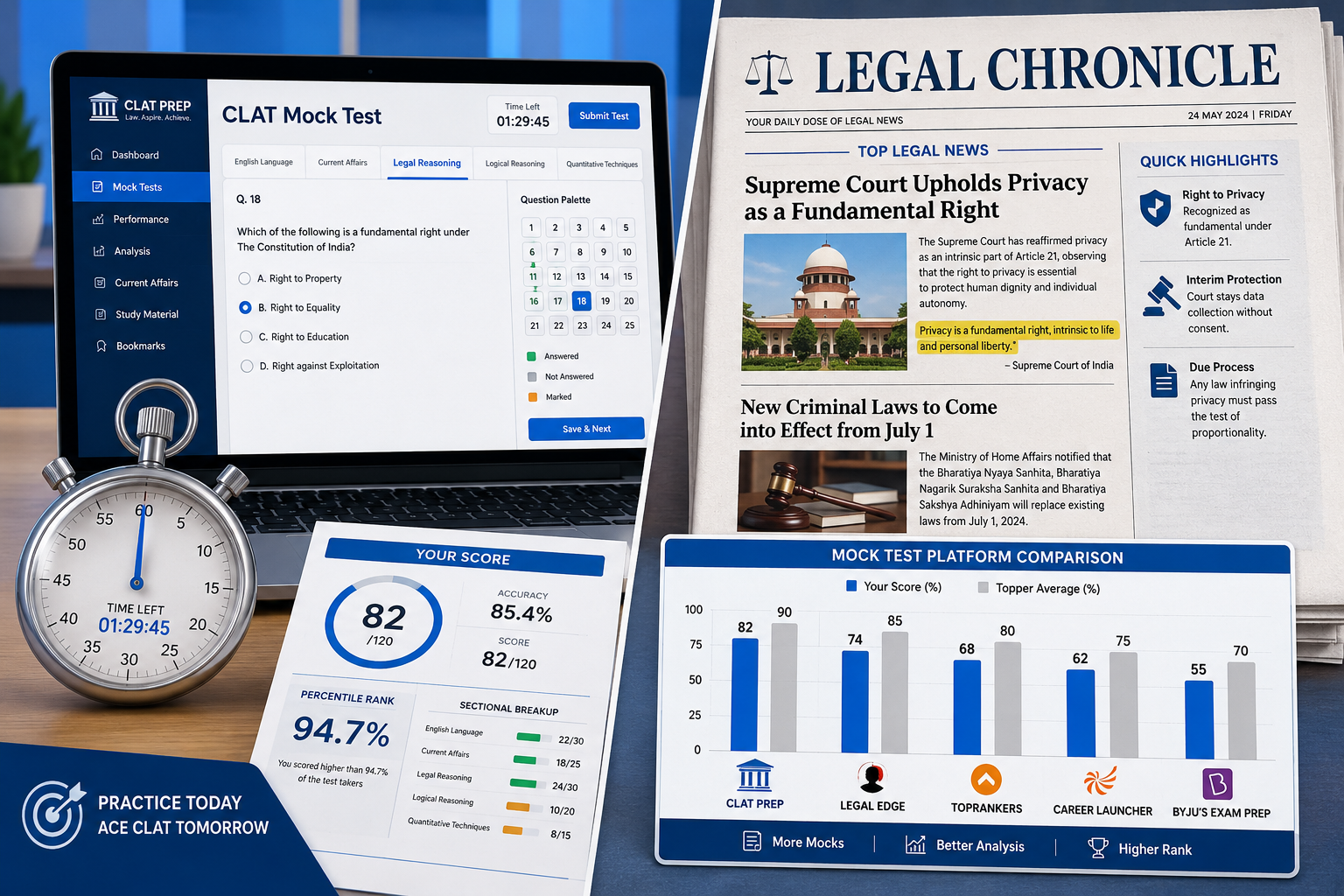
Top sources by category:
Free digital sources:
- The Hindu — strong on legal, constitutional, and policy news; read the editorial page daily.
- Indian Express — good for explained articles on legal judgments and government policy.
- Bar and Bench / Live Law — essential for Supreme Court and High Court developments relevant to legal reasoning.
Paid/structured sources:
- GKToday monthly current affairs PDF — affordable, organized by topic, good for revision.
- Manorama Yearbook — annual static GK reference; buy the latest edition each year.
What to track specifically for CLAT:
- Supreme Court judgments and constitutional amendments
- New legislation passed by Parliament
- International treaties and agreements India has signed
- Awards, appointments, and major government schemes
Decision rule: If you read The Hindu daily and spend 20 minutes on Bar and Bench three times a week, you have enough current affairs coverage. Adding more sources creates noise, not knowledge.
Also see: static vs. current affairs in CLAT GK — finding the right balance.
How Many Hours of Daily Practice Do Toppers Recommend?
Most CLAT toppers and experienced coaches recommend three to five hours of focused daily study, not marathon sessions. Quality of practice matters more than raw hours.
A practical daily breakdown for a student with 10 to 12 months of preparation time:
- English reading and comprehension: 45–60 minutes (one to two passages with timed practice)
- Legal reasoning: 45–60 minutes (passage-based questions or judgment summaries)
- Current affairs: 20–30 minutes (one source, consistent)
- Logical reasoning or quant: 30–45 minutes (rotating daily)
- Mock test or review: 60–90 minutes (full mock twice a week; review on other days)
For school-going aspirants: Two to three hours per day is realistic and sufficient if the time is structured. Weekends can be used for full-length mock tests.
For repeaters: Shift the balance toward mock analysis and weak-area drilling. Spending 60% of study time reviewing mocks (not just taking them) is what separates repeaters who improve from those who plateau.
For a detailed transformation plan, the from 30 to 95 in CLAT mocks: a 90-day plan is one of the most practical resources available.
Are Offline Coaching Classes Better Than Online CLAT Preparation?
Neither format is universally better. The right choice depends on a student's discipline level, location, and budget.
Offline coaching works best when:
- A student needs external accountability and structured classroom pressure.
- The coaching institute has a strong track record with CLAT specifically (not just general law entrance coaching).
- The student lives near a reputable coaching center and can commute without losing significant study time.
Online preparation works best when:
- The student is self-motivated and can follow a schedule independently.
- Budget is a constraint (online courses are typically 40–70% cheaper than offline equivalents).
- The student is in a city without strong CLAT coaching options.
Common mistake: Assuming offline coaching guarantees results. Coaching is a tool, not a shortcut. Students who attend coaching but skip self-study and mock practice consistently underperform those who self-study with discipline.
For a realistic assessment of self-study viability, see can I crack CLAT without coaching? Self-study plan 2027.
What Are Common Mistakes Students Make While Preparing for CLAT?
The most common CLAT preparation mistakes are material overload, neglecting mock analysis, and treating current affairs as an afterthought.
Top mistakes and how to avoid them:
-
Buying too many books: Most students own eight to ten CLAT books and finish none of them. Pick three to four, finish them, and revise them.
-
Taking mocks without reviewing them: A mock test taken without a 60-minute review session is nearly wasted. The review is where the learning happens.
-
Ignoring the passage-based format: Students who practice standalone MCQs are preparing for a different exam. Every practice session should involve reading and analyzing a passage.
-
Leaving current affairs for the last two months: Legal current affairs require context built over months, not weeks. Start from day one.
-
Skipping quantitative techniques: Many aspirants avoid the quant section, then lose easy marks on straightforward arithmetic and data interpretation questions. The 5 must-do CLAT quant topics for non-math students covers exactly what to focus on.
-
Changing study plans too frequently: Switching strategies every few weeks resets progress. Commit to a plan for at least six to eight weeks before evaluating it.
Which Study Materials Work Best for English and Legal Reasoning Sections?
English and legal reasoning together form the core of CLAT 2027 — these two sections typically carry the most weight and reward consistent reading habits above all else.
For English:
- Daily reading of quality editorial content (The Hindu, Indian Express) builds comprehension speed organically.
- Timed passage practice using previous year CLAT papers is the most targeted preparation.
- Work on eliminating reader's fatigue — long passages under time pressure are where most students drop marks. The guide to overcoming reader's fatigue in CLAT English addresses this directly.
For Legal Reasoning:
- Focus on understanding legal principles and applying them to new fact patterns — not memorizing laws.
- Read at least two to three Supreme Court judgment summaries per week from Live Law or Bar and Bench.
- Practice identifying the "rule" in a passage before reading the questions — this saves time during the actual exam.
Decision rule: If you read 30 minutes of quality editorial content every day for six months, your English and legal reasoning scores will improve measurably without any additional specialized resource.
Can I Prepare for CLAT Without Coaching?
Yes, self-study for CLAT 2027 is entirely viable. Many students who rank in the top 500 have prepared without formal coaching, using a structured self-study plan, quality books, and a rigorous mock test schedule.
What self-study requires:
- A fixed daily schedule followed consistently (not aspirationally).
- A reliable mock test series with detailed analytics.
- One accountability mechanism — a study partner, a mentor, or a weekly self-assessment log.
- Access to good current affairs sources (mostly free).
What self-study cannot replace:
- Doubt resolution on complex legal reasoning passages (a mentor or online forum helps here).
- Peer benchmarking (mock test percentile rankings partially substitute for this).
The CLAT 2027 self-study strategies page has a structured plan for students going the independent route.
How Different Are CLAT 2027 Materials Compared to Previous Years?
CLAT 2027 materials are largely consistent with the post-2020 reformed pattern, which shifted to passage-based questions across all sections. The core syllabus has not changed significantly, but the emphasis on analytical reading continues to deepen.
What has stayed the same:
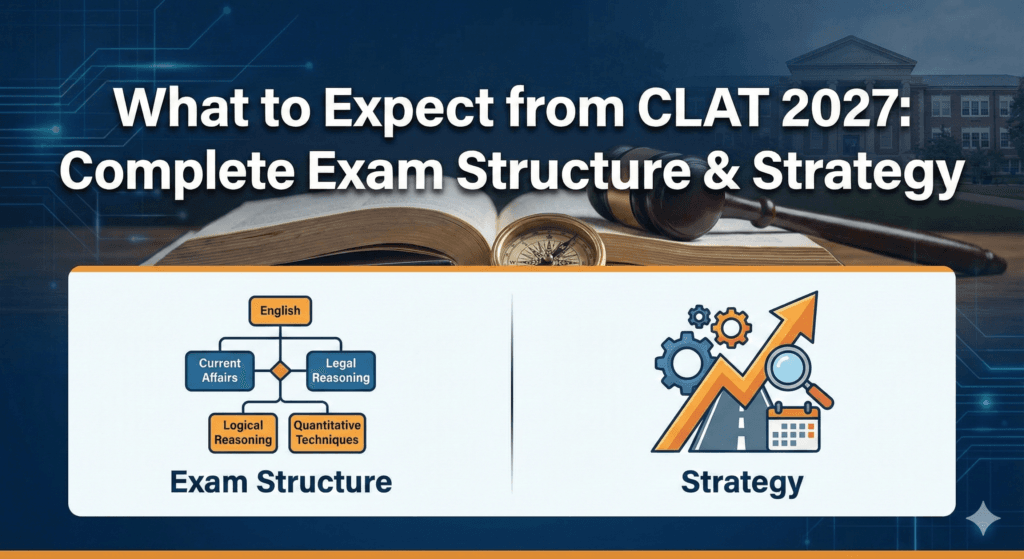
- Five sections: English, Current Affairs/GK, Legal Reasoning, Logical Reasoning, Quantitative Techniques.
- Passage-based format for all sections.
- 120 questions in 120 minutes.
- Negative marking of 0.25 marks per wrong answer.
What to watch for in 2027:
- The Consortium may release updated sample papers — always check the official CLAT website for the latest format updates.
- Legal reasoning passages have trended toward more nuanced constitutional and criminal law scenarios in recent years.
- Current affairs questions increasingly test application (why something matters legally) rather than just recall (what happened).
For the full syllabus breakdown, the CLAT 2027 exam syllabus complete guide is the most current reference.
Recommended Daily Practice Routine for CLAT 2027 Success
A structured daily routine is what separates consistent performers from inconsistent ones. The routine below is designed for a student with 10 to 14 months of preparation time and three to five hours available daily.
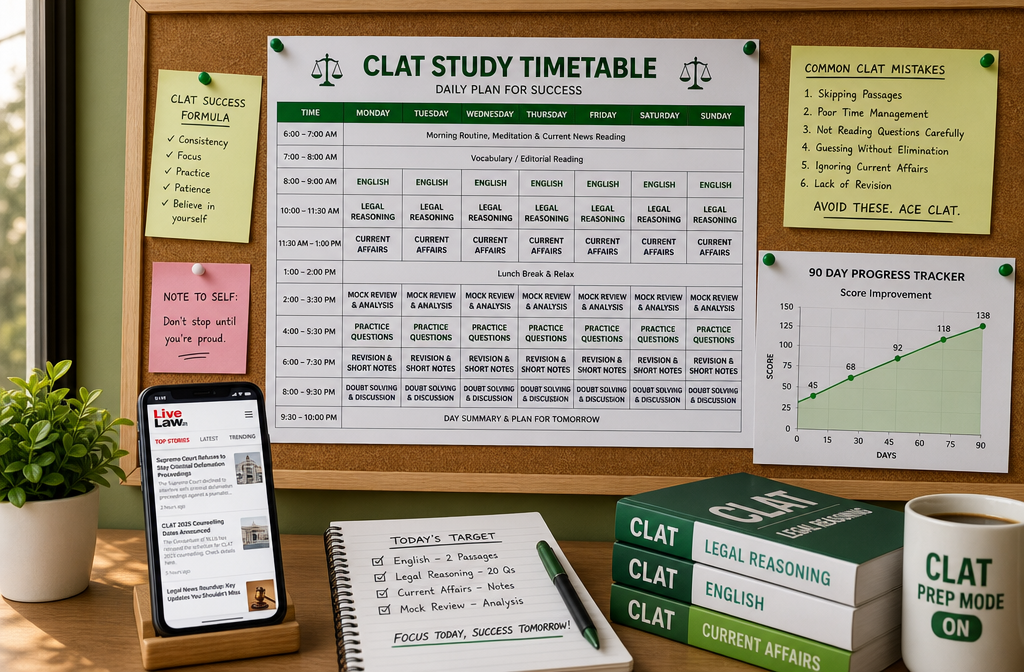
Sample Daily Practice Stack:
| Time Block | Activity | Duration |
|---|---|---|
| Morning | Current affairs reading (one source) | 20–30 min |
| Morning | English passage practice (timed) | 45–60 min |
| Afternoon | Legal reasoning passages or judgment summaries | 45–60 min |
| Afternoon | Logical reasoning or quant (alternate daily) | 30–45 min |
| Evening | Mock test (twice/week) OR mock review/weak-area drill | 60–90 min |
| Night | Light revision — flashcards, notes, GK facts | 15–20 min |
Weekly structure:
- Monday to Friday: Section-wise practice as above.
- Saturday: Full-length mock test (120 minutes, timed strictly).
- Sunday: Complete mock review, error log update, and weekly current affairs revision.
For school-going aspirants: Compress the afternoon blocks into a single 90-minute session after school. Two hours of focused work on weekdays plus a full mock on Sunday is a realistic and effective schedule.
For repeaters: Spend the first two weeks of preparation taking three to four mocks to identify current weak areas. Then build the daily routine around those specific gaps rather than following a generic schedule.
Which Study Materials Are Most Cost-Effective for Middle-Income Students?
The most cost-effective CLAT 2027 stack for middle-income students combines free digital current affairs sources, second-hand books, and a mid-range online mock series — total cost under ₹3,500.
Recommended budget stack:
- Books: Buy second-hand copies of Word Power Made Easy, M.K. Pandey's Analytical Reasoning, and one legal reasoning guide. Total: ₹600–₹900.
- NCERT Maths (Class 8–10): Free PDF from NCERT's official website.
- Current affairs: The Hindu (free online), Live Law (free), GKToday monthly PDF (₹50–₹100/month).
- Mock tests: One reputable online mock series (₹800–₹1,500 for a full package of 20+ tests).
- Previous year papers: Available as free PDFs from the Consortium's official website.
What to skip:
- Expensive printed current affairs magazines when free digital equivalents exist.
- Coaching institute study material packages priced above ₹5,000 unless they include live doubt sessions.
- Multiple mock test series — one good series used thoroughly beats three mediocre ones used partially.
FAQ: Best CLAT Study Materials for 2027
Q: How many books are enough for CLAT 2027 preparation?
Three to four books covering English, legal reasoning, logical reasoning, and quant are sufficient. Previous year papers and daily current affairs reading complete the stack. More books rarely improve scores — consistent use of fewer resources does.
Q: Is the Manorama Yearbook enough for GK and current affairs?
No. Manorama Yearbook covers static GK well but does not replace daily current affairs reading. Use it as a reference, not as a primary current affairs source.
Q: Which section should beginners focus on first?
Start with English comprehension and legal reasoning, since these two sections carry the most marks and take the longest to build. Quant and logical reasoning can be developed in parallel with shorter daily sessions.
Q: How early should mock tests begin?
Start taking section-wise mocks within the first month of preparation. Full-length timed mocks should begin at least four to five months before the exam. The last two months should include at least two full mocks per week.
Q: Are free mock tests as good as paid ones?
Free mocks vary widely in quality. Official Consortium sample papers are the best free resource. For a full series with analytics and explanations, a paid package (₹800–₹1,500) is worth the investment.
Q: Can a student preparing for board exams also prepare for CLAT simultaneously?
Yes, with a compressed schedule. Two focused hours daily on weekdays and a full mock on weekends is manageable. See how to prepare for CLAT while busy with board exams for a practical plan.
Q: What is the best current affairs source specifically for legal news?
Live Law and Bar and Bench are the best free sources for Supreme Court and High Court developments. These are directly relevant to legal reasoning passages in CLAT.
Q: How long does it take to prepare for CLAT from scratch?
Most aspirants need eight to twelve months of consistent preparation to be competitive. Students with strong reading habits can sometimes prepare effectively in five to six months. See how much time is required to prepare for CLAT for a detailed timeline.
Q: Should repeaters buy new study materials?
Not necessarily. Repeaters should first identify why they underperformed — usually it's mock analysis and time management, not lack of books. New materials are only worth buying if there is a genuine gap in content coverage.
Q: Is online coaching worth it for CLAT 2027?
Online coaching adds value primarily through structured schedules, doubt resolution, and peer benchmarking. For self-motivated students, a good mock series and free resources can replace most of what online coaching offers at a fraction of the cost.
Conclusion: Build One System, Use It Completely
The best CLAT study materials for 2027 are not the most expensive or the most comprehensive — they are the ones a student actually finishes and uses repeatedly. The single most damaging habit in CLAT preparation is material overload: buying ten books, subscribing to four mock series, following five current affairs sources, and finishing none of them properly.
Actionable next steps:
- This week: Choose three to four books from the section-wise list above. Order or download them. Do not buy more until these are done.
- This week: Pick one current affairs source and commit to reading it daily for 20 minutes. The Hindu editorial or Live Law works for most students.
- Within the first month: Start section-wise mock practice. Take one full-length mock to establish a baseline score.
- Ongoing: Follow the daily practice stack — English, legal reasoning, current affairs, and rotating quant/logical reasoning — with full mocks twice a week from month four onward.
- Every Sunday: Review your mock errors, update your error log, and revise the week's current affairs. This one habit compounds significantly over months.
CLAT 2027 rewards readers and thinkers more than memorizers. Build a system that makes reading and analysis a daily habit, and the exam becomes significantly more manageable.
Meta Title: Best CLAT Study Materials for 2027: Books, Mocks & Daily Stack
Meta Description: Discover the best CLAT study materials for 2027 — top books, mock tests, current affairs sources, and a daily practice routine. Build one effective system and avoid material overload.