Last updated: June 9, 2026
Quick Answer
Geetali Gupta secured AIR 1 in CLAT 2026 with a score of 112.75 out of 120, making her the top performer among approximately 92,000 registered candidates. [1] Her preparation was built on consistent daily practice, disciplined time management, and structured coaching support. [4] The CLAT 2026 exam was held on December 7, 2025, with results declared on December 16, 2025. [3]
Key Takeaways
- Geetali Gupta topped CLAT 2026 with a score of 112.75 out of 120, securing AIR 1 in the undergraduate category [1]
- The CLAT 2026 exam was conducted on December 7, 2025, across 126 centers nationwide, with roughly 92,000 registered candidates [3]
- LegalEdge coaching institute claimed AIR 1, 2, and 3 in CLAT 2026 [2]
- The highest score in the postgraduate category was 104.25 [3]
- Geetali credited consistent practice and smart time management as the core pillars of her success [4]
- Legal Reasoning and English Comprehension are the most scoring and most challenging sections for most aspirants
- Top NLUs like NLSIU Bangalore and NALSAR Hyderabad typically require scores above 100 for general category seats
- Coaching helps, but a structured self-study plan can also work if followed with real discipline
- Last-month preparation should focus on mock tests, revision, and accuracy over new topics
- Centralized counseling began on December 17, 2025, right after results were announced [5]
Who Topped CLAT 2026 and What Was Their Score
Geetali Gupta is the CLAT 2026 AIR 1 holder, scoring 112.75 out of 120 in the undergraduate exam. This score placed her at the very top of a highly competitive field of nearly 92,000 candidates who registered for the exam. [1]
To put that in perspective, scoring 112.75 out of 120 means she got almost 94% of the paper right. That is not luck. That is months of deliberate, focused preparation.

Here are the key facts about the CLAT 2026 results at a glance:
| Detail | Information |
|---|---|
| AIR 1 (UG) | Geetali Gupta |
| UG Top Score | 112.75 / 120 |
| PG Top Score | 104.25 / 120 |
| Exam Date | December 7, 2025 |
| Result Date | December 16, 2025 |
| Total Registered Candidates | Approximately 92,000 |
| Exam Centers | 126 centers nationwide |
| Counseling Start | December 17, 2025 |
LegalEdge, the coaching institute Geetali was associated with, made headlines by securing AIR 1, 2, and 3 in CLAT 2026. [2] That kind of sweep at the top ranks tells you something real about the value of structured preparation with the right guidance.
How Did the AIR 1 Rank Holder Prepare for CLAT
Geetali Gupta's preparation strategy was built on two non-negotiable pillars: consistent daily practice and sharp time management. In her post-result interview, she emphasized that there was no secret formula, just a disciplined routine repeated day after day. [4]
Here is what stood out from her preparation approach:
- She maintained a fixed daily study schedule rather than studying in irregular bursts
- Mock tests were a regular part of her routine, not just a last-minute activity
- She analyzed her mistakes after every mock test instead of just moving on
- Time management during the actual exam was something she practiced specifically, not assumed
- She kept her approach subject-specific, giving extra attention to her weaker areas
Let's be honest, most aspirants know what they should do. The difference between a topper and an average scorer is almost always execution. Geetali's story is a reminder that showing up consistently, even on days when motivation is low, is what actually builds the score.
For aspirants thinking about how long this kind of preparation realistically takes, check out this detailed breakdown: CLAT Prep Time: How Long to Study for CLAT 2026 Success.
What Study Strategy Worked Best for Top CLAT Performers
The study strategies that worked for CLAT 2026 toppers share a common thread: structured subject-wise planning combined with regular full-length mock tests and honest self-assessment.
Here is a breakdown of what the most effective preparation strategies look like, based on what top rankers consistently report:
Subject-wise weekly planning
Divide your week so every section gets dedicated attention. Do not let one subject dominate at the expense of others.
Mock test cadence
Start with one mock per week early in preparation. Move to three or four per week in the final two months. Review every single test in detail.
Error log maintenance
Keep a notebook or digital log of every question you got wrong. Revisit those entries weekly. This is one of the most underused strategies among average scorers.
Reading habit for English and GK
Top performers read quality newspapers and editorial content daily. This builds both comprehension speed and current affairs awareness simultaneously.
Legal Reasoning practice through passages
CLAT tests applied legal thinking, not memorized law. Practice reading legal passages and answering inference-based questions, not just definitions.
Here's the thing about strategy: it only works if it fits your actual life. That is why flexible learning that fits your life matters more than any one-size-fits-all plan.
How Many Hours Per Day Did CLAT 2026 Toppers Study
Most CLAT toppers, including those who secured top ranks in 2026, studied between 6 to 8 hours per day during peak preparation, with quality of study mattering more than raw hours. [4]
The honest answer is that there is no magic number. A distracted 10-hour study day often produces less than a focused 5-hour session. What top performers consistently report:
- 2 to 3 hours on reading comprehension and English passages daily
- 1 to 1.5 hours on Legal Reasoning with passage-based practice
- 1 hour on GK and current affairs (newspaper reading counts here)
- 1 hour on Logical Reasoning
- 30 to 45 minutes on Quantitative Techniques
- Dedicated mock test and review sessions at least three times a week
The key shift that separates toppers from average scorers is that they treat revision and error analysis as study time, not extra work. If you are spending 8 hours studying but skipping your mock test review, you are leaving your biggest learning opportunity on the table.
What Subjects Are Most Challenging in CLAT Exam
English Language and Legal Reasoning are consistently reported as the most challenging sections by CLAT aspirants, though the difficulty is different for each. English demands speed and comprehension accuracy under time pressure, while Legal Reasoning requires a specific kind of analytical thinking that most students have not practiced before.
Here is a realistic difficulty breakdown by section:
| Section | Why It's Challenging | Weightage |
|---|---|---|
| English Language | Long passages, tight time, inference questions | 28-32 marks |
| Legal Reasoning | Applied thinking, not memory-based | 35-39 marks |
| Logical Reasoning | Pattern recognition under pressure | 28-32 marks |
| General Knowledge | Vast syllabus, current affairs unpredictability | 35-39 marks |
| Quantitative Techniques | Anxiety for non-math students, but low weightage | 13-17 marks |
Legal Reasoning carries the highest weightage and is also the section where most aspirants have the least prior exposure. Getting this section right is often the difference between a top 100 rank and a top 1000 rank. For a deeper look at how to build this skill, 7 Ultimate CLAT Legal Topics for 2026 Success is worth your time.
Average Marks Needed to Get Into Top Law Schools Through CLAT
To secure admission to the top NLUs through CLAT 2026, general category candidates typically needed scores above 100 out of 120, with NLSIU Bangalore and NALSAR Hyderabad being the most competitive. [3]
Here is a general benchmark based on historical cutoff trends and CLAT 2026 score patterns:
| NLU | Approximate Score Needed (General) |
|---|---|
| NLSIU Bangalore (NLU-1) | 108+ |
| NALSAR Hyderabad | 105+ |
| NUJS Kolkata | 103+ |
| NLU Jodhpur | 100+ |
| HNLU Raipur | 95+ |
| Mid-tier NLUs | 88-95 |
These are estimates based on observed trends and should be verified against official counseling data. Category-wise cutoffs differ significantly, with SC, ST, and OBC candidates qualifying at lower scores. For a full breakdown, the Ultimate CLAT 2026 Guide: Good Marks for NLU Admission covers this in detail.
The counseling process for CLAT 2026 started on December 17, 2025, the day after results were announced. [5] That is a tight turnaround, so having your target NLU list ready before results is smart planning.
Is Self-Study Enough to Crack CLAT or Do You Need Coaching
Self-study can absolutely work for CLAT, but it requires a level of discipline, access to quality resources, and honest self-assessment that most students underestimate. Coaching, when done well, shortens the learning curve and provides structured accountability.
Here is a practical way to think about it:
Choose self-study if:
- You are a strong self-motivator with a track record of independent learning
- You have access to good mock test series and study material
- You can honestly identify and fix your weak areas without external feedback
- You have at least 10 to 12 months of preparation time
Consider coaching if:
- You struggle with Legal Reasoning or need conceptual clarity from experienced teachers
- You want structured mock tests with performance benchmarking
- You benefit from accountability and peer competition
- You are preparing in less than 6 months and need an accelerated plan
The good news is that coaching does not have to mean expensive classroom programs. Accessible education for serious aspirants is possible without the premium price tag. Platforms like Lawgic Coaching offer expert guidance from real mentors from top NLUs, with flexible learning that fits your life. No cookie-cutter approach here.
For a realistic self-study plan, Can I Crack CLAT Without Coaching? Self-Study Plan 2027 lays it out honestly.
How to Improve Legal Reasoning Section for CLAT
Legal Reasoning in CLAT does not test your knowledge of law. It tests your ability to read a legal passage, understand the principle stated, and apply it to a given fact situation. This means you can improve it through targeted reading and practice, even without a legal background.
Proven steps to improve Legal Reasoning scores:
- Read the principle carefully before reading the facts. Do not assume you know what it means.
- Apply only the principle given in the passage, not your general knowledge of law.
- Practice with official CLAT past papers. The passage style and question pattern are very consistent.
- Do at least 5 to 10 Legal Reasoning passages per day during peak preparation.
- After each practice set, review wrong answers and identify whether you misread the principle, the facts, or both.
- Gradually move to timed practice to build speed alongside accuracy.
The biggest mistake aspirants make in this section is bringing in outside legal knowledge. CLAT Legal Reasoning is a closed-system test. The answer is always in the passage.
What Books Did CLAT 2026 AIR 1 Recommend
Geetali Gupta and other top CLAT 2026 performers consistently pointed to a combination of standard reference books, quality newspapers, and mock test series as their core preparation toolkit. [4]
While no single book guarantees a top rank, here are the resources that top rankers most commonly recommend:
For English Language:
- Any standard reading comprehension practice book with editorial-style passages
- The Hindu or Indian Express for daily reading (builds speed and vocabulary naturally)
For Legal Reasoning:
- CLAT Consortium's official previous year papers
- Legal Reasoning practice books by reputed CLAT-focused publishers
For General Knowledge:
- Manorama Yearbook or Pearson General Knowledge Manual for static GK
- Monthly current affairs compilations from reliable sources
For Logical Reasoning:
- R.S. Aggarwal's Verbal and Non-Verbal Reasoning (selective chapters)
- CLAT-specific logical reasoning practice sets
For Quantitative Techniques:
- NCERT Mathematics (Class 9 and 10) for foundational concepts
- CLAT-specific quant practice books focused on data interpretation
For a curated comparison of GK resources specifically, Ultimate CLAT GK Books Compared: Expert Guide for Aspirants 2026 is a solid starting point.
How Tough Is CLAT Compared to Other Law Entrance Exams
CLAT is considered moderately difficult compared to other law entrance exams in India, but its unique passage-based format and time pressure make it distinctly challenging for aspirants who prepare using memory-based strategies.
Here is a quick comparison:
| Exam | Difficulty Level | Key Difference from CLAT |
|---|---|---|
| CLAT UG | Moderate-High | Passage-based, analytical focus |
| AILET (NLU Delhi) | High | More factual, static knowledge heavy |
| SLAT (Symbiosis) | Moderate | More straightforward question types |
| MH CET Law | Moderate | State-level, less competitive |
| DU LLB | Moderate-High | Different pattern, Delhi University specific |
CLAT's shift to a passage-based format a few years ago made rote memorization less useful and analytical reading more critical. This is actually good news for aspirants who read widely and think critically. It levels the playing field between students from different educational backgrounds.
For a detailed head-to-head, Ultimate CLAT vs DU LLB 2026: Easiest Choice breaks down the differences clearly.
Tips for Last Month Preparation Before CLAT Exam
The last month before CLAT should be about consolidation, not new learning. This is the time to sharpen what you already know, build exam-day confidence, and fix the specific errors that keep showing up in your mock tests.
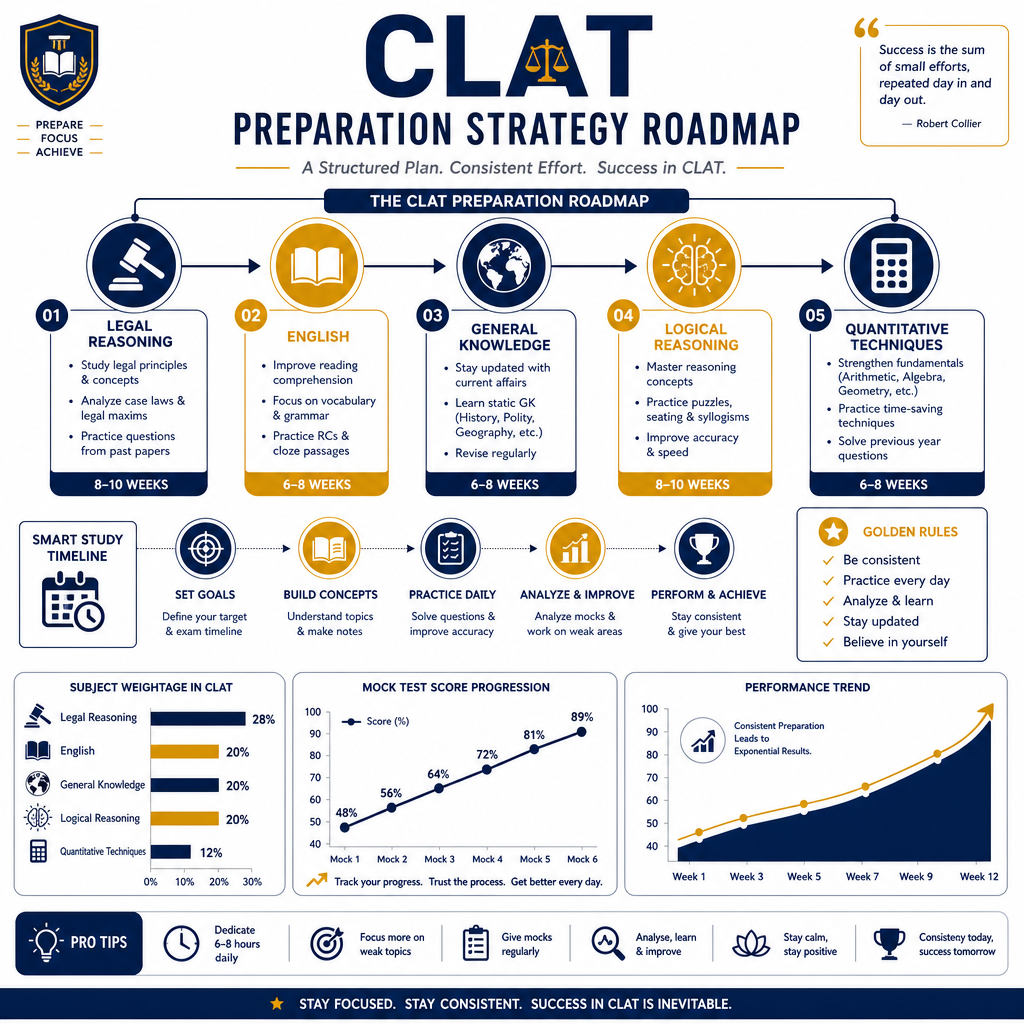
Here is a week-by-week framework for the final four weeks:
Week 1: Intensive mock testing
- Take one full-length mock every two days
- Review every mock in detail, not just your score
- Identify your top three recurring mistake patterns
Week 2: Targeted revision
- Revisit your error log from the past few months
- Focus on Legal Reasoning and English, the two highest-weightage sections
- Do not start any new topics
Week 3: Speed and accuracy drills
- Practice timed section-wise tests
- Work on your slowest section specifically
- Keep GK revision light but consistent (30 minutes daily)
Week 4 (final week): Light and confident
- Reduce study intensity slightly
- One mock test, then rest
- Sleep well, eat well, and trust your preparation
One thing toppers consistently say: anxiety in the last week is normal. Managing it is part of the preparation. The Ultimate CLAT Exam Anxiety Guide 2026 has practical, tested strategies for exactly this phase.
Best Coaching for CLAT Preparation Recommended by Top Rankers
Top CLAT rankers consistently recommend coaching that combines experienced faculty, regular mock tests, personalized feedback, and flexible access. The coaching institute's ability to provide individual attention matters more than its brand name or fee structure. [2]
LegalEdge's sweep of AIR 1, 2, and 3 in CLAT 2026 is a strong data point, but it is also worth noting that the best coaching is the one you can actually use consistently. A premium offline program that you cannot attend regularly will always underperform a structured online program you follow every day.
Here is what to look for when choosing CLAT coaching:
- Faculty with actual NLU background or proven CLAT teaching experience
- Regular full-length mock tests with detailed performance analysis
- Personalized mentorship, not just recorded lectures
- Flexible schedule options that work around your school or college commitments
- Transparent results and honest student testimonials
Your success is our mission at Lawgic Coaching. We've helped thousands crack CLAT with real mentors from top NLUs, proven strategies that actually work, and expert guidance without the premium price tag. Personalized attention you deserve, without the pressure of rigid classroom schedules. Let's build your law career together.
For a comprehensive comparison of coaching options, Ultimate CLAT Coaching in India 2026: Top 10 Institutes for Success gives you a clear, honest breakdown.
Typical Mistakes CLAT Aspirants Make While Preparing
The most common mistakes CLAT aspirants make are not about intelligence or effort. They are about strategy: studying the wrong things, skipping mock test analysis, and underestimating the English and Legal Reasoning sections.
Here are the mistakes that consistently separate average scorers from toppers:
- Spending too much time on Quantitative Techniques (lowest weightage section) at the expense of Legal Reasoning and English
- Treating mock tests as performance checks rather than learning tools
- Memorizing legal definitions instead of practicing applied reasoning
- Ignoring current affairs until the last month, then panicking
- Not practicing under timed conditions until very late in preparation
- Changing study plans too frequently based on anxiety rather than data
- Underestimating the importance of reading speed for the English section
Results speak louder than promises. The aspirants who crack CLAT with top ranks are almost always the ones who identified their specific weak points early and fixed them systematically, not the ones who studied the most hours.
Conclusion: What CLAT 2026 Toppers Teach Every Future Aspirant
The story of CLAT 2026 toppers, led by Geetali Gupta's remarkable score of 112.75 out of 120, is not just inspiring. It is instructive. [1] The path to AIR 1 was built on consistency, smart strategy, and the willingness to learn from every mistake.
Here are the actionable next steps every CLAT aspirant should take right now:
- Assess your current level honestly. Take a diagnostic mock test this week and identify your three weakest areas.
- Build a subject-wise weekly plan that gives Legal Reasoning and English the attention they deserve.
- Start mock tests early and review every single one in detail. Your error log is your most valuable study tool.
- Read quality editorial content daily. Twenty minutes of focused newspaper reading builds both comprehension and GK simultaneously.
- Get structured support if you need it. Accessible education for serious aspirants does not have to be expensive. Explore flexible learning options that fit your real schedule.
- Manage the last month smartly. Consolidate, do not cram. Confidence on exam day comes from preparation, not panic.
Geetali's success and the broader CLAT 2026 toppers list prove one thing clearly: the exam rewards those who prepare with purpose. Your rank is not decided on exam day. It is decided in the months before it.
Frequently Asked Questions
Who secured AIR 1 in CLAT 2026?
Geetali Gupta secured AIR 1 in CLAT 2026 with a score of 112.75 out of 120 in the undergraduate category. [1]
What was the highest score in CLAT 2026?
The highest score in the UG category was 112.75 out of 120. In the PG category, the top score was 104.25 out of 120. [3]
When was the CLAT 2026 exam conducted?
The CLAT 2026 exam was held on December 7, 2025, across 126 centers nationwide, with approximately 92,000 registered candidates. [3]
When were CLAT 2026 results announced?
Results were announced on December 16, 2025, just nine days after the exam. Centralized counseling registrations began the very next day, December 17, 2025. [5]
Which coaching institute dominated CLAT 2026 top ranks?
LegalEdge coaching institute secured AIR 1, 2, and 3 in CLAT 2026, making it the standout performer among coaching institutes that year. [2]
What was Geetali Gupta's preparation strategy?
Geetali emphasized consistent daily practice and disciplined time management as the foundation of her preparation. She also focused on regular mock tests and detailed post-test analysis. [4]
How many hours should I study for CLAT daily?
Most top rankers study 6 to 8 focused hours per day during peak preparation. Quality and consistency matter more than raw hours.
Is coaching necessary to crack CLAT?
No, self-study can work if you are disciplined and have access to good resources. But structured coaching shortens the learning curve, especially for Legal Reasoning and English comprehension.
What score is needed for NLSIU Bangalore through CLAT?
General category candidates typically need scores above 108 out of 120 for NLSIU Bangalore, based on historical cutoff trends. This can vary by year and category.
What is the most important section in CLAT?
Legal Reasoning carries the highest weightage (35-39 marks) and is the section where most aspirants have the least prior experience. Mastering it is critical for a top rank.
How soon after CLAT results does counseling begin?
In CLAT 2026, counseling registrations began on December 17, 2025, the day after results were announced on December 16, 2025. [5]
Can a Class 11 student start preparing for CLAT?
Yes, starting early gives you a significant advantage. A two-year preparation window allows you to build strong foundations in all sections without the pressure of last-minute cramming.