Last updated: June 9, 2026
Quick Answer: In legal terminology, "the def" refers to the formal definition of a term as provided within a statute, regulation, or judicial precedent. For CLAT 2027 aspirants, understanding how to read, interpret, and apply these definitions is not optional — it is the foundation of the entire Legal Reasoning section. Mastering statutory definitions separates average scorers from top-rank holders.
Key Takeaways
- Legal definitions in statutes are binding and override everyday meanings of words — always read the definition clause first.
- CLAT 2027's Legal Reasoning section tests whether candidates can apply a given definition to a fact scenario, not just recall it.
- Statutory definitions (created by Parliament) and common law definitions (developed by courts) function differently and must be treated differently in exam answers.
- Non-law students can absolutely master legal definitions with the right method — prior legal knowledge is not a prerequisite for CLAT UG.
- The most common mistake candidates make is applying the ordinary meaning of a word instead of the statute's specific definition.
- Spending 30 to 45 minutes daily on definition-based passages is sufficient for most aspirants during the six-month preparation window.
- Among Indian law entrance exams, CLAT tests legal definitions most rigorously through passage-based application questions.
- Online courses and structured coaching both work — the deciding factor is how consistently the student practices application, not just theory.
- International legal definitions (especially from common law jurisdictions like the UK and USA) differ from Indian statutory definitions in scope and interpretive approach.
- The trickiest definition types in CLAT involve inclusive definitions, deeming fictions, and definitions that exclude common-sense meanings.
What Exactly Is "Def" in Legal Terminology
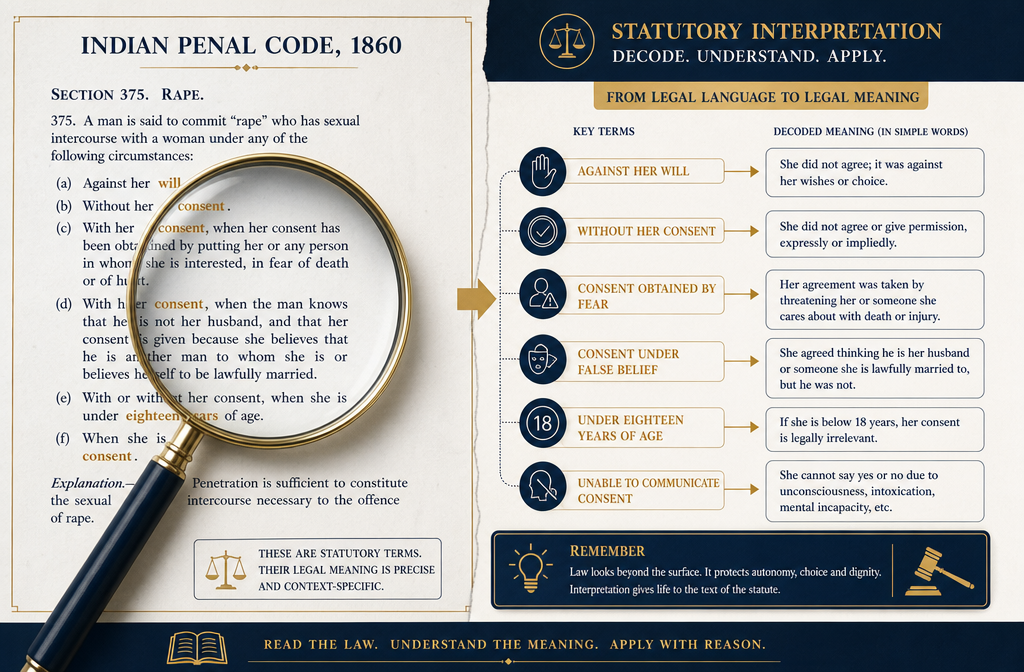
In law, "def" is shorthand for "definition" — the precise, authoritative meaning assigned to a word or phrase within a specific legal instrument. A statutory definition controls how every other provision in that Act must be read.
When a statute says "unless the context otherwise requires," it signals that the definition given in the definition clause governs the entire Act. This is not the same as looking up a word in a dictionary. The legislature can define "vehicle" to include a bicycle, or exclude a tractor — and that choice binds every court, officer, and citizen operating under that law.
For CLAT 2027 aspirants engaging with What is the Def: Decoding Legal Definitions and Statutory Interpretations for CLAT 2027, the practical takeaway is this: always locate the definition section of any statute before reading its operative provisions. In Indian law, definition sections are almost always placed at the beginning of an Act (typically Section 2) and use phrases like "means," "includes," or "means and includes."
Three types of statutory definitions to recognize:
| Definition Type | What It Does | Example Signal |
|---|---|---|
| Exhaustive ("means") | Limits the term strictly to what is listed | "X means…" |
| Inclusive ("includes") | Expands beyond ordinary meaning | "X includes…" |
| Means and includes | Defines core meaning, then expands it | "X means…and includes…" |
Understanding this table alone can prevent several wrong answers on a CLAT paper [9].
How Do Definitions Matter for the CLAT Exam
Definitions matter for CLAT because the exam does not ask candidates to memorize laws — it asks them to apply a given legal rule or definition to a new set of facts. Every Legal Reasoning passage in CLAT provides a principle or definition and then tests whether the candidate can correctly apply it.
This design means that a student who understands how definitions work structurally will outperform one who has memorized hundreds of bare-act provisions. The question is always: does this fact situation fall within or outside the definition as given?
For deeper context on how the exam is structured, the Complete CLAT Success Guide 2027 provides a full breakdown of section weights and question types.
Why definitions are high-stakes in CLAT:
- Legal Reasoning typically carries around 35 questions in the CLAT UG paper.
- A significant portion of those questions hinge on whether a defined term applies to a given scenario.
- Getting the definition wrong cascades — one misread definition can cause two or three follow-up questions to fall as well.
- The exam rewards precision, not general legal awareness.
Common mistake: Treating a definition passage like a reading comprehension exercise. It is not. It is a logic exercise where the definition is the rule and the facts are the variables.
Difference Between Statutory and Common Law Definitions
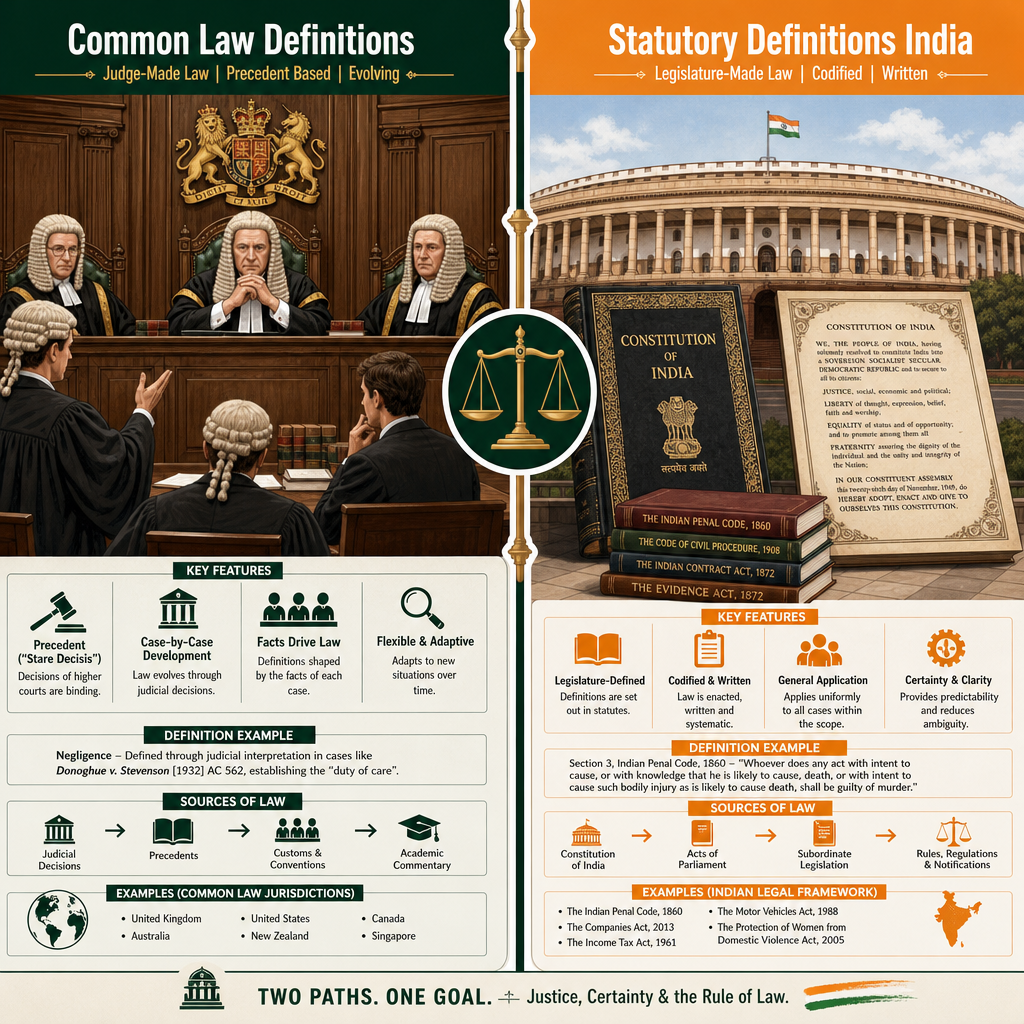
Statutory definitions are written by the legislature and appear in the text of an Act. Common law definitions are developed by judges over time through case decisions. For CLAT 2027, both types appear, but they function very differently.
A statutory definition is fixed until Parliament amends it. A common law definition can evolve as courts encounter new fact patterns. For example, the term "consideration" in contract law has a common law definition developed through centuries of English case law, while the term "document" under the Indian Evidence Act has a statutory definition that controls its meaning in Indian courts.
Key differences at a glance:
- Source: Statutory = Parliament or state legislature. Common law = judicial decisions.
- Flexibility: Statutory definitions are rigid within the Act's scope. Common law definitions can be refined by higher courts.
- Hierarchy: In India, a statutory definition overrides a common law definition for matters covered by that statute.
- CLAT relevance: Passages often provide a statutory-style definition directly in the question. Candidates must apply that definition, not their general knowledge of the term.
For aspirants comparing different exam formats, the CLAT vs AILET exam comparison is worth reviewing, as AILET tests legal definitions somewhat differently.
Which Law Entrance Exam Tests Legal Definitions the Most
Among Indian law entrance exams, CLAT tests legal definitions most rigorously. AILET and LSAT-India also include legal reasoning, but CLAT's passage-based format specifically requires candidates to work through definitional problems in context.
CLAT UG's Legal Reasoning section presents a passage that may contain a statutory definition, a legal principle, or a judicial rule. The candidate must then answer four to five questions by applying only what is stated in the passage — no outside legal knowledge required or rewarded. This makes definitional precision the core skill being tested.
SLAT (Symbiosis Law Admission Test) and MH-CET Law also test legal aptitude, but their formats are more knowledge-based than application-based. For a broader view of your options, see this guide on alternative law entrance exams.
How Hard Are Definition Questions in CLAT
Definition questions in CLAT range from straightforward to genuinely tricky, depending on how the definition is constructed. For most aspirants, the difficulty is not the legal content — it is the logical precision required.
A passage might define "public servant" in a way that includes or excludes certain categories. The question then presents a borderline fact scenario. The candidate who reads carefully and applies the definition literally will get it right. The candidate who relies on common sense or general knowledge will often get it wrong.
Difficulty factors that increase the challenge:
- Definitions with multiple sub-clauses and exceptions
- Inclusive definitions that expand the ordinary meaning in unexpected ways
- Deeming fictions ("X shall be deemed to be Y for the purposes of this Act")
- Definitions that reference other defined terms within the same passage
The Is CLAT Exam Tough guide provides honest difficulty benchmarks across all sections.
Can Non-Law Students Understand Legal Definitions Easily
Yes — non-law students can absolutely understand and master legal definitions for CLAT. The exam is designed for Class 12 students, most of whom have no formal legal training. The passage-based format ensures that all necessary information is provided within the question itself.
What non-law students often struggle with is not the legal content but the habit of reading definitions literally rather than intuitively. Legal language is precise by design. A word like "or" in a statute can mean something different from its conversational use. Building this reading habit takes practice, not a law degree.
Steps for non-law students to build definitional literacy:
- Start by reading the definition sections (Section 2) of simple Indian statutes — the Consumer Protection Act 2019 and the Motor Vehicles Act 1988 are good starting points.
- Practice identifying whether a definition is exhaustive, inclusive, or combined.
- Work through CLAT mock test passages that focus on Legal Reasoning.
- After each mock, review every definition question you got wrong and identify whether the error was a reading error or a logic error.
- Build a vocabulary list of legal signal words: "means," "includes," "notwithstanding," "subject to," "deemed," "shall."
For students starting early, the guide on CLAT preparation from Class 11 outlines how to build this foundation gradually.
What Are the Trickiest Legal Definition Types in CLAT
The trickiest definitions in CLAT are inclusive definitions, deeming fictions, and cross-referential definitions. These three types consistently produce the most errors among test-takers.
Inclusive definitions expand the ordinary meaning of a term. If a statute says "vehicle includes a bicycle," then a question about whether a bicycle-related incident falls under the Act becomes a trap — common sense says no, the definition says yes.
Deeming fictions are provisions where the law treats something as if it were something else. "A shall be deemed to be the owner" does not mean A is actually the owner — it means the law treats A as the owner for specific purposes. Misreading this causes cascading errors.
Cross-referential definitions define Term A by reference to Term B, which is itself defined elsewhere in the passage. Candidates must track both definitions simultaneously.
"The definition section is the key to the entire statute. Read it first, read it carefully, and return to it every time a defined term appears in the operative provisions." — Georgetown Law's Guide to Reading and Interpreting Statutes [9]
Edge case to watch: Some CLAT passages include a definition that explicitly contradicts the everyday meaning of a word. This is intentional. The exam is testing whether you trust the text or your instincts. Always trust the text.
Most Common Legal Definition Mistakes in CLAT
The single most common mistake is substituting the ordinary meaning of a word for the statute's definition. The second most common is failing to notice exceptions or exclusions within the definition itself.
Top mistakes and how to avoid them:
| Mistake | Why It Happens | Fix |
|---|---|---|
| Using dictionary meaning instead of statutory definition | Habit from everyday reading | Always locate and apply the passage's definition first |
| Missing the "includes" signal | Skimming the definition clause | Underline signal words before answering |
| Ignoring exceptions within the definition | Definitions with sub-clauses feel complex | Read the full definition, including provisos |
| Applying outside legal knowledge | Knowing real law can mislead | Answer only from the passage |
| Misreading deeming fictions | "Deemed" sounds like "assumed" | Treat deeming as a hard legal rule, not a soft presumption |
For aspirants who want to identify and fix their weak areas systematically, the CLAT weak section emergency kit is a practical resource.
How Much Time Should You Spend Studying Legal Definitions
For most CLAT 2027 aspirants, 30 to 45 minutes of focused daily practice on Legal Reasoning — including definition-based questions — is sufficient. This assumes a six-month preparation timeline starting from around mid-2026.
The key is quality over quantity. Spending 45 minutes reading statute definitions passively is less effective than spending 20 minutes actively working through three to four passage-based questions and reviewing every error.
Suggested weekly allocation for definition mastery:
- 3 days per week: Work through 2 to 3 Legal Reasoning passages from previous CLAT papers or mock tests.
- 2 days per week: Read one definition section from a real Indian statute and practice classifying each definition as exhaustive, inclusive, or combined.
- 1 day per week: Review all errors from the week's practice and identify patterns.
- 1 day per week: Full-length mock test that includes Legal Reasoning under timed conditions.
Using mock tests strategically is essential. The guide on mock test mastery for CLAT explains how to extract maximum learning from each practice session.
Are Online Courses Better or Coaching Classes for Learning Legal Definitions
Neither format is universally better — the right choice depends on the student's learning style, schedule, and access to quality feedback. Both can produce strong results for CLAT 2027 if used correctly.
Online courses offer flexibility and often include recorded explanations of legal reasoning passages that can be replayed. Coaching classes offer structured accountability and the ability to ask questions in real time. The critical variable is not the format but the quality of practice material and the consistency of the student.
Choose online if:
- You have an irregular schedule or live outside a major city.
- You learn well from video explanations and self-paced review.
- You are disciplined enough to maintain a study routine without external accountability.
Choose classroom coaching if:
- You benefit from peer competition and in-person discussion.
- You need regular feedback on your Legal Reasoning answers from an instructor.
- You struggle with self-motivation over long preparation periods.
For a detailed comparison, the Best CLAT PG Online Coaching buyer's guide covers evaluation criteria across both formats. Aspirants who prefer self-study can also consult the self-study plan for CLAT.
Top Resources to Learn Legal Definitions for CLAT 2027
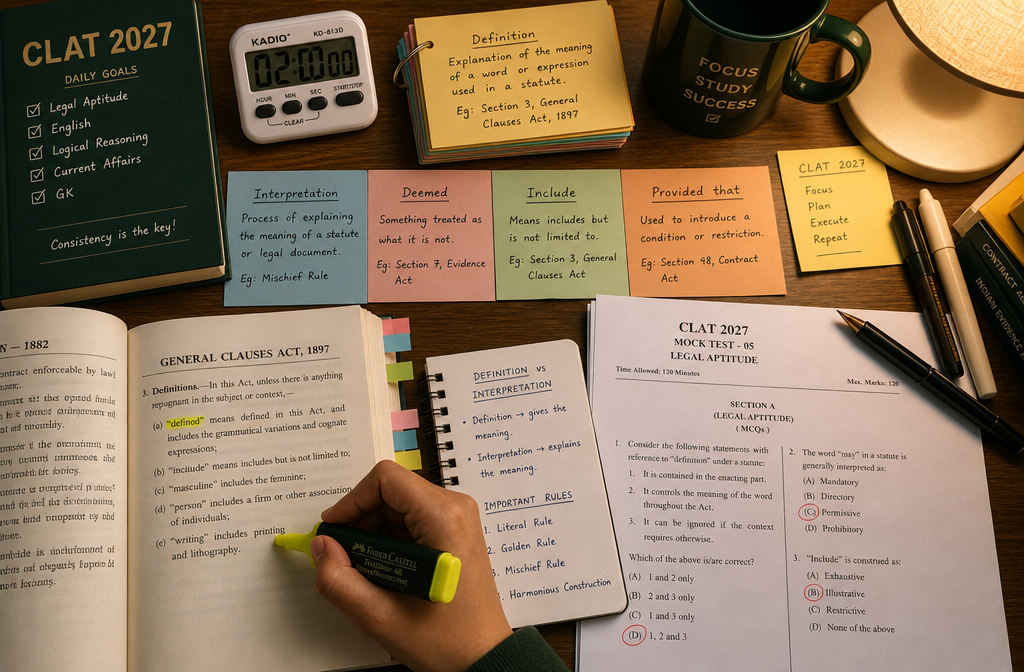
The best resources combine statutory text with application practice. Passive reading of law books is not enough — candidates need to practice applying definitions to fact scenarios repeatedly.
Recommended resources:
- Previous CLAT papers (2015 to 2025): The most reliable source of authentic definition-based questions. Every Legal Reasoning passage is a masterclass in how definitions are tested.
- CLAT consortium's official sample papers: Released before each exam cycle; reflect current question style.
- Simple Indian statutes: The Consumer Protection Act 2019, the Information Technology Act 2000, and the Indian Contract Act 1872 all have well-structured definition sections that are accessible to beginners.
- Georgetown Law's Guide to Reading, Interpreting, and Applying Statutes [9]: A concise, authoritative guide to statutory interpretation that is directly applicable to CLAT-style questions.
- Quality mock test platforms: Platforms that provide detailed answer explanations for Legal Reasoning questions are more valuable than those that only give correct answers.
- 7 Ultimate CLAT Resources for 2027: A curated list of free and low-cost preparation materials.
What to avoid: Generic "legal GK" books that focus on memorizing provisions rather than building interpretive skill. CLAT does not reward memorization of definitions — it rewards the ability to apply them.
How Do International Legal Definitions Differ from Indian Legal Definitions
International legal definitions — particularly those from UK common law and US federal statutes — differ from Indian statutory definitions in interpretive philosophy, drafting style, and judicial approach.
In the UK common law tradition, courts have historically been willing to look beyond the literal text to find the "mischief" the law was meant to address (the Mischief Rule). Indian courts use a mix of the Literal Rule, the Golden Rule, and the Mischief Rule, but Indian statutes are generally drafted to be self-contained, with definition sections that reduce reliance on judicial interpretation.
US federal statutes often include extensive legislative history (committee reports, floor debates) that courts use to interpret ambiguous definitions. Indian courts rely primarily on the text, with reference to the Statement of Objects and Reasons when the text is genuinely ambiguous.
Practical implications for CLAT 2027:
- CLAT passages are modeled on Indian statutory drafting conventions. Apply the literal meaning of the definition as given.
- Do not import interpretive approaches from other jurisdictions unless the passage explicitly invites it.
- If a passage references an international legal concept, the definition provided in the passage controls — not your knowledge of how that concept works in another country's law.
For aspirants interested in how the legal profession itself is evolving in response to global influences, the article on how the legal profession is going to change provides useful context.
FAQ
What does "def" mean in a legal statute?
"Def" is shorthand for "definition." In a statute, it refers to the formal meaning assigned to a specific term within that Act. This meaning controls how the term is read throughout the entire legislation, regardless of its ordinary meaning.
Is legal reasoning the hardest section in CLAT?
Legal Reasoning is considered challenging because it requires logical precision, not legal knowledge. Most aspirants find it manageable once they learn to read definitions literally and apply them systematically rather than relying on intuition.
Do I need to memorize legal definitions for CLAT 2027?
No. CLAT provides all necessary definitions within the passage. The skill being tested is application, not memorization. Memorizing bare-act definitions can actually be counterproductive if it leads you to apply outside knowledge instead of the passage's definition.
What is a deeming fiction in law?
A deeming fiction is a statutory provision that treats something as legally equivalent to something else for specific purposes, even if it is not actually the same thing. For example, "a minor shall be deemed to be an adult for the purposes of this section" does not change the person's age — it changes their legal status under that specific provision.
How many questions in CLAT test legal definitions directly?
While the exact number varies by year, a substantial portion of the Legal Reasoning section (which typically carries around 35 questions) involves applying a definition or legal principle to a fact scenario. Definitional precision affects nearly every Legal Reasoning question.
Can I prepare for CLAT legal definitions without a coaching institute?
Yes. Self-study using previous CLAT papers, official sample papers, and basic Indian statutes is sufficient. Consistent practice and error analysis matter more than the source of instruction.
What is the difference between "means" and "includes" in a statutory definition?
"Means" creates an exhaustive definition — the term covers only what is listed. "Includes" expands the ordinary meaning — the term covers its ordinary meaning plus what is listed. "Means and includes" does both: it defines the core meaning and then expands it.
Are CLAT 2027 legal definitions based on Indian law only?
CLAT passages may draw on concepts from any legal system, but the definition provided in the passage is always the controlling definition. Candidates should apply what the passage says, not what they know about the concept from any particular jurisdiction.
How do I improve my speed on Legal Reasoning passages?
Practice reading definition clauses first, then the fact scenario, then the questions. This sequence reduces re-reading. Timed practice with previous CLAT papers builds the pattern recognition needed for speed. The guide on reading 450-word CLAT passages offers specific techniques.
What is the best way to practice applying legal definitions?
Work through CLAT mock test passages under timed conditions, then review every error. For each wrong answer, identify whether you misread the definition, misapplied it, or were misled by outside knowledge. This targeted review builds precision faster than volume practice alone.
Conclusion
What is the Def: Decoding Legal Definitions and Statutory Interpretations for CLAT 2027 comes down to one core skill: reading legal language precisely and applying it logically. The exam does not reward legal knowledge — it rewards the ability to take a definition as given and determine whether a specific set of facts falls within or outside it.
Actionable next steps for CLAT 2027 aspirants:
- Start with the definition sections of two or three accessible Indian statutes this week. Read each definition and classify it as exhaustive, inclusive, or combined.
- Work through at least five previous CLAT Legal Reasoning passages, focusing exclusively on how definitions are constructed and applied.
- Build a signal-word vocabulary list: "means," "includes," "deemed," "notwithstanding," "subject to," "unless the context otherwise requires."
- Integrate timed mock tests into your weekly schedule and review every Legal Reasoning error with the question: did I misread the definition, or did I misapply it?
- Use the 7 Ultimate CLAT Resources for 2027 to access quality practice material without overspending.
The aspirants who score highest in Legal Reasoning are not those with the most legal knowledge. They are the ones who have trained themselves to trust the text, apply the definition as written, and resist the pull of common sense when the statute says otherwise. That discipline is entirely learnable — and 2026 is the right time to build it.