Last updated: June 19, 2026
Quick Answer: A CLAT mock test is a full-length practice exam that mirrors the actual CLAT pattern, 120 questions in 120 minutes with +1/-0.25 marking. Taking them consistently, analyzing your errors, and adjusting your strategy is the single most effective way to improve your score. Beginners should start with one mock per week and build up to three or more in the final month before the exam.
Key Takeaways
- The official CLAT mock test from the Consortium of NLUs is free but requires candidate login. Third-party platforms offer additional series with detailed analytics.
- Attempting a mock test without a proper review session is almost useless. Analysis is where the real learning happens.
- Negative marking of 0.25 per wrong answer means blind guessing will hurt your score. Learn to make educated eliminations instead.
- Section-wise performance tracking across multiple mocks reveals patterns that single-test results never show.
- Most serious aspirants take between 30 and 50 full-length mocks before the actual exam.
- Time management is a skill you build through repetition, not theory. Mocks are the only way to train it.
- Your first mock score does not predict your final score. Improvement is the only number that matters early on.
- Free resources exist, but structured mock series with answer explanations and analytics are worth investing in.
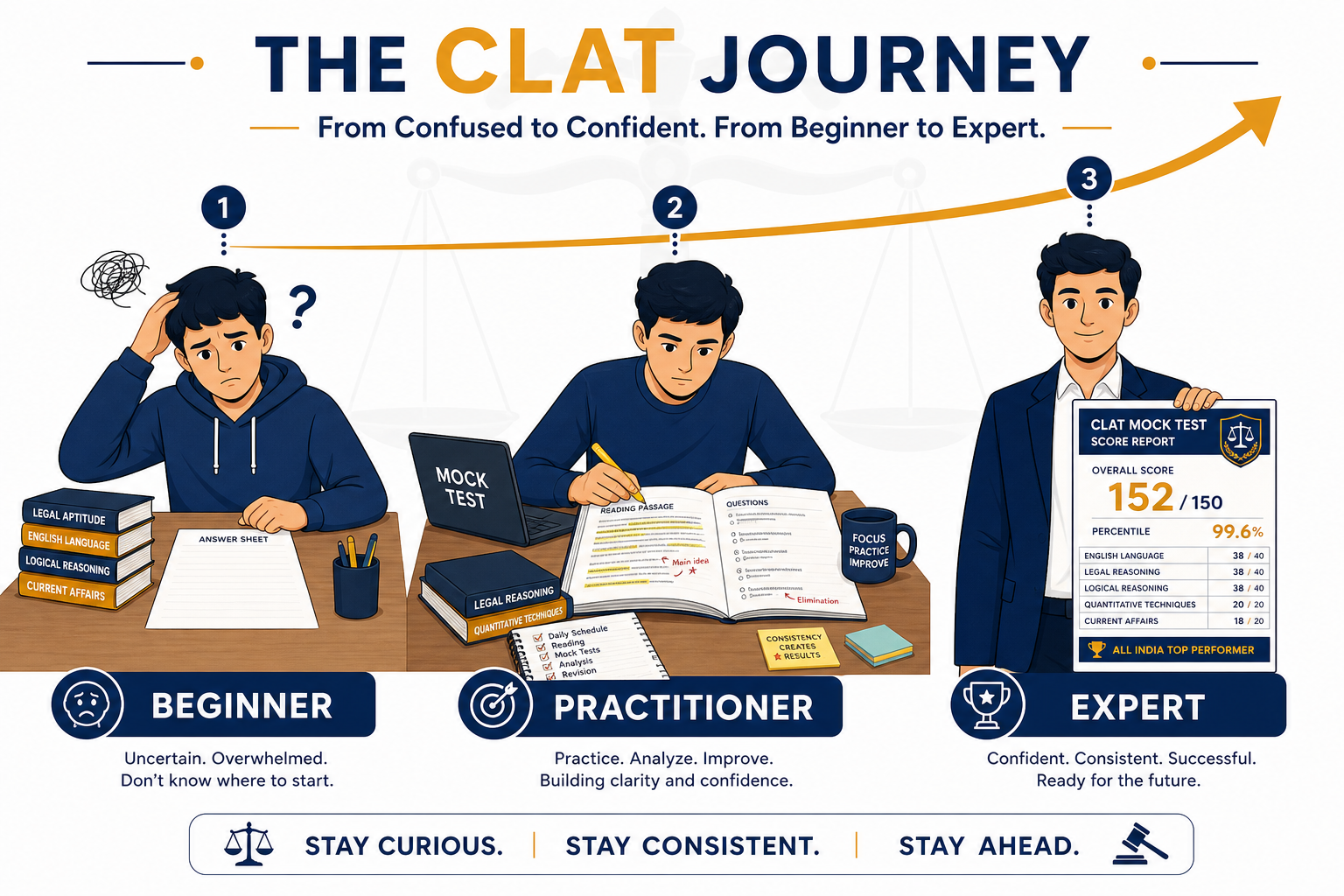
What Exactly Is a CLAT Mock Test and Why Does It Matter So Much
A CLAT mock test is a simulated version of the actual Common Law Admission Test, designed to replicate the real exam in format, difficulty, and time pressure. For 2026 and beyond, the UG paper has 120 questions to be solved in 120 minutes, with +1 for every correct answer and -0.25 for every wrong one.
But here’s the thing: the mock test is not just a practice tool. It is a diagnostic instrument. Every time you sit for one, you are generating data about where you stand, what you know, what you are guessing on, and how you manage pressure. That data, when used properly, is what separates aspirants who improve from those who plateau.
Why mocks matter more than any other prep activity:
- They expose the gap between what you think you know and what you can actually apply under time pressure.
- They train your brain to work at exam speed, which is a separate skill from content knowledge.
- They reveal section-specific weaknesses that chapter-by-chapter study often hides.
- They build the mental stamina needed to stay focused for two full hours.
- They normalize exam anxiety so the real day feels familiar, not foreign.
Let’s be honest: reading theory and solving chapter-wise questions is necessary, but it is not sufficient. The aspirants who crack CLAT with top ranks are almost always the ones who treated their CLAT mock test practice as seriously as they treated their content preparation.
How the Official CLAT Mock Test Works and Where to Find It
The Consortium of NLUs, which conducts CLAT, provides an official mock test free of charge. This is the most accurate representation of the actual exam interface and question style available. However, it is gated behind candidate login, meaning you need to register for CLAT before you can access it [4].
Official mock test details:
- Provider: Consortium of NLUs (consortiumofnlus.ac.in)
- Cost: Free for registered candidates
- Format: Matches the actual CLAT UG paper exactly (120 questions, 120 minutes, +1/-0.25)
- Purpose: Familiarizes candidates with the online interface and navigation
Beyond the official test, several third-party platforms offer CLAT mock test series with varying levels of quality and analytics [1][8]:
| Platform | Free Tests Available | Paid Series | Key Feature |
|---|---|---|---|
| Careers360 | Yes (limited) | Yes | Detailed section analytics [4] |
| Shiksha | Yes | Yes | Peer comparison data [1] |
| Toprankers | Yes (limited) | Yes | AI-based weak area detection [8] |
| Testbook | Yes | Yes | Large question bank [10] |
| iXambee | Yes | Yes | Full-length free mocks [5] |
| LawEntrance | Yes (FreeZone) | Yes | Free practice resources [2] |
The Consortium’s official mock is non-negotiable. Take it early in your prep to get comfortable with the interface. Then supplement with third-party series for volume and variety.
For aspirants watching their budget, there are also free Telegram channels and community resources worth exploring. Check out our guide on the best Telegram channels for free CLAT mocks and study material to find quality resources without spending a rupee.
A quicker option to start with. We have put a free 30-question CLAT mock test on this site — no signup, no download, marked the way CLAT marks it (+1 and −0.25), with a worked solution for every question. It is a diagnostic rather than a full-length paper, so it takes about half an hour and tells you which section to read the rest of this guide for.
When Should You Start Taking CLAT Mock Tests
Start earlier than you think you need to. Most aspirants wait until they feel “ready,” and that moment never quite arrives.
The right time to take your first full-length CLAT mock test is within the first four to six weeks of starting your preparation. Yes, even if you haven’t covered all the syllabus. Here’s why: your first mock is not about scoring well. It is about understanding what the exam actually demands.
A realistic mock test schedule by preparation stage:
Early stage (6+ months before exam)
- One full-length mock per week or every ten days
- Focus: understanding the format, building stamina, identifying weak sections
- After each mock: spend 2x the test time on review
Mid stage (3 to 6 months before exam)
- Two full-length mocks per week
- Focus: section-wise improvement, time allocation strategy, eliminating careless errors
- Add sectional mocks for your weakest areas between full-length tests
Final stage (last 4 to 6 weeks)
- Three or more full-length mocks per week
- Focus: speed, accuracy, consistency, exam-day simulation
- Take at least 4 to 5 mocks under strict exam conditions (no phone, no breaks, timed)
If you started your preparation in Class 11, you have a significant advantage here. Our guide on starting CLAT preparation from Class 11 walks through how to build this mock test habit from the very beginning.
The aspirants we’ve helped who made the most dramatic improvements followed one rule: they never let a week pass without at least one timed mock in the final three months. Results speak louder than promises, and this pattern shows up consistently in top scorers.
If you are working from past papers as well as mocks, check which CLAT past papers still match the current format first — twelve of the nineteen in circulation are for a different exam.
How to Analyze a CLAT Mock Test the Right Way
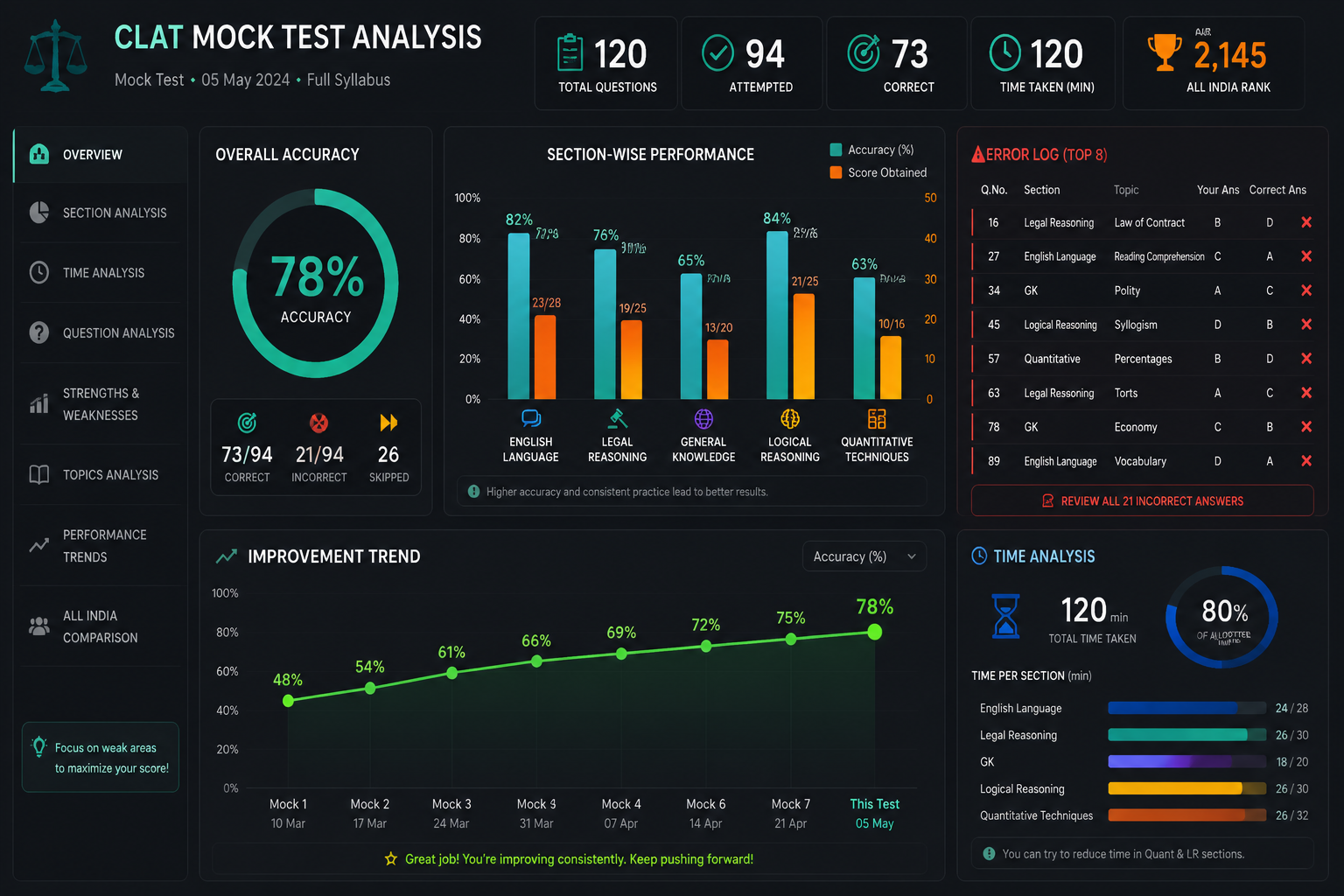
Taking the test is only half the work. The analysis session afterward is where actual improvement happens. Most aspirants skip this or do it superficially, which is why they keep making the same mistakes across 20 different mocks.
Here is a structured approach to mock test analysis that actually works:
Step 1: Categorize every wrong answer
Do not just note that you got a question wrong. Classify it:
- Wrong because of a knowledge gap (you didn’t know the content)
- Wrong because of a reasoning error (you understood but misapplied)
- Wrong because of a careless mistake (you knew but rushed)
- Wrong because of a time crunch (you guessed under pressure)
Each category needs a different fix. Lumping them together means you’ll never solve the real problem.
Step 2: Track your attempt rate and accuracy separately
A student who attempts 100 questions with 70% accuracy scores differently from one who attempts 85 questions with 85% accuracy. Both are valid strategies, but you need to know which profile you are and which one serves you better.
Step 3: Identify your “leaking” sections
If you consistently score well in English but lose marks in Legal Reasoning, that is your priority. Our detailed guide on unmasking weaknesses through mock tests goes deep into how to use mock data to find and fix these leaks systematically.
Step 4: Review every question you got right through guessing
This one surprises people. If you guessed correctly, you got lucky. That question is still a knowledge gap. Mark it and revisit it.
Step 5: Time audit
Go through your attempt sequence. Where did you spend too long? Which question types slow you down? This is where you build your personal time management strategy for the real exam.
Common mistake: Spending the analysis session re-reading explanations for questions you already understood. Spend 80% of your analysis time on wrong answers and skipped questions, not on the ones you got right.
What a Smart CLAT Mock Test Strategy Looks Like Section by Section
The CLAT UG paper has five sections, and each one demands a different approach during mock tests. Treating them all the same is one of the biggest strategic errors aspirants make.
English Language (28-32 questions)
This section is passage-based. During mocks, practice reading the questions before the passage so you know what to look for. Track how long you spend per passage. Most aspirants should aim for 18 to 22 minutes on this section. Our guide on how to read 450-word CLAT passages covers the specific techniques that work for this format.
Current Affairs and General Knowledge (35-39 questions)
This is the highest-weightage section and also the most unpredictable. In mocks, note which GK topics you consistently blank on. This tells you where your current affairs coverage has gaps. For a structured approach to this, see our guide on mastering CLAT current affairs without daily newspapers.
Legal Reasoning (35-39 questions)
The most misunderstood section. CLAT does not test legal knowledge here. It tests your ability to apply a given principle to a given set of facts. In mocks, if you are getting legal reasoning questions wrong, ask yourself: are you bringing in outside legal knowledge? That is the most common error.
Logical Reasoning (28-32 questions)
Passage-based logical reasoning has evolved significantly. The CLAT 2026 paper introduced puzzle-type questions that caught many aspirants off guard. Understanding why CLAT 2026 logical reasoning changed the game will help you prepare for what current mocks should be testing.
Quantitative Techniques (13-17 questions)
The lowest-weightage section but also the most time-consuming if you let it be. In mocks, set a hard cap: if a quant question takes more than 90 seconds, skip it and come back. Never let this section eat into your Legal Reasoning or GK time.
How Many CLAT Mock Tests Do You Actually Need to Take
There is no single magic number, but the data from serious aspirants points to a range of 30 to 50 full-length mocks as a reasonable target for someone preparing over 8 to 12 months. For shorter preparation windows, prioritize quality of analysis over quantity of tests.
Here’s a more useful way to think about it:
Choose volume based on your timeline:
- 12+ months of prep: 40 to 60 mocks total
- 6 to 12 months: 25 to 40 mocks total
- 3 to 6 months: 15 to 25 mocks total
- Under 3 months: 10 to 15 mocks with intensive analysis
Signs you need more mocks:
- Your score varies wildly between tests (high variance means inconsistency)
- You still feel anxious or unfamiliar with the exam format
- You haven’t stabilized your section-wise time allocation
Signs you need better analysis, not more mocks:
- You’re taking 5 mocks a week but your score hasn’t moved in a month
- You keep making the same types of errors
- You rush through review sessions
The 90-day transformation plan from 30 to 95 in CLAT mocks is one of the most practical roadmaps we’ve built for aspirants who want to see real score movement in a defined timeframe. It is not about doing more. It is about doing the right things in the right order.
The Biggest CLAT Mock Test Mistakes That Kill Your Score
We’ve seen thousands of aspirants go through mock test cycles, and certain mistakes come up again and again. Knowing them in advance saves you weeks of wasted effort.
Mistake 1: Taking mocks without exam conditions
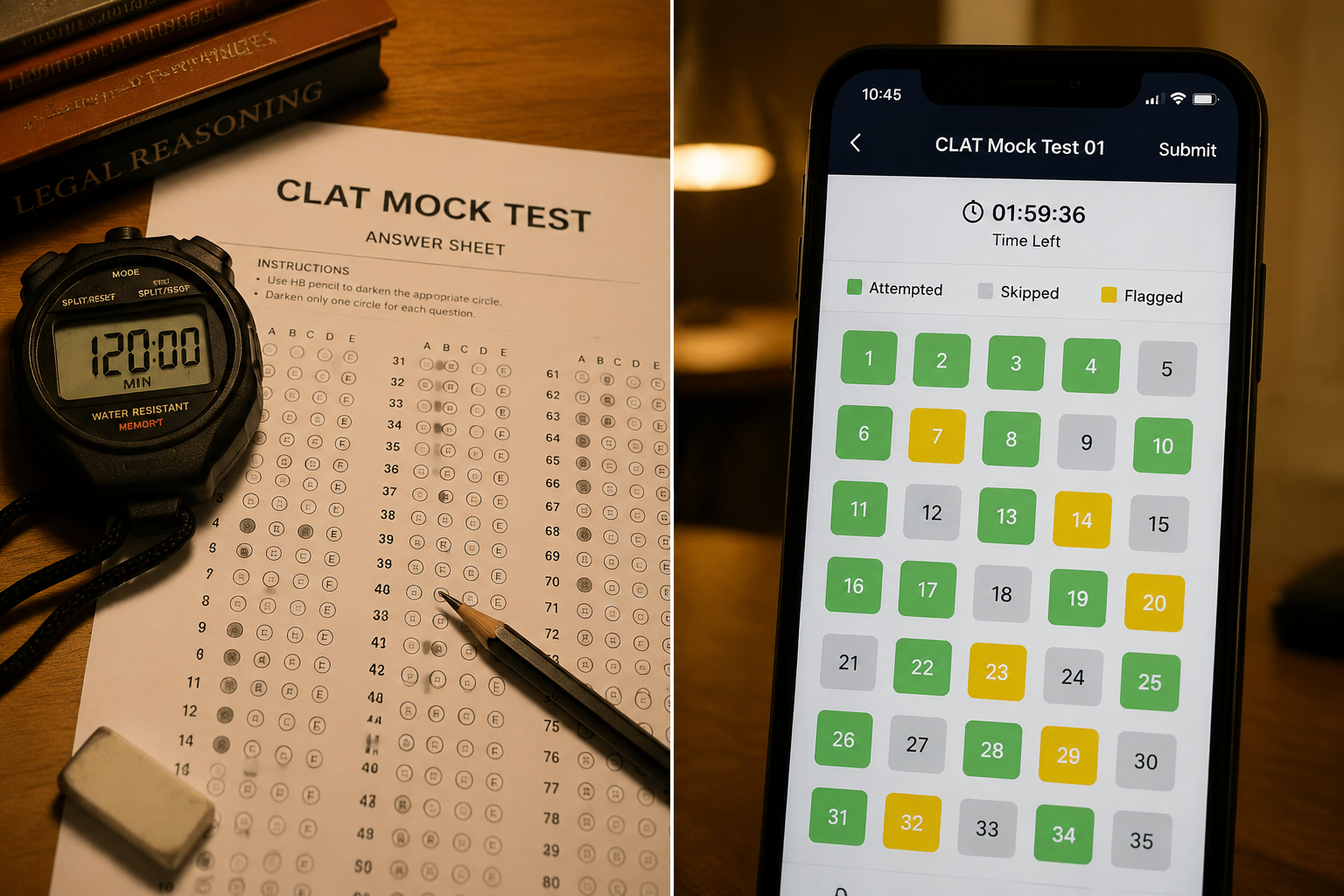
Solving a mock test with your phone nearby, music playing, or the ability to pause and look something up is not practice. It is false confidence. Always simulate real exam conditions: timer on, no breaks, no distractions.
Mistake 2: Focusing only on the total score
Your total score tells you very little. Section-wise scores, attempt rates, and accuracy percentages tell you everything. A student scoring 85 overall with 60% accuracy in Legal Reasoning has a very different problem from one scoring 85 with 90% accuracy but only attempting 70 questions.
Mistake 3: Skipping mocks when preparation feels incomplete
Waiting until you’ve “finished the syllabus” before taking mocks means you’ll take your first mock three weeks before the exam. That is not enough time to use the data. Take mocks even when you feel unprepared.
Mistake 4: Not maintaining a mock test error log
Every wrong answer should go into a dedicated notebook or spreadsheet. Topic, question type, reason for error, correct approach. Review this log weekly. Patterns will emerge that you cannot see by looking at individual test reports.
Mistake 5: Ignoring the negative marking math
At -0.25 per wrong answer, attempting 10 extra questions with 40% accuracy actually reduces your score. In mocks, practice calculating your expected score from attempts and accuracy. This teaches you when to attempt and when to skip.
Mistake 6: Treating every mock as a performance test
Some mocks should be experiments. Try a different section order. Test a new time allocation strategy. Use some mocks to practice, not just to perform. Save the full performance mindset for the final 10 to 15 mocks before the exam.
How to Use CLAT Mock Test Results to Build a Revision Plan
Your mock test data should directly drive your revision schedule. This is where most aspirants leave significant marks on the table.
After every three to four mocks, do a consolidated review:
- Which topics appear most frequently in your error log?
- Which section has the lowest accuracy rate consistently?
- Are your errors concentrated in specific question types or spread evenly?
Use the answers to set your revision priorities for the next two weeks. This is not a cookie-cutter approach. Your revision plan should look different from your friend’s because your mock data is different.
For a structured revision framework that works alongside your mock test cycle, our guide on CLAT revision mastery gives you a practical system for making revision sessions count.
A simple weekly structure that works:
| Day | Activity |
|---|---|
| Monday | Full-length mock test (timed, exam conditions) |
| Tuesday | Full analysis of Monday’s mock |
| Wednesday | Targeted revision of weak areas identified |
| Thursday | Sectional mock on weakest section |
| Friday | Content study and current affairs |
| Saturday | Full-length mock test |
| Sunday | Analysis + light revision + next week planning |
This structure is flexible. Adjust it to fit your school schedule, board exam commitments, or coaching timetable. Flexible learning that fits your life is the point. The structure itself matters less than the consistency.
Conclusion: Your CLAT Mock Test Journey Starts Now
Let’s pull this together. The CLAT mock test is not a formality you tick off before the real exam. It is the core of your preparation strategy. Every mock you take, every error you log, every analysis session you complete is building the skills and instincts you need on exam day.
Here are your actionable next steps:
- Register on the Consortium of NLUs portal and access the official mock test immediately.
- Take your first full-length mock this week, even if you feel unprepared. Use it as a baseline.
- Set up an error log today. A simple notebook or spreadsheet works fine.
- Build a mock test schedule that increases in frequency as your exam date approaches.
- Commit to spending at least as much time analyzing each mock as you spent taking it.
- Use your mock data to drive your revision plan, not the other way around.
Your success is our mission at Lawgic Coaching. We’ve helped thousands crack CLAT, and the pattern is always the same: the aspirants who treat mock tests as learning tools rather than performance tests are the ones who show up on results day with smiles on their faces.
You don’t need a perfect plan. You need a consistent one. Let’s build your law career together, one mock test at a time.
Frequently Asked Questions
How many CLAT mock tests should I take before the exam?
Most serious aspirants take between 30 and 50 full-length mocks over their preparation period. For shorter timelines of three to six months, aim for at least 15 to 25 mocks with thorough analysis after each one.
Is the official CLAT mock test free?
Yes. The Consortium of NLUs provides an official free mock test, but it is only accessible after you have registered as a CLAT candidate and logged into the portal [4].
What is the pattern of the CLAT UG mock test?
The current CLAT UG mock test follows the official exam pattern: 120 questions in 120 minutes, with +1 mark for correct answers and -0.25 for incorrect ones. No official change to this format has been announced for upcoming cycles.
When should I start taking full-length CLAT mock tests?
Start within the first four to six weeks of preparation. Your first mock is a diagnostic tool, not a performance test. Do not wait until you feel ready.
Which is the best platform for CLAT mock tests?
The official Consortium mock is the most accurate for interface familiarity. For volume and analytics, platforms like Careers360, Toprankers, Testbook, and iXambee offer quality series with varying features [4][8][10]. Free resources are also available on LawEntrance and through community channels [2].
How long should I spend analyzing a CLAT mock test?
Spend at least as much time on analysis as you spent taking the test. For a 120-minute mock, that means at least two hours of review, ideally more in the early stages of preparation.
Should I take mock tests if I haven’t finished the syllabus?
Yes, absolutely. Waiting for complete syllabus coverage before taking mocks is one of the most common and costly mistakes. Mocks taken on incomplete preparation still generate useful diagnostic data.
What score should I aim for in CLAT mock tests?
There is no universal target, but consistently scoring above 85 to 90 out of 120 with good accuracy puts you in a competitive range for top NLUs. Focus on your improvement trajectory rather than absolute scores in the early months.
Can I take CLAT mock tests on my phone?
Yes. Several platforms including iXambee offer mobile-compatible or app-based mock tests [5][7]. However, if the actual exam is on a desktop interface, practice on a laptop or desktop for at least half your mocks to build interface familiarity.
How do I stop making the same mistakes in every mock?
Maintain a detailed error log categorizing every wrong answer by error type. Review it weekly. If you are not tracking your errors systematically, you will repeat them because you have no clear record of the pattern.
Is negative marking really that significant in CLAT?
Yes. At -0.25 per wrong answer, attempting 20 extra questions with 40% accuracy loses you 3 net marks. Learning when to skip versus when to attempt is a skill that mocks build over time.
Do CLAT mock tests predict my actual exam score?
They are a reasonable indicator of your readiness, but not a perfect predictor. Exam-day conditions, question difficulty variation, and mental state all affect your actual score. Use mock scores as trend data, not as final predictions.