The landscape of legal education in India has witnessed unprecedented growth, with over 75,000 students competing annually for admission into prestigious law schools through various entrance examinations. This surge in competition makes understanding the distinct syllabi and examination patterns crucial for success.
The Common Law Admission Test (CLAT) remains the most sought-after pathway to National Law Universities (NLUs), but it’s not the only option. Other significant examinations like AILET, LSAT-India, and MH CET Law offer alternative routes to legal education, each with unique characteristics and requirements.
This comprehensive guide provides an in-depth analysis of the CLAT syllabus compared to other major law entrance examinations, helping aspirants make informed decisions about their preparation strategy and exam selection.
Key Insights for Law Entrance Exam Preparation
- CLAT syllabus encompasses five core sections with specific weightage for each subject area
- Understanding differences between various law entrance exam patterns enables strategic preparation
- Each examination has distinct focus areas requiring tailored study approaches
- Effective preparation involves mastering syllabi, understanding exam patterns, and developing time management skills
- Current affairs and legal reasoning form the backbone of most law entrance examinations
Understanding India’s Major Law Entrance Examinations
The Current Competitive Landscape
India’s legal education sector has expanded significantly, with 25 National Law Universities and over 1,400 law colleges offering undergraduate and postgraduate programs. The competition intensity varies across different entrance examinations, with CLAT maintaining the highest competition ratio.
Key Statistics for 2026:
- CLAT: Expected 70,000+ applicants for approximately 2,500 seats
- AILET: Around 25,000 applicants for 120 seats
- LSAT-India: 15,000+ test-takers for multiple admissions
- MH CET Law: 40,000+ candidates for Maharashtra colleges
CLAT (Common Law Admission Test)
The Common Law Admission Test serves as the gateway to 25 National Law Universities across India. Conducted by the Consortium of NLUs, CLAT has evolved significantly since its inception, particularly after the 2020 pattern change.
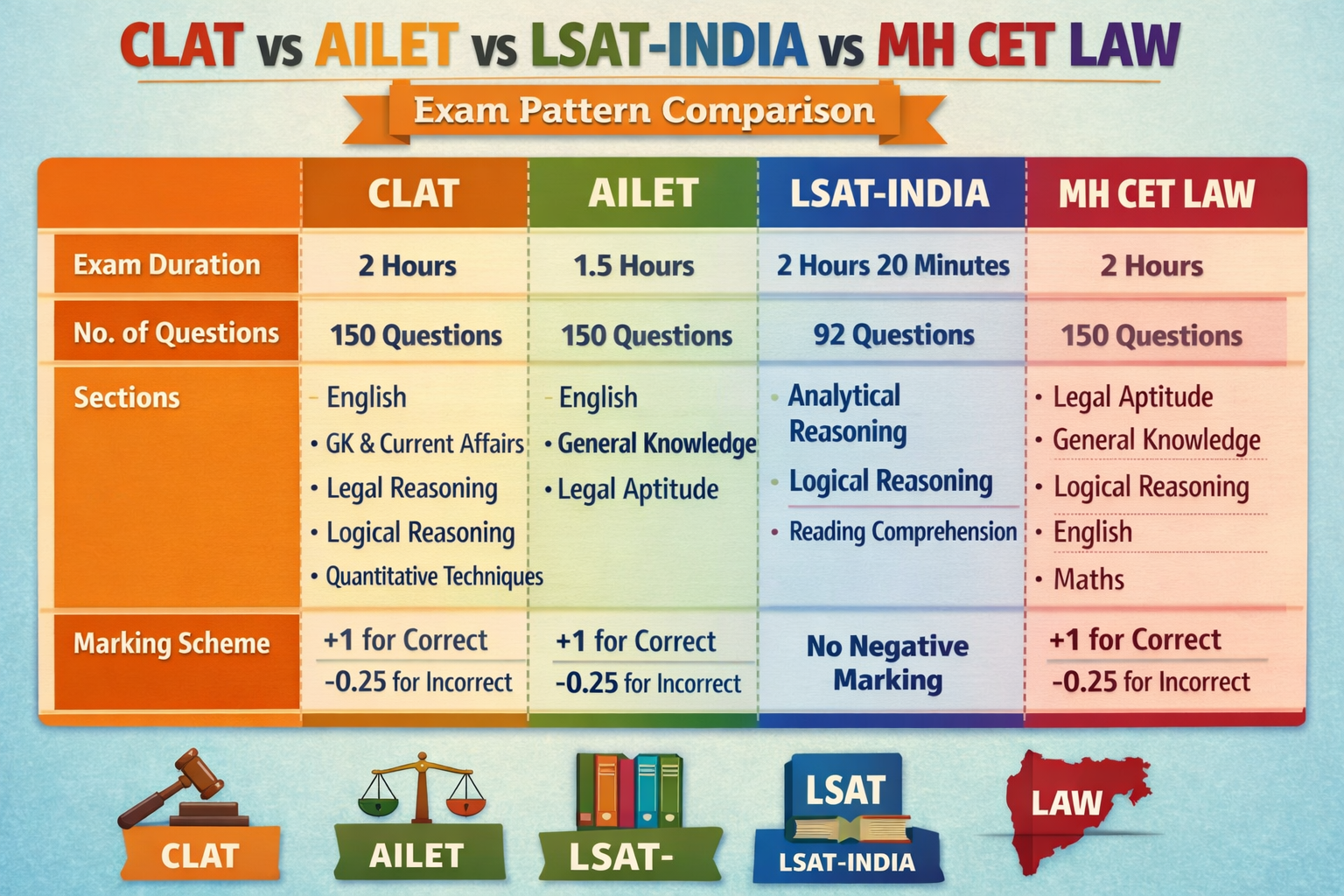
Current CLAT Pattern (2026):
- Duration: 2 hours
- Questions: 120 multiple-choice questions
- Marking Scheme: +1 for correct answers, -0.25 for incorrect responses
- Sections: 5 comprehensive sections based on passage-based questions
The CLAT syllabus emphasizes comprehension-based learning rather than rote memorization, making it essential for candidates to develop analytical and critical thinking skills.
AILET (All India Law Entrance Test)
Conducted exclusively by National Law University Delhi, AILET maintains its traditional format while incorporating contemporary legal developments. The examination attracts high-caliber candidates due to NLU Delhi’s prestigious reputation.
AILET Characteristics:
- Duration: 1.5 hours
- Questions: 150 multiple-choice questions
- Sections: English, General Knowledge, Legal Aptitude, Reasoning, Mathematics
- Unique Feature: Higher emphasis on legal knowledge and current legal developments
LSAT-India (Law School Admission Test-India)
LSAT-India offers a different approach to law school admissions, focusing primarily on analytical and logical reasoning abilities. Administered by Pearson VUE, it provides multiple test dates throughout the year.
LSAT-India Structure:
- Duration: 2 hours 20 minutes
- Questions: 92-100 questions across three sections
- Sections: Analytical Reasoning, Logical Reasoning (2 sections), Reading Comprehension
- Notable Absence: No General Knowledge or Mathematics sections
MH CET Law (Maharashtra Common Entrance Test)
MH CET Law facilitates admissions to government and private law colleges across Maharashtra. The examination pattern closely resembles traditional law entrance tests with some state-specific modifications.
MH CET Law Features:
- Duration: 2 hours
- Questions: 150 multiple-choice questions
- Unique Advantage: No negative marking
- Focus Areas: Legal aptitude with Maharashtra legal framework emphasis
Comprehensive CLAT Syllabus Analysis
Current CLAT Syllabus Structure (2026)
The CLAT syllabus underwent significant restructuring in 2020, shifting from subject-specific questions to passage-based comprehensive evaluation. This change aligns with modern legal education requirements, emphasizing analytical skills over memorization.
English Language and Comprehension
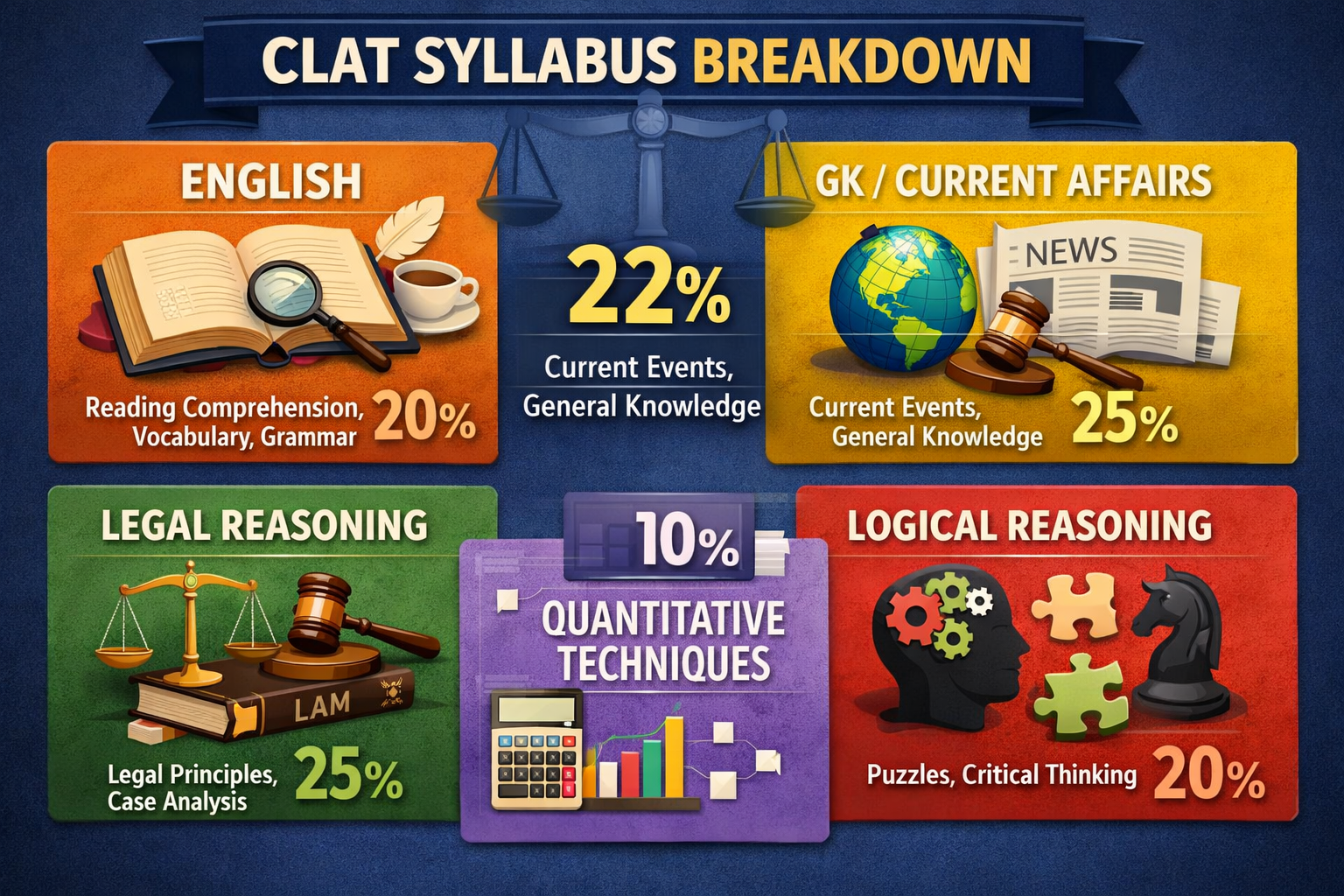
Weightage: 22-26 questions (approximately 20-22%)
The English section evaluates candidates’ ability to comprehend and analyze complex texts, essential for legal studies. Questions are based on passages of 450+ words covering diverse topics.
Key Components:
- Reading Comprehension: Understanding main ideas, author’s tone, and implicit meanings
- Vocabulary in Context: Determining word meanings based on passage context
- Grammar and Usage: Identifying grammatical errors and improving sentence structure
- Critical Analysis: Drawing inferences and evaluating arguments
Preparation Strategy:
- Read quality newspapers like The Hindu, Indian Express daily
- Practice with legal journals and academic articles
- Focus on understanding rather than speed reading
- Develop vocabulary through contextual learning
Current Affairs and General Knowledge
Weightage: 28-32 questions (approximately 25-28%)
This section tests awareness of contemporary developments across various fields, crucial for future legal professionals who must stay informed about societal changes.
Coverage Areas:
- Political Developments: Government policies, international relations, constitutional amendments
- Economic Affairs: Budget highlights, economic policies, market developments
- Social Issues: Education, health, environment, human rights
- Legal Updates: Landmark judgments, new legislation, legal reforms
- International Affairs: Global treaties, international organizations, cross-border issues
Monthly Focus Areas:
- January-March: Budget analysis, policy implementations
- April-June: Electoral developments, international summits
- July-September: Monsoon session legislation, economic indicators
- October-December: Festival seasons, year-end reviews
For comprehensive current affairs preparation, refer to 10 High-Yield GK Topics Every CLAT 2026 Aspirant Must Master.
Legal Reasoning
Weightage: 28-32 questions (approximately 25-28%)
Legal reasoning forms the core of CLAT, testing candidates’ ability to apply legal principles to factual scenarios. This section requires no prior legal knowledge but demands logical thinking.
Question Types:
- Principle-Based Questions: Applying given legal principles to specific situations
- Case Study Analysis: Understanding legal implications of complex scenarios
- Constitutional Law: Basic understanding of fundamental rights and duties
- Contract Law: Simple contract principles and their applications
- Criminal Law: Basic criminal law concepts and their practical applications
Sample Legal Principle:
“A person is liable for negligence if they fail to exercise reasonable care, resulting in harm to another person.”
Application: Candidates must apply this principle to various scenarios, determining liability based on the given facts.
Logical Reasoning
Weightage: 22-26 questions (approximately 20-22%)
Logical reasoning evaluates analytical thinking abilities essential for legal argumentation and case analysis.
Core Topics:
- Critical Reasoning: Strengthening and weakening arguments
- Assumption-Based Questions: Identifying underlying assumptions
- Syllogisms: Drawing logical conclusions from given premises
- Analogical Reasoning: Finding similarities between different scenarios
- Cause and Effect: Understanding relationships between events
Advanced Concepts:
- Formal Logic: Understanding logical structures and validity
- Informal Fallacies: Identifying flawed reasoning patterns
- Argument Evaluation: Assessing argument strength and validity
Quantitative Techniques (Mathematics)
Weightage: 13-17 questions (approximately 10-15%)
Mathematics in CLAT focuses on practical applications rather than theoretical concepts, emphasizing data interpretation and basic calculations.
Key Areas:
- Data Interpretation: Charts, graphs, tables, and statistical analysis
- Basic Arithmetic: Percentages, ratios, averages, profit-loss calculations
- Algebra: Simple equations and inequalities
- Geometry: Basic mensuration and coordinate geometry
- Statistics: Mean, median, mode, and basic probability
For detailed mathematical preparation strategies, explore Quantitative Techniques in CLAT: Tricks and Shortcuts.
Subject-Wise Comparison Across Law Entrance Exams
English Language: Comparative Analysis
CLAT English Approach:
CLAT emphasizes comprehensive passage analysis with questions testing deep understanding rather than surface-level comprehension. Passages often include legal, philosophical, or socio-political content.
AILET English Focus:
AILET maintains traditional English testing methods with separate grammar, vocabulary, and comprehension sections. The difficulty level often exceeds CLAT requirements.
Key Differences:
- Question Format: CLAT uses passage-based questions; AILET uses discrete questions
- Vocabulary Testing: CLAT tests contextual understanding; AILET tests direct vocabulary knowledge
- Passage Complexity: CLAT passages are longer and more analytical
LSAT-India Reading Comprehension:
LSAT-India focuses exclusively on analytical reading with complex passages requiring deep analysis and inference-making abilities.
Preparation Recommendations:
- For CLAT: Focus on analytical reading and contextual understanding
- For AILET: Balance between traditional grammar study and comprehension
- For LSAT-India: Develop advanced analytical and inferential skills
General Knowledge and Current Affairs: Exam-Specific Approaches
CLAT Current Affairs Strategy:
CLAT integrates current affairs with legal and constitutional developments, requiring candidates to understand the legal implications of contemporary events.
Recent CLAT Current Affairs Trends:
- Increased focus on judicial pronouncements
- Environmental law and climate change issues
- Digital rights and privacy concerns
- International law and human rights developments
AILET General Knowledge Pattern:
AILET covers broader general knowledge including historical facts, geographical information, and scientific developments alongside current affairs.
Coverage Distribution:
- Static GK: 40% (History, Geography, Science, Literature)
- Current Affairs: 60% (Recent developments across all fields)
MH CET Law Approach:
MH CET Law emphasizes Maharashtra-specific developments while maintaining national and international awareness requirements.
Legal Reasoning: Examination-Specific Nuances
CLAT Legal Reasoning Evolution:
Post-2020 CLAT focuses on passage-based legal reasoning with complex scenarios requiring multi-layered analysis.
Common Legal Areas in CLAT:
- Constitutional Law: Fundamental rights, directive principles, constitutional amendments
- Contract Law: Formation, performance, breach, and remedies
- Tort Law: Negligence, defamation, nuisance, and strict liability
- Criminal Law: Elements of crime, defenses, and punishments
- Property Law: Ownership, possession, and transfer rights
AILET Legal Aptitude Characteristics:
AILET often includes more technical legal questions requiring deeper understanding of legal principles and their applications.
Advanced Legal Concepts in AILET:
- Jurisprudence: Legal philosophy and theory
- Legal Maxims: Latin phrases and their applications
- Comparative Law: Different legal systems and their features
Strategic Preparation Approaches for Different Exams
CLAT Preparation Strategy
Phase 1: Foundation Building (6-8 months before exam)
- Develop strong reading habits with quality newspapers
- Build conceptual understanding of basic legal principles
- Strengthen mathematical foundations and data interpretation skills
- Create comprehensive current affairs notes
Phase 2: Intensive Preparation (3-4 months before exam)
- Practice passage-based questions extensively
- Take regular mock tests to improve speed and accuracy
- Focus on weak areas identified through practice tests
- Develop time management strategies
Phase 3: Final Preparation (1-2 months before exam)
- Intensive revision of current affairs and legal concepts
- Daily mock test practice with detailed analysis
- Work on exam-day strategies and stress management
- Fine-tune time allocation for different sections
For comprehensive CLAT preparation guidance, visit CLAT 2026 Study Strategy.
AILET Preparation Approach
Distinctive AILET Requirements:
- Greater emphasis on traditional learning methods
- Higher difficulty level in mathematics and reasoning
- More detailed legal knowledge requirements
- Faster pace due to shorter duration
AILET-Specific Strategies:
- Balance between speed and accuracy due to time constraints
- Focus on legal maxims and jurisprudential concepts
- Practice complex mathematical problems
- Develop strong general knowledge base
Learn more about AILET preparation at AILET 2025 Preparation Tips and Strategy.
LSAT-India Preparation Focus
Core Competencies for LSAT-India:
- Analytical Reasoning: Logic games and pattern recognition
- Logical Reasoning: Argument analysis and critical thinking
- Reading Comprehension: Complex passage analysis and inference
LSAT-India Advantages:
- No general knowledge requirements
- Multiple test dates available
- Focus on skills rather than content knowledge
- International recognition for some programs
Exam Pattern Analysis and Time Management
Comparative Exam Patterns
| Exam | Duration | Questions | Sections | Negative Marking |
|---|---|---|---|---|
| CLAT | 2 hours | 120 | 5 (passage-based) | -0.25 |
| AILET | 1.5 hours | 150 | 5 (traditional) | -0.25 |
| LSAT-India | 2h 20m | 92-100 | 4 (reasoning-focused) | None |
| MH CET Law | 2 hours | 150 | 5 (traditional) | None |
Time Management Strategies
CLAT Time Allocation:
- English: 25-30 minutes (22-26 questions)
- Current Affairs: 30-35 minutes (28-32 questions)
- Legal Reasoning: 30-35 minutes (28-32 questions)
- Logical Reasoning: 25-30 minutes (22-26 questions)
- Mathematics: 15-20 minutes (13-17 questions)
- Review Time: 5-10 minutes
AILET Time Management:
With only 90 minutes for 150 questions, AILET requires exceptional speed and accuracy. Average time per question should not exceed 35-40 seconds.
Recommended AILET Approach:
- Attempt easier questions first
- Skip time-consuming calculations initially
- Return to skipped questions if time permits
- Maintain accuracy to maximize score
Choosing the Right Exam for Your Goals
Factors to Consider
Career Aspirations:
- Corporate Law: CLAT (top NLUs) or LSAT-India (international exposure)
- Litigation Practice: CLAT or AILET for comprehensive legal education
- Judicial Services: Strong foundation from any top law school
- Academia: Research-oriented NLUs through CLAT
Preparation Strengths:
- Strong in Current Affairs: CLAT or AILET
- Analytical Thinker: LSAT-India
- Mathematics Weakness: LSAT-India (no math section)
- Regional Preference: MH CET Law for Maharashtra
Risk Assessment:
- CLAT: High competition, multiple NLU options
- AILET: Extremely high competition, single institution
- LSAT-India: Multiple attempts possible, growing acceptance
- MH CET Law: Regional opportunities, moderate competition
Success Rate Analysis
Historical Success Patterns:
- CLAT: Top 2% candidates secure admission in Tier-1 NLUs
- AILET: Less than 1% selection rate due to limited seats
- LSAT-India: Variable based on participating institutions
- MH CET Law: 8-10% success rate for government colleges
Advanced Preparation Resources and Strategies
Recommended Study Materials
For CLAT Preparation:
- Current Affairs: Monthly magazines, daily newspapers, legal news portals
- Legal Reasoning: Previous year papers, legal principle books
- English: Quality literature, legal writing samples
- Mathematics: Basic mathematics books, data interpretation guides
Quality Assessment Criteria:
- Updated content reflecting latest exam patterns
- Comprehensive explanation of concepts
- Adequate practice questions with solutions
- Mock test integration for self-assessment
For detailed book recommendations, check Best Books for CLAT Preparation.
Mock Test Strategy
Mock Test Frequency:
- Initial Phase: 1-2 tests per week for pattern familiarity
- Intensive Phase: 3-4 tests per week with detailed analysis
- Final Phase: Daily tests with focus on weak areas
Analysis Methodology:
- Identify question-wise time consumption
- Analyze accuracy patterns across different sections
- Track improvement trends over time
- Adjust strategy based on performance data
Enhance your preparation with CLAT Mock Tests.
Online vs Offline Preparation
Online Preparation Advantages:
- Flexible scheduling and self-paced learning
- Access to updated study materials and current affairs
- Regular mock tests and performance tracking
- Cost-effective compared to traditional coaching
Choosing Online Coaching:
Consider factors like faculty expertise, study material quality, doubt resolution mechanisms, and peer interaction opportunities.
For guidance on selecting online coaching, read 5 Mistakes to Avoid When Choosing Online CLAT Coaching.
Conclusion: Making an Informed Decision
The choice between CLAT and other law entrance examinations should align with individual strengths, career aspirations, and preparation capabilities. While CLAT remains the most popular choice due to its comprehensive coverage and multiple NLU options, alternatives like AILET, LSAT-India, and MH CET Law offer unique advantages for specific candidate profiles.
Key Decision Factors:
- Preparation Timeline: CLAT requires comprehensive preparation across all subjects
- Strength Areas: Choose exams that align with natural abilities
- Career Goals: Consider long-term objectives and institutional preferences
- Risk Tolerance: Balance between competition level and success probability
Final Recommendations:
- Analyze personal strengths and weaknesses honestly
- Consider appearing for multiple exams to maximize opportunities
- Develop a structured preparation plan with regular assessment
- Stay updated with exam pattern changes and admission criteria
Success in law entrance examinations requires not just academic preparation but also strategic planning, consistent effort, and adaptability to changing patterns. Choose the examination that best fits your profile and dedicate yourself to comprehensive preparation for optimal results.
For personalized guidance and comprehensive preparation support, explore the resources available at Lawgic Coaching, where expert faculty and proven methodologies help aspirants achieve their law school dreams.