Last updated: 28 October 2026
Quick Answer
The best clat study material for 2027 is not one magic book. It is a smart mix of passage-based section books, newspapers, monthly current affairs compilations, previous year papers, and mock tests aligned with the latest CLAT pattern. For most aspirants, the winning stack includes strong reading material for English, current affairs sources for 12 months, focused legal reasoning books, critical reasoning practice, and class 10 level quantitative techniques books.
Key Takeaways
- CLAT 2027 is comprehension-heavy, so books that teach reading, analysis, and passage solving matter more than fact-heavy guides.
- Four of the five sections are built on passages of about 450 words, so reading and reasoning books matter more than fact lists.
- The best books for CLAT depend on your weak areas, not just popularity.
- Latest editions matter because book selection should match the current exam pattern and question style.
- Free CLAT study material can work well if paired with disciplined mock analysis and previous year paper practice.
- Online and offline resources both help, but digital resources are often better for updates and physical books are better for deep revision.
- Budget-friendly law entrance exam preparation is possible with 1 to 2 core books per section plus free compilations and PDFs.
- A good CLAT preparation strategy starts with concepts, then passages, then timed mocks.
- Previous year solved papers and mock test preparation books are essential for realistic practice.
- If boards are also running, choose fewer books and revise them deeply instead of collecting too many.

What are the top 5 books for CLAT preparation in 2027?
The top 5 CLAT preparation books for 2027 are the ones that match CLAT's passage-based format and help with analysis, not rote learning. For most students, these are reliable starting picks across major sections.
Quick list of top recommended books
- Word Power Made Easy by Norman Lewis for English vocabulary
- Objective General English by S.P. Bakshi for grammar and usage
- A Modern Approach to Logical Reasoning by R.S. Aggarwal for logical reasoning preparation
- Quantitative Aptitude by R.S. Aggarwal for quantitative techniques basics
- Previous year solved papers and mock books by Oswaal for exam-like practice
These books work best when combined with:
- Daily reading from The Hindu or Indian Express for current affairs for CLAT
- Monthly GK compilations
- Sectional mocks and full-length mock tests
- A clear syllabus map from the CLAT 2027 syllabus guide
Choose this set if: basic concepts are weak and a balanced foundation is needed.
Avoid this mistake: buying 4 books for one subject and finishing none.
CLAT books 2027: the shortlist at a glance
Every title below has been checked against its publisher’s listing. Buy the latest edition you can find, and
no more than one or two per section.
| Section | Book | Use it for |
|---|---|---|
| English Language | Word Power Made Easy, Norman Lewis | Vocabulary in context |
| English Language | Objective General English, S.P. Bakshi (Arihant) | Grammar and usage |
| Legal Reasoning | Legal Awareness and Legal Reasoning, A.P. Bhardwaj (Pearson) | Principle-application practice |
| Logical Reasoning | A Modern Approach to Logical Reasoning, R.S. Aggarwal (S. Chand) | Arguments, assumptions, conclusions |
| Logical Reasoning | Analytical Reasoning, M.K. Pandey (BSC Publishing) | Extra practice once the basics hold |
| Quantitative Techniques | Fast Track Objective Arithmetic, Rajesh Verma (Arihant) | Class 10 arithmetic, quickly |
| Current Affairs | A daily newspaper plus one monthly compilation | No static GK book replaces this |
| Past papers | The official papers from the Consortium, or a solved-paper book from 2024 onwards | Timing and question style |
On past papers, check the years before you buy: only the papers from 2024 onwards match the 120-question format
of CLAT 2027. Our guide to CLAT previous year question papers
sets out which years are still worth solving.
How should aspirants choose the right clat study material?
The right clat study material should match the official pattern, current strengths, budget, and available time. A class 11 student, a class 12 student with boards, and a dropper do not need the exact same book list.
Use this 5-point selection rule
1. Match the current pattern first
CLAT is now heavily passage-based, with English, Legal Reasoning, Logical Reasoning, and GK all testing comprehension and application. So, avoid old-style objective books as the only source.
2. Buy for weakness, not for hype
- Weak in reading speed? Get English reading and editorial-based practice.
- Weak in logic? Prioritize critical reasoning over puzzle-heavy books.
- Weak in math? Use one basics book and a CLAT-specific practice source.
3. Prefer latest editions
Publishers update books to reflect new patterns. This matters especially for solved papers and mocks.
4. Limit the stack
Aspirants usually do better with:
- 1 core concept book
- 1 practice source
- 1 mock source
per section.
5. Balance print and digital
Physical books help deep study. E-books and dashboards help updates, portability, and tracking.
Simple decision table
| Student type | Best approach | Book strategy |
|---|---|---|
| Beginner | Build concepts first | One standard book per section + newspaper |
| Strong reader, weak GK | Prioritize current affairs | Monthly compilations + editorial reading + mocks |
| Boards + CLAT student | Keep resources limited | Compact booklist + short daily revision |
| Dropper | Mock-heavy strategy | Previous year papers + sectional work + full mocks |
| Budget aspirant | Use selective paid books | 2 to 3 paid books total + free resources |
For a deeper shortlist, see the CLAT 2027 booklist guide.
Which subject-wise CLAT preparation books 2027 are actually worth buying?
The best CLAT subject-wise books are the ones that mirror the exam's reading-intensive style. Below is a practical subject-by-subject breakdown with use cases, not just names.
English Language
The best English resources for CLAT build vocabulary, grammar clarity, and reading comprehension. Since CLAT English is passage-driven, daily editorial reading matters as much as books.
Recommended books
- Word Power Made Easy by Norman Lewis
- Objective General English by S.P. Bakshi
Best use
- Norman Lewis: vocabulary building
- S.P. Bakshi: grammar correction and usage
Also do daily
- Read editorials from The Hindu or Indian Express for 20 to 30 minutes
Choose these if: vocabulary is weak or RC accuracy is low.
Common mistake: spending too much time on grammar rules and too little on comprehension.
For a detailed section plan, use this CLAT English preparation guide.
Current Affairs and General Knowledge
The best current affairs for CLAT comes from consistent reading and monthly revision, not one static GK book. CLAT now rewards awareness of contemporary issues linked to legal and social themes.
Recommended resources
- The Hindu
- Indian Express
- Pratiyogita Darpan Monthly
- PIB summaries
- Monthly current affairs compilations from reliable coaching sources
Coverage target
- Cover at least 12 months of current affairs before the exam
Best use
- Newspaper for understanding issues
- Monthly compilation for revision
- Weekly quizzes for retention
Choose this approach if: GK feels unpredictable.
Edge case: if starting late, focus first on the last 6 months plus legal, constitutional, international, and policy-linked events.
You can also strengthen this section with the CLAT GK strategy guide and the free CLAT resources list.
Legal Reasoning
The best legal reasoning books teach principle-fact application, not legal theory memorization. CLAT legal reasoning is about reading a passage, understanding a legal idea, and applying it to scenarios.
Recommended study material
- Legal Awareness and Legal Reasoning by A.P. Bhardwaj (Pearson), 2026–27 edition. Use its principle-application exercises; its legal-knowledge chapters go further than CLAT UG asks
- Coaching modules that provide passage-based legal sets
What to look for in a good legal reasoning book
- Passage-based sets
- Principle-application questions
- Explanation of answer choices
- Contemporary legal issue context
Choose this if: legal section accuracy falls due to overthinking.
Common mistake: reading bare acts or first-year law textbooks for CLAT UG prep.
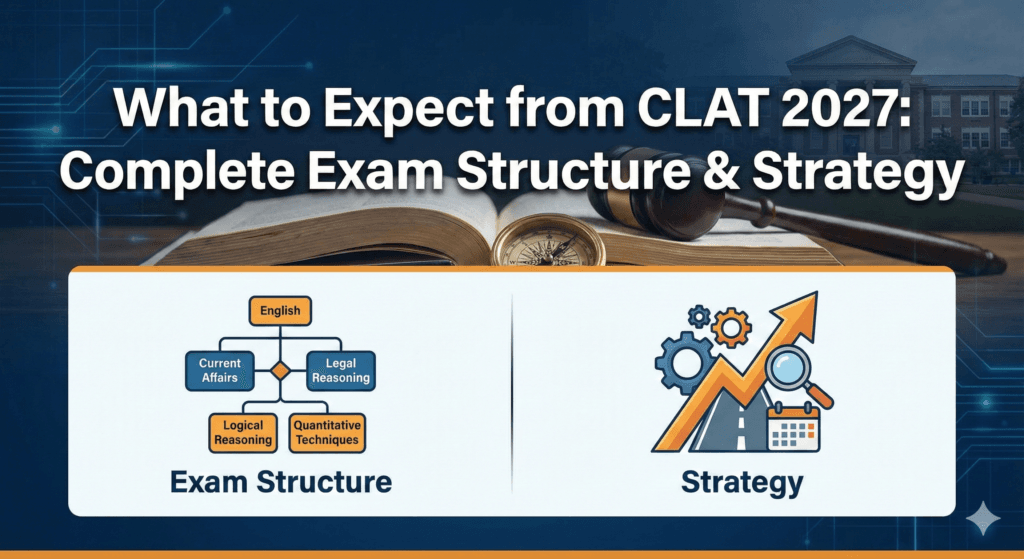
For broader exam structure context, this CLAT 2027 exam structure and strategy guide is useful.
Logical Reasoning
The best books for CLAT logical reasoning focus on arguments, assumptions, inference, and critical reasoning rather than puzzle-heavy content.
Recommended books
- A Modern Approach to Logical Reasoning by R.S. Aggarwal (S. Chand)
- Analytical Reasoning by M.K. Pandey (BSC Publishing)
Best use
- R.S. Aggarwal: statements, assumptions, conclusions and cause and effect, the argument types CLAT passages test
- M.K. Pandey: deeper practice once the basics hold; skip the rule-based chapters such as coding and input-output, which CLAT does not test
Choose these if: accuracy drops in strengthen, weaken, assumption, or conclusion questions.
Common mistake: practicing bank exam reasoning instead of CLAT-style passage reasoning.
Quantitative Techniques
The best quantitative techniques books for CLAT should stay close to class 10 arithmetic and data interpretation. This section is smaller in weightage but often becomes a rank booster.
Recommended books
- Quantitative Aptitude by R.S. Aggarwal
- Fast Track Objective Arithmetic by Rajesh Verma
What to practice most
- Percentages
- Ratios
- Averages
- Profit and loss
- Simple data interpretation
- Tables and graphs
Choose this if: basics are shaky and speed is low.
Common mistake: studying advanced maths topics that are not needed for CLAT.
For focused support, use the CLAT maths syllabus and strategy guide.
Are online or offline CLAT coaching books better?
Both online and offline CLAT resources work, but they solve different problems. Physical books are better for slow, focused revision. Digital material is better for updates, portability, and self-paced practice.
Offline books: where they help
- Deep reading with fewer distractions
- Easier annotation and revision
- Better for long-term memory for many students
- Useful for grammar, reasoning drills, and quant practice
Online study material: where it helps
- Updated monthly GK and current affairs
- Dashboards, quizzes, and progress tracking
- Video explanations for weak topics
- Flexible learning that fits your life
E-book packs for CLAT often cover all five sections and help self-paced learners with concept-building plus practice.
Best hybrid setup for most aspirants
- Offline: English, logic, quant core books
- Online: current affairs updates, mocks, doubt-solving, analytics
- Both: previous year papers
That mix works well because CLAT changes with current issues, and static books alone can't cover that. If self-study is the plan, this can you crack CLAT without coaching guide is worth reading.
What is the best CLAT exam study guide and preparation strategy for 2027?
The best CLAT exam study guide for 2027 is a staged plan: build basics, shift to passage practice, then move into mock-heavy revision. Because the exam is comprehension-based, preparation should move from understanding to timed application.
If CLAT 2027 is only weeks away
CLAT 2027 is on Sunday 6 December 2026. With weeks rather than months left, stop adding books. Work from what you already have, sit a full-length mock on the 120-question pattern every week, and spend the rest of your time on review and on the most recent months of current affairs. Our free CLAT mock test will show you which section to spend that time on. If you are preparing for CLAT 2028, the three phases below are the plan, starting now.
3-phase preparation model
Phase 1: Foundation
- Finish one core book per subject
- Build reading habit
- Create GK notes
- Learn quant basics
Phase 2: Application
- Start passage sets daily
- Solve sectional tests
- Revise weak concepts
- Begin previous year paper work
Phase 3: Exam mode
- Full-length mocks
- Timed sectional practice
- Error log revision
- Current affairs consolidation
Weekly plan that actually works
Monday to Friday
- 1 reading passage set
- 1 reasoning set
- 20 to 30 minutes current affairs
- 30 minutes revision
Saturday
- Sectional tests
- Quant review
- Error notebook update
Sunday
- Full mock or previous year paper
- Deep analysis
For students juggling school, this CLAT with board exams plan can save a lot of stress.
Good CLAT preparation is not about finishing the most books. It's about repeating the right ones until accuracy becomes a habit.
Which free CLAT study material is actually useful?
Free CLAT study material is useful when it fills gaps, especially for current affairs, mocks, and concept revision. But free resources only help if they are curated and used consistently.
Best free resources to use
1. Previous year questions and sample practice
- Valuable for pattern familiarity
- Good for spotting weak sections. Our free 30-question CLAT mock test does this in half an hour, with solutions
2. Free current affairs PDFs and monthly compilations
- Best for budget aspirants
- Strong support for revision
3. Newspaper editorials
- Still one of the best free tools for English, GK, and legal issue awareness
4. Free mock tests and quizzes
- Useful if quality is good and analysis is done after each test
5. Coaching blogs and topic explainers
- Good for legal reasoning examples and quick concept refreshers
Reliable free study material and practice resources are available from CLAT prep providers. For handpicked options, use the best Telegram channels for free CLAT mocks and study material and the ₹0 budget CLAT resources guide.
Budget rule: if money is tight, spend on previous year solved papers plus one logic book and one quant or English book. Build the rest through free resources.
How much do the best books for CLAT cost, and which ones are budget-friendly?
CLAT preparation does not need an expensive library. A smart, budget-focused setup can be built by selecting a few core books and using free updates for current affairs.
Approximate price guidance
Prices change by seller, edition, and discount. Still, a practical budget range helps.
- Core section books: often mid-range, depending on publisher and edition
- Solved paper and mock sets: check the edition year first. A solved-paper book from before 2024 is mostly papers on the old format. The official past papers cost Rs 500 from the Consortium
- E-books: often cost less than large printed bundles and offer portability
Budget plans
Starter budget plan
- Word Power Made Easy
- R.S. Aggarwal, A Modern Approach to Logical Reasoning
- One solved papers book
- Free newspaper reading and GK PDFs
Balanced budget plan
- 1 English book
- 1 reasoning book
- 1 quant book
- 1 solved paper book
- Monthly current affairs source
Premium but still sensible
- Printed books + mock package + digital e-books + mentorship
Where students overspend
- Buying duplicate books from multiple institutes
- Paying for static GK books that go out of date
- Collecting coaching modules without revision
What makes the difference is not the size of the library but how often you revise what is in it.
What mistakes should students avoid when buying CLAT preparation books?
Most book-related CLAT mistakes are simple: too many books, wrong books, or no revision. The damage shows up late, usually during mocks.
Common mistakes to avoid
Buying old-pattern books only
CLAT has shifted toward long passages and application-based questions. Old objective-only books can mislead preparation.
Ignoring current affairs till the last moment
Current Affairs and GK carries major weight, and the prep window is long.
Treating legal reasoning like law school
CLAT UG legal reasoning needs application skill, not textbook legal doctrine.
Skipping previous year papers
Solved papers show actual trend lines better than random worksheets.
No error log
Without an error notebook, students repeat the same wrong reasoning patterns.
Mock addiction without analysis
A mock is useful only if each wrong answer is reviewed.
For mock review systems, the guide to reviewing CLAT mocks and progress assessment guide are worth using.
What do experienced CLAT mentors recommend for study material?
Experienced mentors usually recommend fewer books, more revisions, and strong mock analysis. The common theme is clarity over clutter.
What strong aspirants typically do
- Stick to a limited set of trusted books
- Read newspapers daily
- Revise monthly current affairs regularly
- Solve previous year papers
- Build a mistake notebook
- Increase mocks gradually, then analyze deeply
Personalized recommendation by student profile
If English is weak
- Start with Norman Lewis
- Add editorial reading
- Solve RC passages daily
If GK is weak
- Use one monthly compilation source
- Revise weekly
- Build issue-based notes
If legal reasoning is weak
- Solve passage-based legal sets
- Focus on principle application
- Read explanations, not just answers
If logic is weak
- R.S. Aggarwal first, then M.K. Pandey
- Then CLAT-specific passage sets
If quant is weak
- Learn class 10 basics
- Practice DI sets 3 times a week
The point is to match the material to the gap, not to buy the whole list.
Frequently asked questions
What is the best clat study material for beginners?
The best beginner setup is one core book per section, daily newspaper reading, monthly current affairs notes, and previous year solved papers.
Which are the best books for CLAT legal reasoning?
A.P. Bhardwaj’s Legal Awareness and Legal Reasoning (Pearson) is the standard choice. Use it for principle-application practice and pair it with passage-based legal sets, because CLAT UG gives you the principle in the passage and needs no prior knowledge of law.
Are NCERT books enough for CLAT preparation?
NCERTs help with basic reading and class 10 maths, but NCERTs alone are not enough for full CLAT preparation.
How many books should be used for CLAT 2027?
Most aspirants should use 1 to 2 books per section plus newspapers, mocks, and solved papers. More than that often hurts revision.
Is online clat study material better than printed books?
Online material is better for updates and analytics. Printed books are better for deep study. A hybrid approach works best for most students.
Are previous year papers important for CLAT?
Yes. Previous year papers are essential because they show actual question style, passage structure, and difficulty trends.
What is the best source for current affairs for CLAT?
The best current affairs sources are quality newspapers, monthly compilations, PIB summaries, and regular revision notes.
Can CLAT be cracked with free study material?
Yes, but only if free material is high quality, limited, and combined with mock practice, solved papers, and disciplined revision.
Which section needs the most book support?
Legal Reasoning, Current Affairs, and Logical Reasoning usually need the most structured support because all three are built on long reading passages.
When should CLAT 2027 aspirants start mock tests?
Serious aspirants should begin sectional tests early and move to regular full mocks once the basics are covered. By the consolidation phase, mock frequency should increase.
Conclusion
The best clat study material for 2027 is not the longest list. It is the right list.
For most aspirants, that means:
- one reliable English setup,
- one strong logic book,
- one quant basics source,
- a legal reasoning guide built for passages,
- current affairs from newspapers and monthly compilations,
- and previous year papers plus mocks.
CLAT rewards reading, judgment, and consistency. So build a study ecosystem, not a book pile. Mix offline books with digital updates. Track errors. Revise aggressively. And if a resource is not helping scores, replace it fast.
If you would rather have someone set the booklist, the mocks and the review for you, Lawgic runs one live online CLAT course at Rs 20,000 flat. See how the course works.
Next steps:
- Finalize your booklist this week.
- Start one newspaper habit today.
- Buy or download previous year papers.
- Schedule your first mock.
- Build a revision system before adding new material.
Sources
Checked on 28 October 2026. Consortium of National Law Universities,
CLAT 2027 UG syllabus (120 questions in two hours,
five sections, passages of about 450 words) and
CLAT 2027 UG instructions (exam on Sunday 6 December
2026; previous years’ question papers Rs 500). Book titles, authors and publishers checked against the publishers’
own listings, including Pearson India for A.P. Bhardwaj and S. Chand for R.S. Aggarwal.