You didn’t make it the first time. That stings, doesn’t it?
But here’s what most people won’t tell you: failing CLAT once doesn’t mean you’re not cut out for law school. It means you need a different approach. The same strategies that didn’t work last year won’t magically succeed this year. You need something more targeted, more personal, more strategic.
That’s where CLAT mentorship for retaking comes in. It’s not just another coaching program. It’s a complete transformation of how you prepare, guided by someone who understands exactly where you went wrong and how to fix it.
Let’s be honest. Retaking CLAT in 2026 or 2027 means you’re competing against fresh aspirants who have momentum, plus other retakers who are equally determined. The difference between those who crack it on their second attempt and those who don’t? Personalized guidance that addresses their specific weaknesses, not generic advice that fits everyone and helps no one.
Key Takeaways
- CLAT mentorship for retaking provides personalized, one-on-one guidance specifically designed for students attempting the exam again, focusing on weakness identification and strategic improvement
- Retakers need customized study plans that address previous mistakes rather than repeating the same preparation methods that didn’t work before
- Effective mentorship combines diagnostic assessment, adaptive learning techniques, regular performance tracking, and psychological support to maximize second attempt success rates
- Online mentorship platforms offer flexible, accessible coaching that fits various schedules and budgets, making quality guidance available to serious aspirants nationwide
- Success in retaking CLAT depends on choosing the right mentor who understands your unique challenges and provides actionable, results-driven strategies
Understanding Why CLAT Mentorship for Retaking Matters

Retaking CLAT isn’t just about studying harder. It’s about studying smarter with someone who can see what you can’t.
When you prepare for CLAT the first time, everything feels new. You’re learning the exam pattern, understanding what NLUs expect, figuring out time management. But when you’re retaking, you carry baggage. You know what went wrong, but you might not know how to fix it. That’s the gap mentorship fills.
The Psychology of Retaking
Here’s the thing about attempting CLAT again: confidence becomes your biggest enemy or your greatest asset.
Students who retake often fall into two camps. The first group gets overconfident because they “already know the syllabus.” They coast through preparation, assuming familiarity equals mastery. The second group becomes paralyzed by fear, constantly doubting whether they’re good enough.
Neither approach works.
CLAT mentorship for retaking addresses this psychological dimension head-on. A good mentor helps you maintain realistic confidence while building genuine competence. They’ve seen hundreds of retakers and know exactly which mental traps to avoid.[1]
What Makes Retaker Preparation Different
Your second attempt requires a fundamentally different strategy than your first.
You already know the CLAT syllabus. You’ve probably solved previous year papers. You understand the exam format. What you need now isn’t more information but better application.
This is where personalized CLAT guidance becomes non-negotiable. Generic coaching that treats all students the same won’t work for you. You need someone who can:
- Identify your specific weak areas through diagnostic testing
- Create a customized study plan that focuses on your gaps
- Provide regular feedback on your progress
- Adjust strategies based on what’s working and what isn’t
- Keep you accountable throughout the preparation journey
The Ultimate CLAT Mentorship Techniques 2026 demonstrate how individualized attention transforms preparation outcomes.
Common Mistakes Retakers Make
Let’s talk about what doesn’t work when you’re attempting CLAT again.
Mistake 1: Using the exact same preparation method. If your approach didn’t work last year, why would it work this year? Yet countless retakers follow the same routine, use the same books, and wonder why results don’t change.
Mistake 2: Ignoring weakness analysis. You might think you know where you struggled, but without proper diagnostic assessment, you’re guessing. Maybe you believe Legal Reasoning is your weak point when actually it’s reading speed in English comprehension that’s killing your score.
Mistake 3: Skipping mock tests or taking them without analysis. Mock tests aren’t just practice. They’re your most valuable feedback mechanism. Taking mocks without detailed performance analysis is like working out without tracking progress.
Mistake 4: Studying in isolation. When you prepare alone, you have no benchmark. You don’t know if your pace is competitive, if your strategies are optimal, or if you’re making avoidable mistakes.
One-to-one mentorship eliminates these pitfalls by providing external perspective and expert guidance.[2]
Components of Effective CLAT Mentorship for Retaking
What does quality mentorship actually look like? Not all programs calling themselves “mentorship” deliver real value.
Comprehensive Diagnostic Assessment
Before you can improve, you need to know exactly where you stand.
Effective CLAT mentorship for retaking starts with thorough diagnostic testing. This isn’t just one mock test. It’s a systematic evaluation of:
- Subject-wise strengths and weaknesses
- Time management patterns
- Question selection strategies
- Accuracy rates across different topics
- Stress response during timed conditions
- Knowledge gaps in current affairs and legal awareness
At Lawgic Coaching, we’ve helped thousands crack CLAT by starting with honest assessment. Your success is our mission, and that begins with understanding your current reality, not where you wish you were.
The diagnostic phase typically takes 1-2 weeks and includes multiple assessments across all CLAT sections. Your mentor analyzes these results to create a baseline and identify priority areas.[3]
Personalized Study Plans That Actually Work
Cookie-cutter study plans are worthless for retakers. You need a roadmap built specifically for you.
Your personalized study plan should account for:
Your timeline: Are you preparing for 6 months or 12? The intensity and focus areas change dramatically based on available time. Our complete guide to preparing for CLAT in 6 months shows how timeline affects strategy.
Your strengths: If you’re already strong in Logical Reasoning, you don’t need to spend equal time there. Allocate more hours to areas with higher improvement potential.
Your weaknesses: Some weaknesses are foundational (like English comprehension skills), while others are tactical (like Current Affairs coverage). The approach differs.
Your learning style: Do you learn better through reading or video lectures? Do you need multiple repetitions or do concepts stick quickly? Adaptive learning techniques match methods to your natural preferences.
A quality mentor doesn’t hand you a pre-made schedule. They build it with you, adjusting weekly based on performance data.
Strategic Subject-Wise Preparation
Each CLAT section requires different preparation strategies for retakers.
English Language: If you struggled here before, the issue is likely reading speed or comprehension depth, not vocabulary. Your mentor should focus on proven strategies to transform English weakness into strength, including techniques for handling 450-word passages efficiently.
Current Affairs and General Knowledge: This section changes completely each year, giving retakers a fresh start. Strategic preparation means focusing on important GK topics for CLAT 2026 rather than trying to memorize everything.
Legal Reasoning: Many retakers make common mistakes in CLAT Legal Reasoning without realizing it. Mentorship helps identify these patterns and correct them systematically.
Logical Reasoning: With CLAT 2026 Logical Reasoning changing the game, retakers need updated strategies, not outdated approaches from previous years.
Quantitative Techniques: The smallest section but often the quickest score booster. Targeted practice on high-yield topics delivers maximum ROI.
Regular Performance Tracking and Feedback
Preparation without measurement is just hope disguised as effort.
Your mentorship program should include:
- Weekly mock tests with detailed analysis
- Section-wise performance tracking over time
- Comparison against competitive benchmarks
- Identification of recurring error patterns
- Specific action items for improvement
The power of continuous feedback in your CLAT journey cannot be overstated. Real-time course correction prevents wasted months on ineffective strategies.
Quality platforms provide performance dashboards where you can visualize progress. You should see clear trends: Are accuracy rates improving? Is speed increasing? Are weak areas getting stronger?
Psychological Support and Motivation
Let’s talk about something most coaching programs ignore: the mental game.
Retaking CLAT comes with unique psychological challenges. You’re dealing with:
- Fear of failing again
- Pressure from family and peers
- Comparison with friends who succeeded on their first attempt
- Self-doubt about your abilities
- Stress about “wasted” time
A good mentor addresses these issues directly. They provide proven strategies for managing CLAT exam anxiety and maintaining mental wellness throughout preparation.[4]
Your mentor should help you develop resilience, maintain perspective, and stay motivated during tough phases. This isn’t fluffy emotional support. It’s practical psychology that directly impacts performance.
Choosing the Right CLAT Mentorship Program for Your Second Attempt
Not all mentorship programs are created equal. Some are genuinely transformative. Others are just expensive disappointments.
Key Features to Look For
When evaluating CLAT mentorship for retaking, assess these critical elements:
1. Mentor Qualifications and Experience
Who will actually mentor you? Are they NLU graduates? Have they successfully coached retakers before? What’s their track record?
Don’t settle for vague claims. Ask for specific credentials. At Lawgic, our expert guidance comes from faculty with top NLU backgrounds who understand exactly what it takes to succeed.
2. Personalization Level
How customized is the program really? Some platforms claim “personalized mentorship” but deliver the same content to everyone with minor tweaks.
True personalization means:
- Individual diagnostic assessment
- Custom study schedules built for your situation
- One-on-one doubt clearing sessions
- Personalized feedback on every mock test
- Adaptive content that changes based on your progress
3. Accessibility and Flexibility
Can you access your mentor when you need help? Or are you limited to one weekly call?
Flexible learning that fits your life is essential, especially if you’re balancing preparation with college, a job, or board exams. Look for platforms offering multiple touchpoints: scheduled sessions, on-demand doubt clearing, message-based support.
4. Comprehensive Study Material
Does the program provide quality CLAT study material or do you need to buy resources separately?
Your mentorship should include:
- Updated content aligned with latest CLAT patterns
- Subject-wise practice questions
- Full-length mock test series
- Previous year papers with solutions
- Current affairs compilations
- Legal awareness resources
The CLAT 2027 Booklist guide can help you evaluate if provided materials meet quality standards.
5. Mock Test Quality and Frequency
How many mocks are included? Are they CLAT-pattern accurate? Is the difficulty level appropriate?
For retakers, mock tests are your most important preparation tool. You need frequent testing with detailed analytics. The power of mock tests in elevating CLAT prep shows why this matters so much.
Online vs Offline Mentorship
Should you choose online CLAT coaching or traditional classroom programs?
For most retakers, online mentorship offers significant advantages:
Flexibility: Study at your own pace without commuting. This is especially valuable if you’re in a location without quality coaching centers.
Accessibility: Access top mentors regardless of geography. You’re not limited to whoever happens to teach in your city.
Cost-effectiveness: Online programs typically cost less than classroom coaching while offering comparable or better quality. We believe law school dreams shouldn’t be complicated or expensive.
Personalization: Digital platforms can track your performance data more comprehensively, enabling truly adaptive learning.
Convenience: Review recorded sessions, access materials 24/7, and schedule sessions around your commitments.
That said, some students prefer in-person interaction. The choice depends on your learning style and circumstances. Our guide on Live Classes vs Recorded Lectures for CLAT Coaching 2026 explores this decision in depth.
Red Flags to Avoid
Watch out for these warning signs when selecting mentorship:
Unrealistic promises: If a program guarantees admission to NLU Delhi or promises “100% success,” run away. No legitimate program can guarantee specific outcomes.
Lack of transparency: Avoid programs that won’t share mentor credentials, student results, or detailed curriculum information upfront.
One-size-fits-all approach: If the program doesn’t start with diagnostic assessment and customization, it’s not real mentorship.
No trial or demo: Quality programs offer trial sessions or money-back guarantees because they’re confident in their value.
Poor reviews and testimonials: Check independent reviews, not just testimonials on the program’s website. Talk to current or former students if possible.
Creating Your CLAT Retaking Success Timeline
Time management makes or breaks your second attempt. Let’s map out what effective preparation looks like.
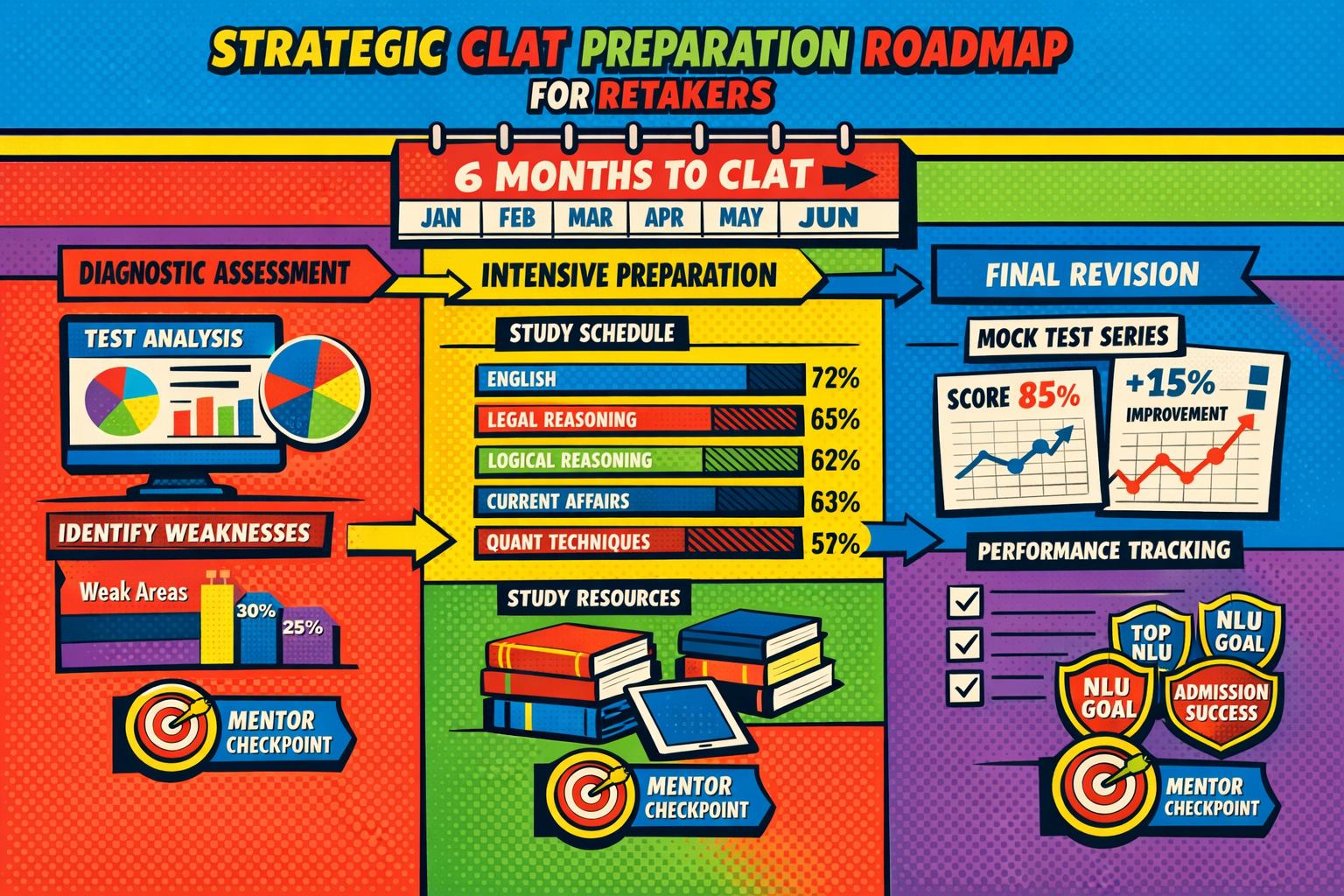
The 12-Month Preparation Journey
If you have a full year before CLAT 2027, you have time to build comprehensive mastery. Here’s how to structure it:
Months 1-2: Foundation and Diagnosis
- Complete diagnostic testing across all sections
- Identify specific weaknesses and knowledge gaps
- Build or rebuild foundational concepts
- Establish study routine and discipline
- Set up performance tracking systems
Months 3-5: Intensive Subject-Wise Preparation
- Deep dive into each CLAT section systematically
- Complete syllabus coverage with thorough understanding
- Build speed alongside accuracy
- Start regular mock testing (weekly)
- Develop subject-specific strategies
Months 6-8: Integration and Application
- Practice mixed-section questions
- Increase mock test frequency (bi-weekly)
- Work on time management across full tests
- Address persistent weak areas with focused modules
- Build current affairs knowledge consistently
Months 9-10: Consolidation and Refinement
- Take full-length mocks under exam conditions
- Analyze every test thoroughly with mentor
- Refine exam-day strategies
- Strengthen remaining weak points
- Maintain current affairs updates
Months 11-12: Final Push and Peak Performance
- Daily mock tests in final month
- Quick revision of all topics
- Maintain physical and mental wellness
- Fine-tune time allocation strategies
- Build exam-day confidence
This timeline assumes full-time or near-full-time preparation. Your mentor should adjust intensity based on your other commitments.[5]
The 6-Month Accelerated Plan
Got six months? You can still succeed, but intensity increases significantly.
The key difference: less time for foundational building means you must be more strategic about what to study and what to skip. Your mentor’s role becomes even more critical in making these prioritization decisions.
Focus areas for 6-month preparation:
- High-yield topics that appear frequently
- Your weakest areas with highest improvement potential
- Current affairs from past 12 months
- Mock test practice with rigorous analysis
- Efficient revision techniques
Our detailed 6-month CLAT success roadmap provides specific week-by-week guidance.
Balancing Retaking with Other Commitments
Many retakers aren’t preparing full-time. You might be:
- Attending college while preparing
- Working a job to support yourself
- Preparing for board exams simultaneously
- Managing family responsibilities
CLAT mentorship for retaking should accommodate your reality, not some ideal scenario where you have 12 hours daily for study.
Be honest with your mentor about available time. They can create realistic schedules that maximize your limited hours. Quality matters more than quantity when time is constrained.
If you’re juggling CLAT preparation with board exams, strategic planning becomes essential. Your mentor helps identify overlapping topics and efficient study methods.
Real Success Stories: How Mentorship Transformed Retakers
Theory is great, but results speak louder than promises.
From 60 to 120: The Power of Targeted Improvement
Consider a typical retaker scenario. First attempt score: 62 out of 120. Fell short of even Tier-2 NLU cutoffs. Devastated but determined to try again.
What changed the second time? Personalized mentorship that identified the real problems:
- Reading speed was too slow, causing time pressure
- Legal Reasoning approach was fundamentally flawed
- Current Affairs preparation was unfocused and inefficient
- Mock test analysis was superficial
With targeted interventions in each area, the same student scored 118 on the second attempt. That’s not a miracle. That’s what happens when you address actual weaknesses instead of studying blindly.
The realistic 90-day transformation plan shows how focused improvement works in practice.
Breaking Through Mental Barriers
Another common retaker story: capable student with crippling exam anxiety.
First attempt went poorly not because of knowledge gaps but because of panic during the actual exam. Knew the material but couldn’t perform under pressure.
Mentorship addressed this through:
- Regular timed practice to build stress tolerance
- Breathing and mindfulness techniques for exam day
- Confidence-building through incremental successes
- Reframing failure as feedback, not judgment
Second attempt result: calm, confident performance and a seat at a top NLU.
Mental wellness isn’t separate from exam success. It’s foundational to it. Understanding how mental wellness fuels CLAT exam success can transform your preparation.
The Strategic Advantage of Expert Guidance
Here’s what students consistently report after working with quality mentors:
“I was studying the same topics before, but my mentor showed me how to study them differently. The approach changed everything.”
“Having someone who believed in me when I doubted myself made all the difference.”
“The weekly check-ins kept me accountable. I couldn’t slack off because I knew I’d have to report progress.”
“Mock test analysis with my mentor revealed patterns I never would have spotted on my own.”
These aren’t exceptional cases. This is what good mentorship delivers consistently.
Technology-Enabled Personalized Learning
Modern CLAT mentorship leverages technology to provide better, more personalized guidance than ever before.
Data-Driven Preparation Strategies
Quality online platforms track everything:
- Time spent on each question type
- Accuracy rates by topic and difficulty level
- Progress trends over weeks and months
- Comparison with peer performance
- Optimal study times based on your engagement patterns
This data enables your mentor to make evidence-based recommendations rather than generic advice. They can see exactly where you’re improving and where you’re stuck.
Adaptive Learning Platforms
The best mentorship programs use adaptive technology that adjusts to your performance.
If you’re consistently acing Logical Reasoning questions, the system serves you harder problems to maintain challenge. If you’re struggling with Legal Reasoning, it provides additional practice at appropriate difficulty levels.
This personalization happens automatically in the background while your mentor provides strategic oversight and human judgment that algorithms can’t replace.
Accessibility Across Devices
Study on your laptop, review on your phone, take mocks on a tablet. Modern platforms work seamlessly across devices, letting you learn whenever and wherever works for you.
This flexibility is especially valuable for retakers who might be balancing multiple commitments. Waiting for a class? Review current affairs on your phone. Have a focused study session? Use your laptop for full mock tests.
Making the Most of Your Mentorship Investment
You’ve chosen a program and started working with a mentor. Now what? How do you extract maximum value?
Be Radically Honest About Your Weaknesses
Your mentor can only help if you’re honest about what you don’t know and where you struggle.
Don’t pretend to understand concepts you don’t. Don’t hide poor mock scores out of embarrassment. Don’t claim you studied when you didn’t.
Remember: your mentor isn’t there to judge you. They’re there to help you improve. Honesty accelerates progress.
Follow Through on Recommendations
The best mentorship in the world won’t help if you ignore the guidance.
If your mentor assigns specific practice problems, do them. If they recommend changing your approach to a section, try it genuinely before deciding it doesn’t work. If they suggest taking more mocks, take more mocks.
You’re paying for expertise. Use it.
Ask Questions Actively
Don’t wait for your mentor to guess what you’re confused about. Ask specific questions.
Instead of “I don’t understand Legal Reasoning,” ask “I’m struggling to identify the legal principle in fact-based questions. Can you walk me through your approach?”
Specific questions get specific, actionable answers.
Track Your Own Progress
While your mentor monitors your performance, you should too. Keep a preparation journal noting:
- Daily study hours and topics covered
- Difficulties encountered
- Mock test scores and key takeaways
- Concepts that clicked
- Areas still confusing
This self-awareness complements your mentor’s external perspective.
Communicate About What’s Working and What Isn’t
If a study strategy isn’t working for you, tell your mentor. They can adjust.
If you’re feeling overwhelmed or losing motivation, communicate that too. Your mentor can help recalibrate expectations or provide encouragement.
Mentorship is a partnership. Communication makes it work.
Common Questions About CLAT Mentorship for Retaking
Is mentorship worth the investment for retakers?
If you’re serious about cracking CLAT on your second attempt, yes.
Consider the alternative: repeating the same preparation approach that didn’t work before. That’s the definition of insanity, expecting different results from the same actions.
Quality mentorship costs money, but it’s an investment in your future legal career. The difference between getting into a top NLU versus a lower-tier college affects your entire career trajectory.
That said, choose wisely. Not all expensive programs deliver value. Focus on programs with proven results, experienced mentors, and genuine personalization.
How is mentorship different from regular coaching?
Regular coaching provides content and instruction. Mentorship provides personalized guidance.
In a coaching class, you’re one of many students following the same curriculum. The teacher covers topics systematically but can’t address your specific weaknesses in depth.
In mentorship, especially one-to-one mentorship, everything is customized to you. Your study plan, your practice problems, your feedback, your support.
Think of coaching as a map. Mentorship is a GPS that adjusts your route based on where you actually are and where you’re trying to go.
Can I succeed in retaking CLAT without mentorship?
Technically, yes. Some students do crack CLAT through self-study on their second attempt.
But it’s harder and riskier. Without external guidance, you might repeat the same mistakes without realizing it. You lack the accountability and structure that mentorship provides.
If you’re considering self-study, be brutally honest: Why didn’t it work the first time? What will be different this time?
Our guide on whether CLAT is possible without expensive coaching offers a realistic perspective.
What if I can’t afford premium mentorship programs?
Quality legal education preparation shouldn’t be accessible only to wealthy students.
Look for programs that offer:
- Flexible payment plans
- Scholarships based on merit or need
- Free trial periods to test fit before committing
- Tiered options with different price points
At Lawgic Coaching, we believe expert guidance shouldn’t come with a premium price tag. We offer accessible education for serious aspirants because we know talent exists everywhere, not just among those who can afford expensive coaching.
Also consider alternative free resources to supplement affordable mentorship.
How do I know if my mentor is actually helping?
Track objective metrics:
- Are your mock test scores improving over time?
- Are you making fewer mistakes in your weak areas?
- Do you feel more confident about the exam?
- Are you getting specific, actionable feedback?
- Is your study approach more strategic than before?
If you’re not seeing measurable improvement after 4-6 weeks, have an honest conversation with your mentor. If things still don’t improve, consider switching programs.
Good mentorship produces visible results. If you’re not getting them, something needs to change.
Taking the Decision: Should You Retake CLAT?

Before we talk about how to retake successfully, let’s address whether you should retake at all.
When Retaking Makes Sense
Consider retaking CLAT if:
- You were close to cutoffs but fell short
- You had specific circumstances that affected performance (illness, family emergency, etc.)
- You’ve identified clear, fixable reasons for underperformance
- You’re genuinely passionate about law and NLU education
- You have the mental resilience for another year of preparation
- You have family support for the decision
When to Consider Alternatives
Retaking might not be the best choice if:
- You barely prepared the first time and aren’t committed to serious effort
- You’re retaking only due to family pressure, not personal desire
- You have other strong career interests you’re ignoring
- The stress is severely affecting your mental health
- You’ve already retaken once without improvement
Our flowchart for decision making about taking a drop year for CLAT can help you think through this decision systematically.
There’s no shame in choosing a different path. Law isn’t the only worthy career. But if you decide to retake, commit fully and get the support you need to succeed.
Your Next Steps: Starting Your Retaking Journey Right
You’ve read this far, which means you’re serious about giving CLAT another shot. Here’s how to start strong.
Step 1: Honest Self-Assessment
Before reaching out to mentors or programs, spend time reflecting:
- What specifically went wrong in your first attempt?
- Which sections were weakest?
- Did you have enough practice tests?
- Was your study plan realistic and followed?
- What would you do differently this time?
Write down your answers. This clarity will help you choose the right mentorship program and communicate effectively with potential mentors.
Step 2: Research and Shortlist Programs
Don’t just pick the first mentorship program you find. Research multiple options:
- Compare features, mentor credentials, and pricing
- Read independent reviews and testimonials
- Check success rates with retakers specifically
- Assess the level of personalization offered
- Evaluate study materials and mock test quality
Create a shortlist of 3-5 programs that seem promising.
Step 3: Take Trial Sessions
Most quality programs offer free trial sessions or demo classes. Use these to:
- Experience the teaching style
- Assess mentor expertise and communication
- Evaluate platform usability
- Ask specific questions about retaker support
- Get a feel for whether this is the right fit
Don’t skip this step. The mentor-student relationship matters enormously. You need someone you can work with effectively.
Step 4: Commit and Start
Once you’ve chosen a program, commit fully. Half-hearted preparation produces half-hearted results.
Set up your study space, establish your routine, and dive in. The first few weeks set the tone for your entire preparation journey.
Step 5: Stay Consistent and Adapt
Consistency matters more than intensity. Studying 4 hours daily for 10 months beats sporadic 12-hour marathons.
But also stay flexible. If something isn’t working, communicate with your mentor and adjust. Rigid adherence to a failing strategy helps no one.
Why Lawgic Coaching for Your CLAT Retaking Journey
Let’s be honest about who we are and what we offer.
We’re an online CLAT coaching platform built on a simple belief: law school dreams shouldn’t be complicated or expensive. We combine experienced faculty from top NLUs with flexible, accessible learning that fits real student schedules.
What Makes Us Different
Real mentors from top NLUs: Our faculty aren’t just teachers. They’re graduates from the very institutions you’re trying to enter. They’ve walked the path you’re on and know exactly what it takes.
Personalized attention you deserve: We don’t believe in cookie-cutter approaches. Your preparation plan is built for you, based on your diagnostic results, your timeline, and your specific needs.
Flexible learning that fits your life: Study at your own pace. Access materials 24/7. Schedule sessions when they work for you. We adapt to your reality, not the other way around.
Proven strategies that actually work: We’ve helped thousands crack CLAT. Our methods aren’t theoretical. They’re battle-tested approaches that produce results.
Accessible education for serious aspirants: Expert guidance without the premium price tag. We believe talent deserves opportunity regardless of financial background.
Our Approach to Retakers
We understand that retaking CLAT comes with unique challenges. You need more than content. You need:
- Detailed analysis of what went wrong before
- Strategic planning to address specific weaknesses
- Regular accountability to stay on track
- Psychological support to maintain confidence
- Adaptive strategies that evolve with your progress
That’s exactly what we provide. Your success is our mission, and we’re committed to building your law career together.
Conclusion: Your Second Chance Starts Now
Retaking CLAT isn’t a sign of failure. It’s a sign of determination.
The difference between students who succeed on their second attempt and those who don’t isn’t intelligence or talent. It’s strategy, support, and sustained effort.
CLAT mentorship for retaking provides the framework you need: personalized guidance that addresses your specific weaknesses, expert strategies proven to work, accountability to keep you on track, and support to maintain confidence throughout the journey.
You already know the pain of falling short. Now it’s time to experience the triumph of breaking through.
The path forward is clear:
- Make an honest assessment of what went wrong before
- Choose a mentorship program that offers genuine personalization
- Commit fully to the preparation process
- Trust the guidance you’re receiving
- Stay consistent and adapt as needed
Your dream of studying law at a top NLU is still within reach. But dreams without action remain fantasies. It’s time to turn yours into reality.
Let’s build your law career together. Your second chance starts now.
Ready to transform your CLAT preparation with personalized mentorship that actually works? Lawgic Coaching offers expert guidance from top NLU faculty, customized study plans for retakers, comprehensive mock test series with detailed analysis, and flexible online learning that fits your schedule. Don’t repeat the same mistakes. Get the strategic support you need to crack CLAT 2027. Schedule your free diagnostic session today and discover exactly what’s been holding you back and how to fix it. Your NLU seat is waiting. Let’s claim it together.
References
[1] One To One Mentorship For Clat Prep Guide – https://www.toprankers.com/one-to-one-mentorship-for-clat-prep-guide
[2] 5 Clat Mentorship Program – https://12minutestoclat.com/app-blog/5-clat-mentorship-program?page=0
[3] Cimp Individual Mentorship Program For Clat 2026 6758933aa0254f5edbf76d45 – https://www.origincoaching.co.in/courses/CIMP–Individual-Mentorship-Program-for-CLAT-2026-6758933aa0254f5edbf76d45
[4] Clat Mentorship Free Coaching – https://www.careersadda.in/product-onlineliveclasses/98311/clat-mentorship-free-coaching
[5] Watch – https://www.youtube.com/watch?v=3yo8xeooaCo
/<!DOCTYPE html> <html lang="en"> <head> <meta charset="UTF-8"> <meta name="viewport" content="width=device-width, initial-scale=1.0"> <title>CLAT Retaking Assessment Calculator</title> <style> .cg-element-container { max-width: 700px; margin: 40px auto; padding: 30px; background: linear-gradient(135deg, #667eea 0%, #764ba2 100%); border-radius: 15px; box-shadow: 0 10px 40px rgba(0,0,0,0.2); font-family: 'Segoe UI', Tahoma, Geneva, Verdana, sans-serif; } .cg-element-title { color: #ffffff; font-size: 26px; font-weight: 700; margin-bottom: 10px; text-align: center; } .cg-element-subtitle { color: #e0e7ff; font-size: 14px; text-align: center; margin-bottom: 25px; } .cg-element-form { background: #ffffff; padding: 25px; border-radius: 10px; } .cg-element-question { margin-bottom: 20px; } .cg-element-label { display: block; color: #2d3748; font-weight: 600; margin-bottom: 8px; font-size: 15px; } .cg-element-input, .cg-element-select { width: 100%; padding: 12px; border: 2px solid #e2e8f0; border-radius: 8px; font-size: 14px; transition: border-color 0.3s; box-sizing: border-box; } .cg-element-input:focus, .cg-element-select:focus { outline: none; border-color: #667eea; } .cg-element-button { width: 100%; padding: 15px; background: linear-gradient(135deg, #667eea 0%, #764ba2 100%); color: white; border: none; border-radius: 8px; font-size: 16px; font-weight: 700; cursor: pointer; margin-top: 20px; transition: transform 0.2s; } .cg-element-button:hover { transform: translateY(-2px); } .cg-element-result { margin-top: 25px; padding: 20px; background: #f7fafc; border-radius: 8px; border-left: 4px solid #667eea; display: none; } .cg-element-result-title { color: #2d3748; font-size: 18px; font-weight: 700; margin-bottom: 10px; } .cg-element-result-text { color: #4a5568; line-height: 1.6; font-size: 14px; } .cg-element-score { font-size: 32px; font-weight: 700; color: #667eea; text-align: center; margin: 15px 0; } @media (max-width: 600px) { .cg-element-container { margin: 20px; padding: 20px; } .cg-element-title { font-size: 22px; } } </style> </head> <body> <div class="cg-element-container"> <h2 class="cg-element-title">CLAT Retaking Readiness Assessment</h2> <p class="cg-element-subtitle">Discover if personalized mentorship is right for your second attempt</p> <div class="cg-element-form"> <div class="cg-element-question"> <label class="cg-element-label">What was your previous CLAT score out of 120?</label> <input type="number" id="cg-previous-score" class="cg-element-input" min="0" max="120" placeholder="Enter your score"> </div> <div class="cg-element-question"> <label class="cg-element-label">How many months do you have for preparation?</label> <select id="cg-prep-time" class="cg-element-select"> <option value="">Select duration</option> <option value="3">3 months or less</option> <option value="6">4-6 months</option> <option value="9">7-9 months</option> <option value="12">10-12 months</option> </select> </div> <div class="cg-element-question"> <label class="cg-element-label">What was your weakest section?</label> <select id="cg-weak-section" class="cg-element-select"> <option value="">Select section</option> <option value="english">English Language</option> <option value="legal">Legal Reasoning</option> <option value="logical">Logical Reasoning</option> <option value="gk">Current Affairs & GK</option> <option value="quant">Quantitative Techniques</option> </select> </div> <div class="cg-element-question"> <label class="cg-element-label">How many full-length mocks did you take before your first attempt?</label> <select id="cg-mock-count" class="cg-element-select"> <option value="">Select range</option> <option value="5">Less than 5</option> <option value="10">5-10 mocks</option> <option value="20">11-20 mocks</option> <option value="30">More than 20 mocks</option> </select> </div> <div class="cg-element-question"> <label class="cg-element-label">How committed are you to daily preparation?</label> <select id="cg-commitment" class="cg-element-select"> <option value="">Select commitment level</option> <option value="2">2-3 hours daily</option> <option value="5">4-6 hours daily</option> <option value="8">7-8 hours daily</option> <option value="10">Full-time preparation</option> </select> </div> <button class="cg-element-button" onclick="calculateReadiness()">Get Your Readiness Score</button> <div id="cg-result" class="cg-element-result"> <div class="cg-element-result-title">Your Retaking Readiness Score</div> <div class="cg-element-score" id="cg-score-display"></div> <div class="cg-element-result-text" id="cg-recommendation"></div> </div> </div> </div> <script> function calculateReadiness() { const score = parseInt(document.getElementById('cg-previous-score').value) || 0; const prepTime = parseInt(document.getElementById('cg-prep-time').value) || 0; const weakSection = document.getElementById('cg-weak-section').value; const mockCount = parseInt(document.getElementById('cg-mock-count').value) || 0; const commitment = parseInt(document.getElementById('cg-commitment').value) || 0; if (!score || !prepTime || !weakSection || !mockCount || !commitment) { alert('Please answer all questions to get your readiness score.'); return; } let readinessScore = 0; if (score >= 80) readinessScore += 25; else if (score >= 60) readinessScore += 20; else if (score >= 40) readinessScore += 15; else readinessScore += 10; if (prepTime >= 12) readinessScore += 25; else if (prepTime >= 9) readinessScore += 20; else if (prepTime >= 6) readinessScore += 15; else readinessScore += 10; readinessScore += 15; if (mockCount >= 30) readinessScore += 20; else if (mockCount >= 20) readinessScore += 15; else if (mockCount >= 10) readinessScore += 10; else readinessScore += 5; if (commitment >= 10) readinessScore += 15; else if (commitment >= 8) readinessScore += 12; else if (commitment >= 5) readinessScore += 9; else readinessScore += 6; let recommendation = ''; if (readinessScore >= 80) { recommendation = 'Excellent! You have strong fundamentals and good preparation time. With personalized mentorship focusing on your weak areas and strategic improvement, you have high potential to crack CLAT successfully. Focus on consistent mock testing and targeted weakness elimination.'; } else if (readinessScore >= 60) { recommendation = 'Good foundation! You have decent potential for success with the right guidance. Personalized mentorship will help you identify and fix specific gaps in your preparation. Focus on increasing mock test frequency and getting detailed performance analysis to improve strategically.'; } else if (readinessScore >= 40) { recommendation = 'Moderate readiness. You need significant improvement in multiple areas. One-to-one mentorship is highly recommended to create a customized study plan, address fundamental weaknesses, and build consistent preparation habits. Consider extending your preparation timeline if possible.'; } else { recommendation = 'Your current readiness needs substantial improvement. Intensive personalized mentorship is essential to transform your preparation approach. Focus on building strong fundamentals, establishing daily study discipline, and taking regular mocks with detailed analysis. Consider whether you have adequate time and commitment for serious preparation.'; } document.getElementById('cg-score-display').textContent = readinessScore + '/100'; document.getElementById('cg-recommendation').textContent = recommendation; document.getElementById('cg-result').style.display = 'block'; document.getElementById('cg-result').scrollIntoView({ behavior: 'smooth', block: 'nearest' }); } </script> </body> </html>

